Why Paid Ads Can’t Fix Broken Retention (And What to Do Instead)
AT A GLANCE
Paid ads can bring in customers, but retention determines whether those customers become profitable over time.
Quick Summary
- More ad spend does not fix a retention problem. It usually makes the economics of a broken system worse at greater scale.
- When customer acquisition cost is rising and lifetime value is not keeping pace, the instinct is often to optimize ads. The real problem is usually what happens after the first purchase.
- Retention, built through email flows, segmentation, and post-purchase communication, helps determine whether paid acquisition is profitable or simply expensive.
- This guide explains the relationship between acquisition and retention, why one cannot replace the other, and what to build before scaling ad spend further.
Introduction
There is a pattern that shows up often in Shopify stores struggling with profitability.
The store is spending meaningfully on paid ads: Meta, Google, sometimes TikTok. New customers are coming in. Revenue looks reasonable on the surface. But margins are thin, customer acquisition cost keeps rising, and hitting revenue targets requires constantly increasing the ad budget.
The instinct is to fix the ads. Better creative. Tighter targeting. A different bidding strategy. Maybe a new agency.
Sometimes that helps. Often, it does not solve the real issue because the ad performance is not the primary problem. The retention system is.
When a customer buys once and does not return, lifetime value stays close to the value of a single order. The cost to acquire that customer has already been spent. The unit economics only work if enough customers buy again. If there is no system in place to make that happen, the store is running a very expensive one-time purchase business while calling it growth.
More ad spend does not fix that. It scales it.
The Acquisition-Retention Relationship
Acquisition and retention are not separate strategies. They are two parts of the same economic system.
Acquisition brings customers in. It has a cost, usually expressed as customer acquisition cost, or CAC: the total spend required to generate one new customer.
Retention determines what those customers are worth over time, usually expressed as customer lifetime value, or LTV. LTV is the revenue a customer generates across purchases with the brand, adjusted for how you measure margin and cost.
LTV greater than CAC = healthier growth.
LTV close to or below CAC = expensive customer collection.
When ad costs rise or performance becomes less efficient, the CAC side of the equation gets worse. The most practical way to protect profitability is to improve the LTV side. And LTV is heavily influenced by what happens after the first purchase.
This is why a retention problem cannot be solved by acquisition investment alone. More acquisition spending increases the number of customers entering the system. Better retention increases what those customers are worth after they enter.
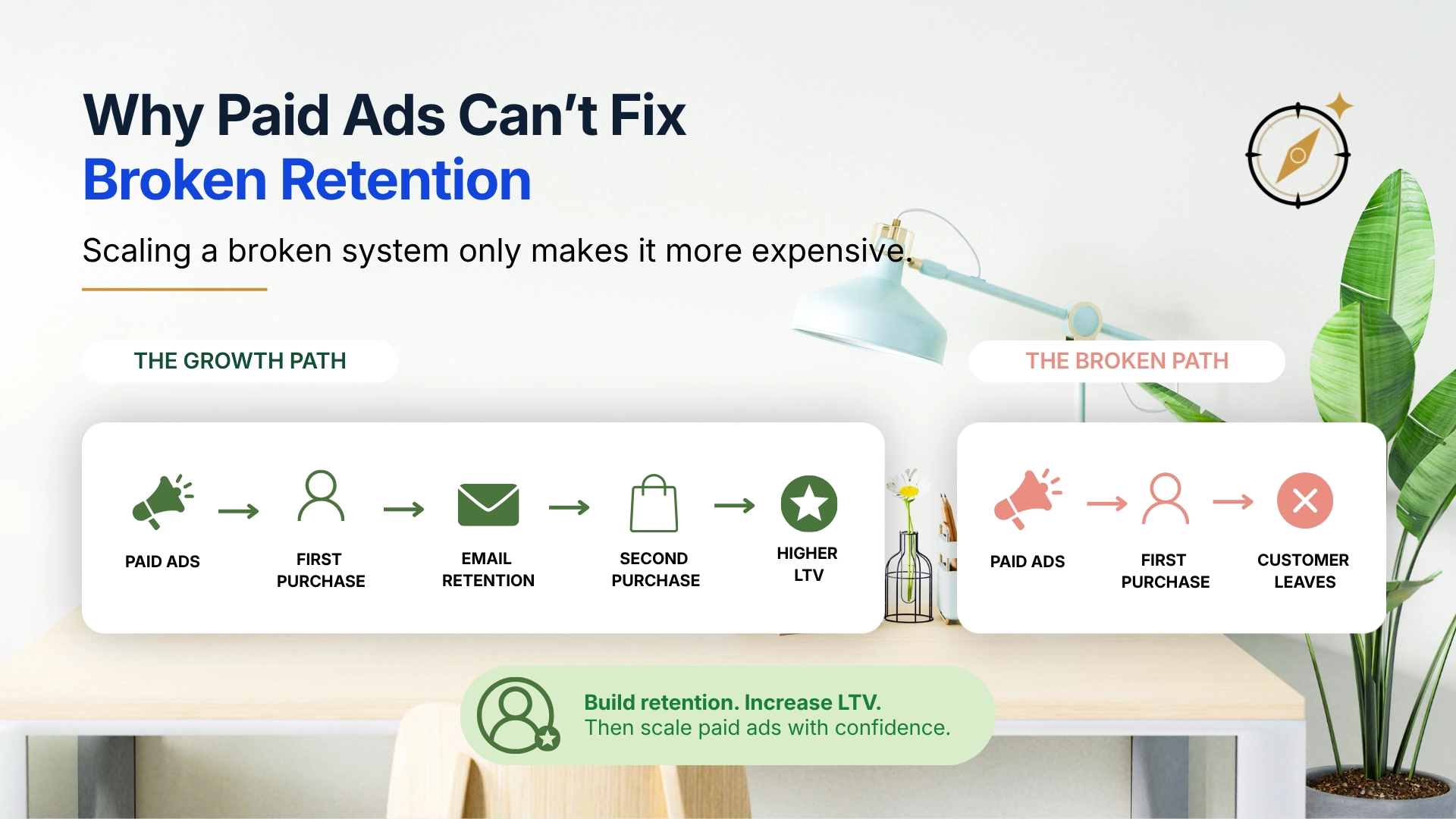
Healthier path: Paid ads -> first purchase -> retention system -> second purchase -> higher LTV -> profitable growth.
Broken path: Paid ads -> first purchase -> no retention system -> customer leaves -> more ad spend required.
What Broken Retention Actually Looks Like
Retention benchmarks vary significantly by category. Consumables, supplements, skincare, coffee, apparel, furniture, and luxury products all have different repurchase patterns.
The goal is not matching a generic benchmark. It is improving your own customer behavior over time.
Broken retention is not always obvious. It rarely announces itself in one dramatic report. It usually shows up through patterns.
Repeat Purchase Rate Is Low for the Category
For stores that sell consumable or frequently repurchased products, a low 90-day repeat purchase rate is worth investigating. For non-consumable categories, the timeframe and expectations shift, but the pattern is the same: if most customers buy once and do not return, retention needs attention.
Revenue Is Event-Driven, Not Compounding
If email revenue spikes during sales and promotions but stays weak between them, the store may not have a recurring revenue base. It may have a discount-activated customer base that rarely buys without a push.
CAC Is Rising Faster Than Average Order Value
When customer acquisition cost increases but average order value stays flat, margin per new customer shrinks. The store needs more customers to generate the same profit, which requires more ad spend, which can push the system into a difficult cycle.
Email Revenue Is a Small Share of Total Revenue
In stores with healthier retention systems, email often contributes a meaningful share of revenue, though the exact percentage depends heavily on category, list maturity, attribution settings, and campaign strategy. If email is producing very little despite a reasonable list size, the retention infrastructure may not be doing enough work.
LTV Growth Has Plateaued
If average customer LTV has not improved while the customer base has grown, new customers may be behaving like old customers: buying once, then disappearing. That is a retention issue, not only an acquisition issue.
Why More Ads Make the Problem Worse, Not Better
When retention is broken, adding more acquisition spend can amplify the problem in two specific ways.
1. It Increases the Cost Without Increasing the Payoff
Every new customer acquired through paid ads comes with a CAC. If the retention system does not convert a meaningful portion of those customers into repeat buyers, the CAC becomes the full cost of that relationship. There is no second or third purchase to spread that acquisition cost across.
Scaling ad spend in this context means spending more money on customers who mostly buy once. The absolute revenue number may go up. Profitability may not.
2. It Diverts Attention From the Actual Problem
When a store’s primary growth lever is ad spend, the optimization conversation centers on ad performance: click-through rate, cost per click, ROAS, creative fatigue, and attribution windows. These are real metrics, but they may not be where the profitability problem lives.
While the team focuses on ad optimization, the post-purchase sequence that could turn more first-time buyers into repeat customers may remain underbuilt. Segmentation may stay basic. Win-back flows may stay on the to-do list.
The retention fix is less visible than ad optimization. But its impact on unit economics can be larger and more durable.
The Math: Why Retention Improvements Can Outperform Acquisition Improvements
Consider a simplified example. These numbers are illustrative, not a benchmark or guarantee.
A Shopify store has:
- Average order value: Rs. 2,500.
- Customer acquisition cost: Rs. 2,000.
- Current repeat purchase rate within 90 days: 15%.
- Current 12-month LTV: Rs. 3,200.
At these numbers, assuming a 50% gross margin, the average customer generates roughly Rs. 1,600 in gross margin before acquisition cost and roughly negative Rs. 400 after acquisition cost. That is a fragile starting point.
Now compare two improvement scenarios:
| Scenario | What Changes | Why It Matters |
|---|---|---|
| Improve ad performance | CAC drops from Rs. 2,000 to Rs. 1,600. | The store saves Rs. 400 per acquired customer. |
| Improve retention | More customers place a second order, increasing LTV. | The store earns more from customers it already paid to acquire. |
If better post-purchase email, segmentation, and win-back strategy increase LTV from Rs. 3,200 to roughly Rs. 4,200, gross margin before acquisition cost rises from about Rs. 1,600 to about Rs. 2,100. That is roughly Rs. 500 more gross margin per customer without needing more ad spend.
The exact math will vary by margin, category, price point, and repurchase behavior. The principle is what matters: when CAC is already paid, improving repeat purchase behavior can improve unit economics without increasing acquisition volume.
Why This Matters
Retention improvements affect every future customer you acquire. Ad optimizations usually affect only the next campaign or the next set of campaigns.
That is why retention work can compound. Once the post-purchase system, segmentation, and customer follow-up are stronger, every new customer entering through paid ads has a better chance of becoming more valuable.
What to Build Before Scaling Ad Spend
If paid acquisition is running but retention is weak, the priority sequence is clear: strengthen retention first, then scale acquisition into the improved system.
1. Build a Post-Purchase Sequence That Extends Beyond 30 Days
The post-purchase window, especially the 45-60 days after a first purchase, is where many repeat purchase decisions are shaped. A customer with no meaningful communication during that window has no structured reason to return.
This is often the highest-leverage retention asset in a Shopify store because every new customer enters it automatically.
At minimum, consider product education around day 7-10, a review request around day 14, a cross-sell or replenishment prompt around day 21-30, and a win-back message around day 45-60 if no second purchase has happened.
Related: What Happens After a Customer Buys?
2. Segment Campaigns So They Reach the Right People
Sending the same campaign to the entire list reduces relevance, weakens engagement signals, and produces mediocre results that can get misread as “email does not work.”
A healthier system sends relevant campaigns to engaged contacts, excludes recent purchasers from unnecessary promotions, and puts lapsed customers into dedicated re-engagement.
Related: The Hidden Cost of Sending Campaigns to Everyone
3. Track Repeat Purchase Rate and LTV Monthly
You cannot improve what you are not measuring. If repeat purchase rate and customer LTV are not reviewed regularly, the retention problem stays invisible until it is large enough to show up in revenue.
4. Build and Protect Your High-Value Customer Segment
Customers who already buy repeatedly are proof that the retention system can work. Protecting that segment with differentiated communication, less generic promotion, and regular engagement checks is one of the most efficient retention investments available.
Related: The Most Valuable Segment Most Shopify Stores Don’t Have
5. Address Deliverability Before Scaling Send Volume
If you plan to scale paid acquisition and grow the email list at the same time, deliverability infrastructure needs to be solid before the list grows. A larger list can amplify deliverability problems: more cold contacts, more non-responders, and more potential complaint volume.
When Paid Ads Are the Right Next Step
This article is not arguing against paid acquisition. Ads are a legitimate growth tool. The argument is about sequence and foundation.
Paid ads make more sense to scale when:
- Your repeat purchase rate is healthy for your category.
- Your post-purchase sequence is built and generating measurable engagement or revenue.
- Your email list engagement ratio is improving or stable.
- Your LTV is growing over time rather than flat.
- Your CAC is stable or declining relative to LTV.
Repeat purchase rate healthy = yes.
Post-purchase flow active = yes.
Engaged segment above 30% = yes.
LTV growing = yes.
Deliverability healthy = yes.
If four or five of these checks are true, scaling acquisition becomes more defensible.
When these conditions are met, increasing acquisition spend puts new customers into a system capable of turning them into repeat buyers. When these conditions are not met, increasing acquisition spend puts customers into a system that loses too many of them after one purchase.
The audit, knowing which situation you are in, comes before the scale decision.
Common Mistakes at the Acquisition-Retention Intersection
Attributing all revenue growth to ads when retention is also improving. Track email revenue and repeat purchase rate separately so each channel’s contribution is visible.
Building retention infrastructure only after ads stop working. By then, many customers who could have been retained are already gone. Build retention while acquisition is still working.
Assuming a high ROAS means the business economics are healthy. ROAS measures revenue generated per rupee of ad spend. It does not fully account for repeat purchase behavior, cost to serve, product margin, fulfillment, or platform fees.
Treating email revenue and ad revenue as separate. Paid acquisition feeds the email list. Email retention improves the value of customers acquired through ads. The two channels work as a system.
Metrics to Track at the Acquisition-Retention Level
| Metric | Source | Why It Matters |
|---|---|---|
| Customer acquisition cost | Ad platform + Shopify | Cost side of the LTV:CAC relationship. |
| 12-month customer lifetime value | Shopify customer reports | Value side of the LTV:CAC relationship. |
| LTV:CAC ratio | Calculated | Primary unit economics health indicator. |
| 90-day repeat purchase rate | Shopify cohort reports | Shows whether first-time buyers are returning. |
| Email revenue as percentage of total revenue | Klaviyo + Shopify | Shows retention channel contribution. |
| Revenue per recipient, post-purchase flow | Klaviyo flow analytics | Shows post-purchase system efficiency. |
| Time between first and second purchase | Klaviyo customer profiles / Shopify | Helps set timing for follow-up messages. |
Review these together, not in isolation. CAC and LTV only mean something relative to each other. Email revenue only means something relative to total revenue. The relationships between the metrics tell the story.
FAQ
Our ROAS is strong. Do we still need to worry about retention?
Yes. ROAS measures revenue relative to ad spend, not profitability across the whole customer relationship. A store can have strong ROAS and still weak unit economics if most acquired customers never return. Pull 90-day repeat purchase rate alongside ROAS before deciding the business is healthy.
We are an early-stage Shopify store. Should we focus on ads or retention first?
Early-stage stores usually need some acquisition to create enough customer volume for retention data to matter. But that does not mean aggressive scaling. Run a modest acquisition effort, build retention infrastructure in parallel, and scale spend once repeat purchase data shows the system is working.
How long does it take for retention improvements to show up in revenue?
Flow improvements can show measurable activity within 30 days because they trigger continuously. Segmentation and deliverability improvements often take longer, commonly 60-90 days. LTV improvements at the cohort level are usually clearer over 6-12 months.
What LTV:CAC ratio should we target?
A commonly used directional target is 3:1 or higher, but this is not a universal rule. The right target depends on category, gross margin, growth stage, cash flow, and purchase cycle. Use it as a starting point, not a hard standard.
Can retention alone sustain revenue without acquisition?
For most ecommerce stores, no. Natural churn means acquisition is still needed. The goal is not to replace acquisition with retention. The goal is to build a retention system strong enough that each acquired customer has a better chance of becoming profitable.
Should retention or acquisition get the larger budget?
Most growing ecommerce brands need both. The better question is whether the retention system is strong enough to support additional acquisition investment. If retention is weak, improving it often produces a higher return than simply increasing ad spend.
Key Takeaways
- Paid ads and email retention are parts of the same economic system. Acquisition determines how many customers enter. Retention determines what those customers are worth.
- When retention is broken, scaling ad spend can amplify the problem because more customers enter a system that loses too many of them after one purchase.
- Improving LTV through retention can be more durable than relying only on CAC reduction through ad optimization.
- Build the retention infrastructure first: post-purchase sequence, segmentation, monthly LTV and repeat purchase tracking, high-value customer protection, and deliverability basics.
- LTV:CAC is one of the most useful metrics for understanding whether the acquisition-retention relationship is healthy.
Practical Action Plan
This Week
- Calculate your current LTV:CAC ratio. Pull CAC from your ad platform and LTV from Shopify customer reports. If LTV data is incomplete, use 12-month revenue per customer as a rough proxy.
- Pull your 90-day repeat purchase rate from Shopify cohort reports.
- Check whether your post-purchase flow extends beyond 30 days. If not, start there.
In the Next 30 Days
- Build or rebuild the post-purchase sequence to cover the full 45-60 day window.
- Add repeat purchase rate and email revenue percentage to your monthly reporting.
- Confirm campaign sends target engaged segments rather than the full list.
In the Next 90 Days
- Review LTV:CAC monthly and track whether retention changes move the ratio in the right direction.
- Build a high-value customer segment and communicate with it differently from the general list.
- Reassess paid acquisition budget using retention data. If repeat purchase rate and LTV are improving, scaling acquisition becomes more defensible.
Related Guides
- The Revenue You’re Losing Between First and Second Purchase
- What Happens After a Customer Buys?
- Why Your Best Customers Are Leaving
- Shopify Email Audit: What I Check First
- The Most Valuable Segment Most Shopify Stores Don’t Have
Review Method
This guide is based on common Shopify and Klaviyo retention patterns, ecommerce unit economics, and practical email marketing workflows. Exact numbers vary by category, margin, purchase cycle, acquisition source, offer strategy, and attribution setup. Use your own Shopify, ad platform, and Klaviyo data before changing budget allocation.
Conclusion
There is a version of ecommerce growth that feels sustainable: each customer acquired through paid ads generates enough repeat revenue to justify the acquisition cost, the email channel compounds as the list matures, and LTV and CAC move in the right direction relative to each other.
There is also a version that is not sustainable: every month requires more ad spend to hit similar revenue targets, most customers buy once and disappear, and the email list exists but does not compound because the retention system is weak.
The difference is not only the ad platform or creative strategy. It is what happens after the first purchase.
Paid ads bring customers in. Retention determines what they are worth. Both matter, but only retention can fix the value side of a unit economics problem.
Last updated: June 2026. Platform features referenced are based on general Klaviyo, Shopify, and paid acquisition workflow patterns. Verify exact settings and reports inside your own accounts before publishing changes.

Related guides
Best Email Marketing Software for Contractors (2026)
A practical comparison of Mailchimp, Constant Contact, Brevo, MailerLite, Kit, and field service marketing tools for contractors.
Best Email Marketing Software for Hair Salons & Spas (2026)
A practical comparison of Mailchimp, Constant Contact, Brevo, MailerLite, Kit, and booking-software marketing tools for salons and spas.

Best Email Marketing Software for Restaurants (2026)
A practical comparison of Mailchimp, Constant Contact, Brevo, MailerLite, Kit, and Toast Marketing for restaurant email marketing.