The Most Valuable Segment Most Shopify Stores Don’t Have
AT A GLANCE
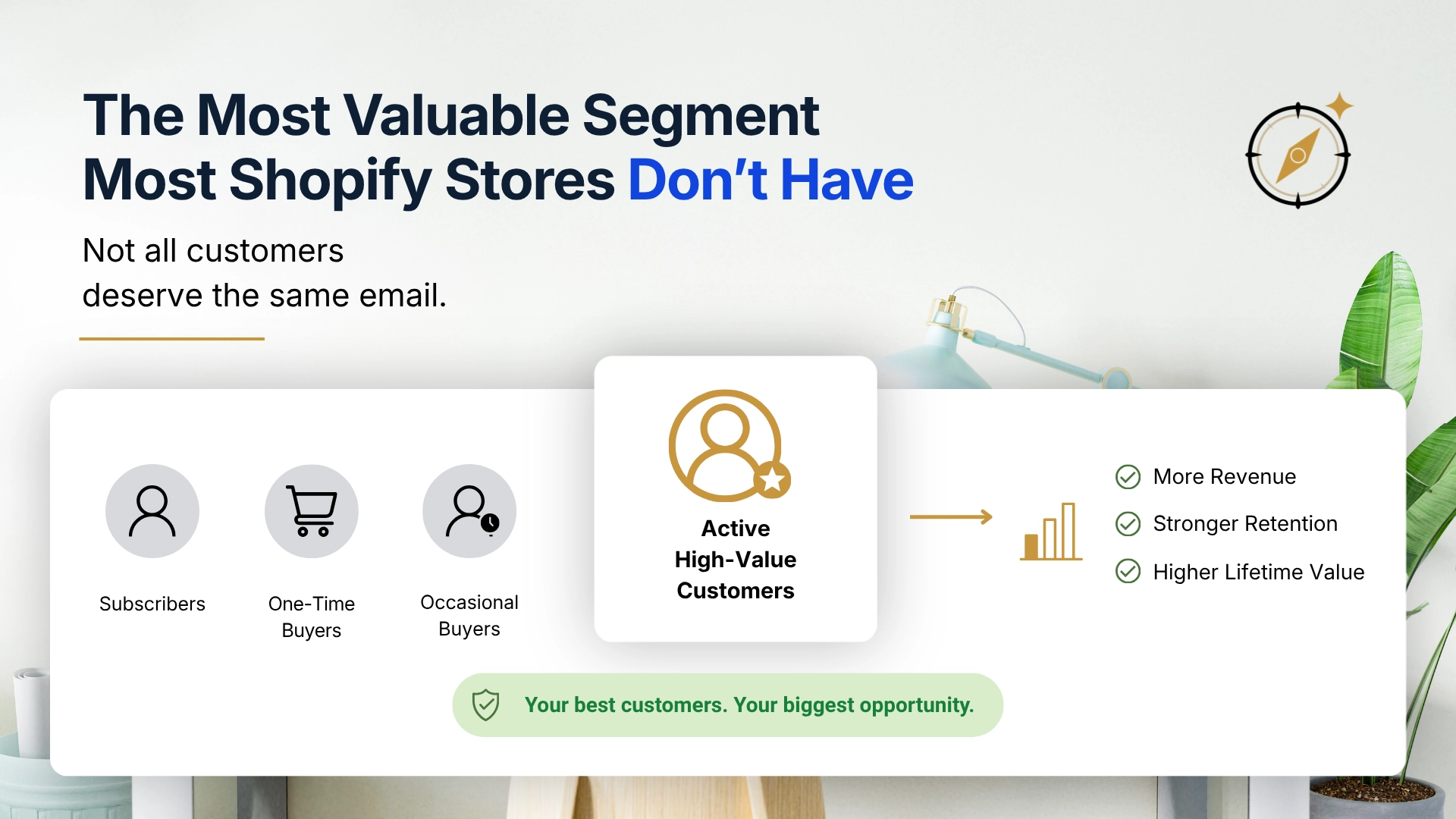
Active high-value customers are often the segment most worth protecting. Treating them like the general list can quietly weaken retention.
Quick Summary
- Most Shopify stores segment by subscription status or basic purchase history. That is not enough.
- The most valuable segment in an ecommerce email account is often the active high-value customer segment: repeat buyers who are currently engaged and spending above average.
- This segment deserves different communication than the rest of your list. Many brands do not treat it differently at all.
- Building and protecting this segment can support revenue, retention, and customer lifetime value.
- This article covers what the segment is, how to define it, how to build it in Klaviyo, and how to use it without burning it out.
Introduction
If you asked many Shopify store owners how they segment their email list, the answer would sound something like this: subscribers who have not bought, customers who have, and maybe a VIP tag for people who have spent a lot.
That is a start. But it leaves one of the most strategically important groups on your list treated like everyone else, receiving the same campaigns, on the same cadence, with the same generic content as a subscriber who signed up for a discount code and never purchased.
That group is your active high-value customers. These are the people who have bought multiple times, are currently engaged, and whose continued loyalty is worth more to your store’s long-term revenue than many new customers you could acquire through paid ads.
These customers are not hard to identify. They are usually sitting inside your Klaviyo account right now. But many stores have not built the segment, have not changed how they communicate with it, and are unknowingly treating their best customers the same way they treat everyone else.
This article is about fixing that.
Why Segmentation Beyond “Subscriber” and “Customer” Matters
The default Klaviyo setup for many Shopify stores divides the list into a few broad buckets: people who have subscribed, people who have purchased, and everyone in between. Some stores add a basic engaged segment, such as opened in the last 90 days, and call it done.
The problem with this approach is not that the segments are wrong. It is that they are not specific enough to inform meaningful communication decisions.
Consider two customers who both fall into your “customer” list:
- Customer A has placed one order, spent close to your average order value, and opened one email in the past 60 days.
- Customer B has placed five orders, has a lifetime value three times your store average, opened your last four campaigns, and purchased again last month.
Under a basic segmentation model, these two customers receive identical emails: same subject lines, same promotions, same cadence, same content.
That is a retention problem waiting to happen. Customer B, your more valuable relationship, gets no special acknowledgment, no differentiated experience, and no signal that the brand recognizes the difference between a one-time buyer and someone who has demonstrated sustained loyalty.
When Customer B eventually drifts, the revenue impact is larger than losing Customer A. But because both were treated the same, there may be no early warning and no tailored communication to prevent it.
The Segment Most Stores Are Missing: Active High-Value Customers
This segment goes by different names: Champions, VIPs, Top Buyers, Power Customers. The label does not matter. The definition does.
General Customer List
- One-Time Buyers
- Repeat Buyers
- Active High-Value Customers
- At-Risk High-Value
- Lapsed High-Value
An active high-value customer, in many Shopify contexts, is someone who meets all three of these conditions:
1. Purchase Frequency Above Threshold
They have placed a meaningful number of orders, often 3 or more, though this depends on your average customer’s purchase behavior. The point is that they have demonstrated repeat buying, not just a single transaction.
2. Lifetime Value Above Your Store Average
Their total spending is in the top tier of your customer base. Exactly where you draw the line depends on your product price point and revenue distribution. A practical starting point is the top 20-25% of customers by total spend.
3. Currently Active
This is the condition many VIP segments miss. A customer who spent heavily two years ago but has not bought or engaged in 18 months is not an active high-value customer. They are a lapsed one, and they need a different strategy.
“Currently active” typically means purchased within the last 90-120 days, or engaged with email within the last 60 days.
The correct timeframe depends on your repurchase cycle. A coffee subscription brand and a furniture brand should not use the same activity window.
All three conditions together define the segment worth protecting. Remove any one of them and you are looking at a different group with different needs.
Why This Segment Is the Most Valuable One You Can Build
The reason this segment deserves dedicated attention is not just that these customers spend more. It is the compounding nature of their value over time.
Customer A spends ₹2,000 once.
Customer B spends ₹2,000 six times over 18 months.
Both customers may appear inside a generic “Customer” segment. But Customer B represents dramatically more future revenue and deserves a different communication strategy.
They have a higher lifetime value ceiling. A customer on their fifth order is usually more likely to place a sixth than a first-time buyer is to place a second. Their trajectory is already established. The cost of maintaining that relationship is usually lower than the cost of replacing it through acquisition.
They are a likely referral source. Customers who buy repeatedly and are currently engaged are more likely to recommend the brand to others through word of mouth, social sharing, or direct referral. That referral value is not always captured in standard retention metrics, but it matters.
They are sensitive to communication quality. Because they have interacted with your brand multiple times, they have a more developed sense of whether your emails feel personal or generic. A high-frequency promotional blast can feel more jarring to someone who has spent significantly with the brand.
They are easy to lose without noticing. Because they have been reliable, their absence is easy to miss in aggregate revenue numbers at first. By the time the gap is obvious, re-engagement is harder.
How to Define the Segment for Your Specific Store
The exact thresholds vary by store. Use your own Shopify and Klaviyo data wherever possible.
Step 1: Find Your Repeat Purchase Baseline
In Shopify Analytics, look at your customer purchase frequency report. What percentage of customers have placed 2 or more orders? What percentage have placed 3 or more?
If 30% of your customers have placed 2+ orders, then 2+ orders may not be a meaningful threshold for identifying your best customers. You may need to go higher. If only 10% have placed 3+ orders, then 3 orders may be a meaningful filter.
Step 2: Find Your Lifetime Value Distribution
Pull a customer lifetime value report from Shopify or Klaviyo. Look at where the top 20-25% of customers by total spend begins. That number becomes your minimum lifetime value threshold for this segment.
For a store where the average customer has spent ₹3,000 lifetime, the top 20% might start around ₹8,000. For a higher-ticket store, the numbers can shift significantly. Use your own data, not broad benchmarks.
Step 3: Define “Currently Active” for Your Category
This depends on your typical purchase cycle. For a consumable product with a 30-45 day reorder window, active might mean purchased in the last 60 days. For a high-consideration product with a 6-month purchase cycle, active might mean purchased in the last 180 days.
A practical fallback if you do not have clear purchase cycle data: purchased within the last 90 days OR opened or clicked an email within the last 60 days.
Building the Segment in Klaviyo
Here is how to construct this segment inside Klaviyo using standard filters.
Segment Definition: Adjust Thresholds to Your Store
All conditions must be true:
- Number of orders placed is at least 3 over all time.
- Total revenue is at least your top 20% threshold over all time.
At least one of these must be true:
- Has placed an order in the last 90 days.
- Has opened an email in the last 60 days.
- Has clicked an email in the last 60 days.
This combination captures customers with strong purchase history and lifetime value who are still engaged through recent buying or recent email interaction.
Naming Convention
Name this segment something clear and consistent: Active High-Value Customers or Champions both work well. Whatever you choose, use it consistently across flows, campaign exclusions, and reporting.
Companion Segments to Build Alongside It
| Segment | Definition | Purpose |
|---|---|---|
| Active High-Value Customers | 3+ orders, top 20% LTV, active last 90 days | Primary retention focus. Protect this group. |
| At-Risk High-Value | 3+ orders, top 20% LTV, no purchase or engagement in 90-120 days | Early churn warning. Intervene before full lapse. |
| Lapsed High-Value | 3+ orders, top 20% LTV, no activity in 120+ days | Win-back with higher-effort content. |
These three segments together give you a clear view of where your best customers are in their lifecycle, and when to shift from retention communication to re-engagement communication.
How to Use This Segment Without Burning It Out
Building the segment is step one. Changing how you communicate with it is what actually supports retention.
The most common mistake after identifying high-value customers is treating the segment as a target for more frequent selling: more emails, more promotions, more urgency. That can accelerate churn instead of preventing it.
Reduce Promotional Frequency for This Segment
High-value customers have already demonstrated that they do not need constant promotional pressure to buy. What erodes loyalty is often a sense that the brand treats them as a transaction rather than a relationship.
Consider suppressing this segment from your highest-frequency promotional periods. Give them a version of the sale with early access or fewer emails, rather than the full promotional blast.
Create Content That Acknowledges Their History
This can be as simple as a dynamic content block in a campaign email that shows different copy to high-value customers, acknowledging that they have been with the brand for multiple purchases or referencing product categories they bought from before.
The signal that the brand recognizes them can be more powerful than the message itself.
Give Them Genuine Early Access
One useful way to make high-value customers feel valued is to give them real firsts: early access to new products, first look at new collections, or a genuine heads-up before a sale goes public.
This is different from fake countdown timers or manufactured scarcity. Real early access, even 24 or 48 hours before public announcement, communicates that the brand views these customers differently.
Ask for Their Input
High-value customers are an underused source of product and brand insight. A short survey, a direct question about what they would like to see next, or an invitation to test a new product in exchange for feedback can deepen the relationship in a way another promotional campaign cannot.
Keep it light and low-pressure. A direct, human question usually works better than a formal survey with 20 questions.
Use a Dedicated Campaign Calendar for This Segment
Rather than sending this segment whatever the rest of the list receives, build a light parallel calendar: 2-3 emails per month specifically for active high-value customers.
These might include:
- A curated recommendation based on purchase history.
- Behind-the-scenes brand content.
- Early access or new arrival previews.
- An occasional thank-you email with no ask attached.
This does not need to be elaborate. The point is intentionality: treating this segment as a relationship to invest in, not just a list to market to.
Klaviyo Campaign Targeting: A Practical Reference
| Campaign Type | Send to Active High-Value? | Notes |
|---|---|---|
| Major promotional sale | Separately, with early access | Do not include in the main blast by default. |
| New product launch | Yes, first | They should hear before the general list. |
| Educational content | Yes | High relevance for engaged customers. |
| Heavy-frequency sale week | Suppressed or reduced | Over-mailing this group can accelerate churn. |
| Win-back campaign | No | They are active. This is not the right message. |
| Loyalty or referral invite | Yes | Natural fit for high-value engaged customers. |
| General newsletter | Yes | Include, but consider a personalized content block. |
Metrics to Track for This Segment
| Metric | Frequency | What to Watch |
|---|---|---|
| Segment size | Monthly | Shrinking can mean churn is accelerating in your best customer tier. |
| Segment growth rate | Monthly | More customers qualifying can mean retention is improving. |
| Average order value, segment vs store | Monthly | Should stay meaningfully above store average. |
| Email engagement rate | Monthly | Declining engagement can mean content or frequency is eroding loyalty. |
| Repeat purchase rate within segment | Quarterly | Should be higher than store average. |
| Revenue attributed to segment | Monthly | Flat or declining can mean a retention problem in the highest-value tier. |
| Movement to At-Risk segment | Monthly | Rising movement is an early warning that churn is increasing. |
The segment size metric is especially important to watch consistently. If your Active High-Value Customers segment is shrinking month over month, it means customers are ageing out of active status faster than new customers are qualifying in. That is a structural retention problem worth addressing before it compounds.
Common Mistakes When Building and Using This Segment
Setting the thresholds too low. If 40% of your customers qualify as high-value, the segment has lost its meaning. It should represent a distinct tier, often around 15-25% of the customer base.
Forgetting the active filter. A high-value customer who has not purchased or engaged in 12 months is not active. Including them in the same segment as currently engaged best customers will muddy your data.
Using the segment only for selling. The purpose is not to sell more aggressively. It is to maintain the relationship that makes them want to keep buying.
Never reviewing the segment thresholds. A store’s top-20% LTV threshold changes as the business grows. Review and adjust the segment definition over time.
Not suppressing this segment from win-back flows. Win-back emails are designed for lapsed customers. Sending a “we miss you” email to an active high-value customer who purchased recently is a segmentation error.
FAQ
Should every Shopify store have this segment?
Yes. The thresholds may differ, but every store has a subset of customers who spend more, buy more often, and engage more consistently than average. Identifying and protecting that group is one of the highest-leverage retention activities available.
What if my store is too small to have a meaningful high-value segment?
Smaller stores can still build this segment. The thresholds just look different. If you have 200 customers and 30 of them have placed 3+ orders, those 30 deserve differentiated communication even if the absolute numbers are small. Start with your top buyers by lifetime spend and treat that group with more intention than the rest.
Should I tell customers they are in a VIP or high-value segment?
You can. Some brands run explicit loyalty or VIP programs. Others simply communicate differently with this group without naming the tier. Both approaches can work. What matters is that the communication actually feels different.
How often should I email active high-value customers?
Usually less frequently than your general list, but with higher-quality content. A practical starting point is 2-4 thoughtful emails per month, depending on your category and standard campaign frequency. The goal is quality over quantity.
What is the difference between a high-value segment and a loyalty program?
A loyalty program is a system customers interact with: points, tiers, or rewards. A high-value segment is an internal data-based grouping that informs how you communicate. They are complementary, but not the same thing.
How long does it take to see results after building this segment?
Segmentation changes show results gradually. The clearest early signal is engagement. Purchase behavior typically takes longer, often 60-90 days, as the new communication approach has time to influence repeat buying.
Key Takeaways
- The most valuable segment in your Klaviyo account is often your active high-value customers: repeat buyers with above-average lifetime value who are currently engaged.
- The segment needs three conditions: purchase frequency above your store’s baseline, lifetime value in the top tier, and recent activity.
- These customers should receive different communication: lower promotional pressure, earlier access, more personalized content, and more value-first emails.
- The companion segments, At-Risk High-Value and Lapsed High-Value, create an early warning system for churn in your most important customer tier.
- Monitor segment size monthly. A shrinking Active High-Value segment is a clear signal that retention may be deteriorating at the top of your customer base.
Practical Action Plan
This Week
- Pull your customer lifetime value distribution from Shopify or Klaviyo.
- Find where the top 20-25% of customers by lifetime spend begins. That number becomes your lifetime value threshold.
- Check what percentage of your customers have placed 3+ orders. Adjust your frequency threshold if needed.
- Build the Active High-Value Customers segment in Klaviyo using the filters described above.
In the Next 30 Days
- Build the two companion segments: At-Risk High-Value and Lapsed High-Value.
- Review your last 5 campaign sends. Check whether active high-value customers received identical content to everyone else.
- Add active high-value customers as a suppression to win-back and re-engagement flows.
In the Next 90 Days
- Build a light parallel campaign calendar for this segment, with 2-3 emails per month designed specifically for them.
- Test one early-access send before a new product or sale goes to the general list.
- Add segment size and revenue attributed to this segment to your monthly metrics review.
Related Retention Guides
- Why Your Best Customers Are Leaving
- 7 Revenue Leaks I Find in Shopify Email Accounts
- The Revenue You’re Losing Between First and Second Purchase
- Klaviyo Segmentation Mistakes That Hurt Open Rates
Review Method
This framework is based on common segmentation patterns observed across Shopify and Klaviyo accounts. Exact thresholds vary by product category, purchase frequency, average order value, customer lifecycle, store size, and available data quality. Use your own Shopify and Klaviyo reports before setting final thresholds.
Conclusion
Every Shopify store has a group of customers who buy more often, spend more per order, and are more likely to refer others. They exist in every store, but in many stores they are invisible inside a broad customers list, receiving the same emails as everyone else.
Building the active high-value customer segment does not require a loyalty program, a new platform, or a major workflow rebuild. It requires setting the right filters in Klaviyo, making deliberate communication decisions for that group, and checking the segment’s health every month.
The stores that retain their best customers longest are not always the ones with the most aggressive email programs. They are the ones that know who their best customers are and treat them accordingly.
Last updated: June 2026. Platform features referenced are based on general Klaviyo and Shopify workflow patterns. Verify exact settings inside your own accounts before publishing changes.

Related guides

Best Email Marketing Software for Contractors (2026)
A practical comparison of Mailchimp, Constant Contact, Brevo, MailerLite, Kit, and field service marketing tools for contractors.
Best Email Marketing Software for Hair Salons & Spas (2026)
A practical comparison of Mailchimp, Constant Contact, Brevo, MailerLite, Kit, and booking-software marketing tools for salons and spas.
Best Email Marketing Software for Restaurants (2026)
A practical comparison of Mailchimp, Constant Contact, Brevo, MailerLite, Kit, and Toast Marketing for restaurant email marketing.