Klaviyo Segmentation Mistakes That Hurt Open Rates
AT A GLANCE
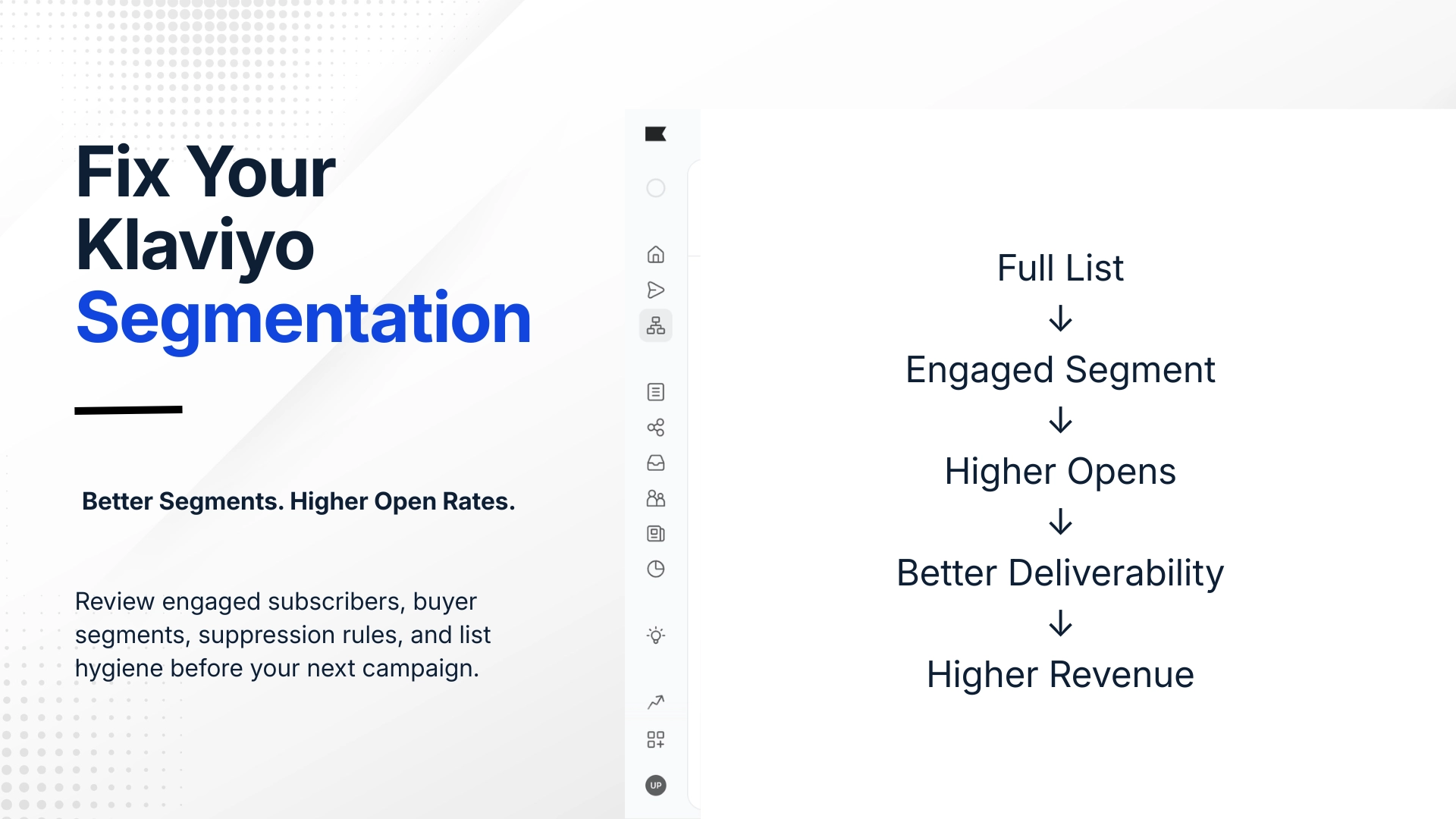
Poor segmentation does not just lower open rates. It can quietly damage deliverability, reduce revenue, and make otherwise good campaigns appear ineffective.
Quick Summary
- Sending to your full list is the most common and most damaging segmentation mistake.
- Unengaged subscribers do not just ignore emails; they can hurt deliverability for everyone else.
- The engaged segment is the baseline every brand should use for regular campaigns.
- Over-segmenting is a real problem too: tiny segments with inconsistent send frequency build little inbox reputation.
- Most open rate problems are not copy problems. They are audience problems.
Who This Guide Is For
This guide is designed for:
- Shopify store owners using Klaviyo
- Ecommerce email marketers
- Retention marketing teams
- Klaviyo freelancers and consultants
- Brands experiencing declining open rates
If your campaign open rates have dropped despite testing new subject lines, segmentation is usually the first place to investigate.
Introduction
When open rates drop, most brands look at subject lines first. They test new formulas, add emojis, and try curiosity gaps instead of direct benefit statements. Sometimes that helps. Often it does not.
The reason open rates are low is frequently not the subject line. It is who the email is being sent to.
Klaviyo segmentation mistakes are quiet. They do not throw errors or trigger warnings. The campaigns go out, the numbers come back lower than expected, and the instinct is to fix the content. But if you are sending to the wrong people, better content does not move the number in any meaningful way.
This article covers the most common Klaviyo segmentation mistakes that hurt open rates, not as a theoretical list, but as a diagnostic framework. If your open rates have plateaued or dropped, one of these is usually the reason.
Real Example: Why Subject Lines Weren’t The Problem
A common scenario looks like this:
| Campaign | Open Rate |
|---|---|
| Campaign A | 18% |
| Campaign B | 19% |
| Campaign C | 17% |
The natural reaction is to test new subject lines.
But if 40-50% of the list has not opened an email in six months, the issue is not the subject line.
After moving campaign sends to an engaged segment, many brands see open rates improve without changing the email content at all.
The audience changed. The copy stayed the same.
Quick Segmentation Audit
| Question | Good | Needs Work |
|---|---|---|
| Sending campaigns primarily to engaged subscribers? | ✓ | |
| Re-engagement flow active? | ✓ | |
| Purchase-based segments created? | ✓ | |
| Recent buyers suppressed from promotions? | ✓ | |
| Segment definitions reviewed this quarter? | ✓ | |
| Full-list campaign sends avoided? | ✓ |
If several boxes fall into the “Needs Work” category, segmentation is likely contributing to lower open rates.
Mistake 1: Sending Campaigns to Your Full List
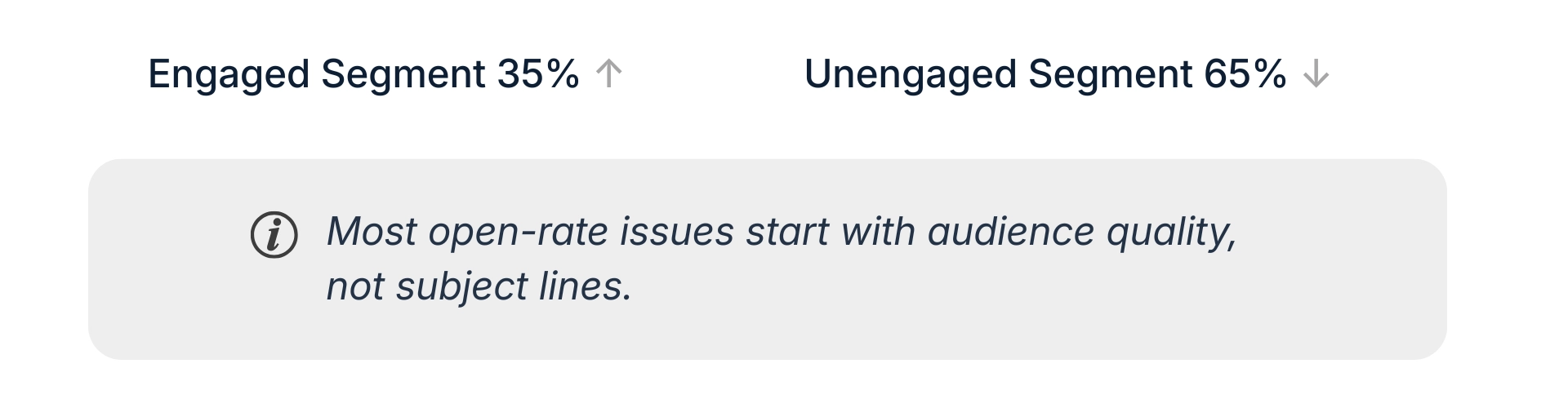
This is the most widespread mistake in ecommerce email marketing, and it compounds over time.
Every list contains three types of subscribers: active buyers who open regularly, occasional openers who engage when the offer is relevant, and disengaged subscribers who stopped opening months ago but never unsubscribed. When you send every campaign to all three groups, the disengaged segment drags your overall metrics down.
More importantly, inbox providers use engagement signals to decide where your emails land. A high proportion of emails going to people who never open tells inbox providers that your content is not worth surfacing. That hurts deliverability for engaged subscribers too, not just disengaged ones.
The fix is straightforward but requires a mindset shift: campaigns should go to your engaged segment by default, not your full list.
How to build a basic engaged segment in Klaviyo:
- Opened email at least once in the last 90 days, or
- Clicked email at least once in the last 90 days, or
- Placed an order in the last 90 days.
This segment captures active subscribers and recent buyers, the people most likely to open, click, and convert. For many ecommerce brands, this may be a smaller share of the total list than expected. The reduction in reach feels uncomfortable at first, but the improvement in open rates, click rates, and deliverability is often measurable over time.
Sending campaigns to every subscriber simply because they are on the list.
Mistake 2: Ignoring the Unengaged Segment Entirely
Not sending to unengaged subscribers is the right call for regular campaigns. Abandoning them completely is a different mistake.
Subscribers who have not engaged in 90-180 days are not necessarily lost. Some went dormant because the timing was not right, the content was not relevant, or they simply got busy. A structured re-engagement sequence, separate from your regular campaign calendar, gives them a defined off-ramp: either re-engage or get suppressed.
Without this, the unengaged segment grows passively over time. Eventually, a large portion of the list may not have opened in months. That is a deliverability problem waiting to worsen.
A minimal re-engagement sequence:
- Email 1: “Still interested?” Acknowledge the gap and offer a reason to stay.
- Email 2: Send 7 days later to non-openers only with last-chance messaging or a specific offer.
- Email 3: Send 7 days later to remaining non-engagers with a clear removal notice.
Subscribers who do not open any of the re-engagement emails should usually be suppressed. They are unlikely to come back through regular campaigns, and continuing to send to them can cost you deliverability.
Create a simple re-engagement sequence before suppressing inactive subscribers.
Mistake 3: Not Segmenting by Purchase History
Sending the same campaign to a first-time buyer and a customer who has purchased six times is a missed opportunity at minimum and actively damaging at worst.
A new customer who bought once needs different messaging than a loyal customer who knows the brand well. The loyal customer does not need an introduction to the product. They may need early access, VIP treatment, or a cross-sell based on what they already bought.
Segments worth building around purchase history:
- Never purchased: prospects still in consideration; welcome flow and educational content.
- One purchase, 30-90 days ago: highest-priority group for second purchase conversion.
- 2-3 purchases: forming a habit; loyalty reinforcement and cross-category introduction.
- 4+ purchases: loyal customers; VIP access, referral programs, and product feedback requests.
- Purchased 90+ days ago, not since: lapsing customers; win-back sequence before they go fully cold.
Each group has different intent, different familiarity with the brand, and different campaign messaging that is relevant to them. Treating them the same reduces the relevance of every email you send.
Simple Purchase-Based Segmentation Framework
Not every customer should receive the same campaign.
A simple purchase-based structure looks like this:
- VIP Customers: 4+ orders.
- Repeat Buyers: 2-3 orders.
- One-Time Buyers: 1 order.
- Subscribers: no purchase yet.
Each group has different intent, familiarity with the brand, and purchase likelihood.
The more relevant the message, the higher the engagement.
Mistake 4: Building Segments That Are Too Small
Segmentation is not always better when it is more granular. This is less commonly discussed, but it causes real problems for brands that over-index on precision.
Sending campaigns to very small segments on an irregular basis builds little inbox reputation with those subscriber addresses. Inbox providers use engagement patterns over time to evaluate sender reputation. Tiny, infrequent sends do not generate enough signal and may create more operational complexity than they are worth.
There is also a practical problem: very granular segments require more creative resources to maintain relevance. A segment like “purchased product X between 60 and 90 days ago and lives in a specific city” is probably not worth the overhead unless the product has a genuinely time-specific replenishment cycle.
A useful test: if a segment is under 1,000 subscribers and you are not sending to it at least twice a month, question whether it should be a campaign segment at all or whether that targeting logic belongs in a flow instead.
Mistake 5: Using Time-Based Engagement Windows That Do Not Fit the Business
The standard engaged segment definition, opened or clicked in the last 90 days, is a reasonable default. It is not right for every business.
A brand that sends daily emails has a different engagement pattern than one that sends twice a month. For a high-frequency sender, 90 days may be too long. For a low-frequency sender, 90 days might not be enough.
Match the engagement window to your send frequency:
- High frequency, 5+ campaigns per month: 60-day window, or last 15 sends.
- Standard frequency, 2-4 campaigns per month: 90-day window.
- Low frequency, 1-2 campaigns per month: 120-180-day window.
Klaviyo allows filtering by email activity over a set time period. Use the definition that reflects your actual send rhythm, not a default copied from another brand.
A 90-day engagement window is not automatically correct for every business.
Mistake 6: Segmenting on Demographics Without Behavioural Data
Location, age, and stated preferences at signup are useful context, but they are weaker segmentation signals than behaviour.
A subscriber who has bought twice, opened the last several emails, and clicked on product recommendation links is a high-value active customer regardless of what they selected in a signup form preference survey. A subscriber who ticked “interested in men’s clothing” but has not opened in four months is disengaged regardless of how accurately they self-categorised.
Behaviour should take precedence over demographics when the two conflict. Use demographics to personalise within behavioural segments, not to define the main segments themselves.
Build primary segmentation around:
- Email engagement: opened and clicked.
- Purchase behaviour: frequency, recency, and category.
- On-site behaviour: browsed product pages, abandoned cart, or viewed categories.
Mistake 7: Not Suppressing Recent Buyers from Promotional Campaigns
This happens more than it should: a brand runs a sale campaign and sends it to the full list, including customers who purchased at full price three days ago.
The customer experience of receiving a discount email immediately after paying full price is poor. It signals that the brand does not track purchase history and does not value the relationship enough to notice.
The fix is a straightforward filter on promotional campaigns: suppress customers who placed an order in the last 7-14 days. Adjust the window based on your average order cycle.
In Klaviyo, add a segment condition excluding people who placed an order in the chosen recent window. Two minutes of setup can protect both customer experience and perceived brand integrity.
Avoid sending discount campaigns to customers who purchased at full price within the last 14 days.
Mistake 8: Treating Klaviyo Segments as Static
Segments in Klaviyo are dynamic by default. They update automatically as subscriber behaviour changes. But the definitions of your segments are not self-updating.
If you built your engaged segment 18 months ago based on a 60-day window and your send frequency has since doubled, the definition may no longer be accurate.
Review your core segment definitions every quarter:
- Is the engagement window still appropriate for your send frequency?
- Has your list grown enough that more granular purchase-based segments are worth building?
- Are your re-engagement thresholds catching people before they go fully cold?
- Do any segments overlap in ways that create conflicting campaign messages?
Segments that are not reviewed become stale. The list grows, subscriber behaviour shifts, and the segment definition stops reflecting who is actually in it.
Quick Diagnostic: Why Are Your Open Rates Low?
If your Klaviyo open rates have dropped or plateaued, run through this sequence:
1. What percentage of campaign sends go to your full list? If over 50%, unengaged subscribers are likely suppressing your overall open rate. Build an engaged segment and compare open rates on the next campaign.
2. What is the size of your unengaged segment? Pull subscribers who have not opened in 180 days. If that number is high, deliverability may be affected. Start a re-engagement sequence.
3. Are recent buyers receiving promotional campaigns? Check the last few promotional sends. If customers who purchased recently are included, add suppression filters.
4. When did you last review your segment definitions? If it has been over six months, review the engagement window and purchase history segments.
5. Are small segments receiving irregular sends? Consolidate or migrate those targeting criteria into flows rather than campaign segments.
Tools I Use For Segmentation Reviews
Klaviyo
Used for:
- Segment creation
- Engagement tracking
- Campaign reporting
- Flow suppression
Google Sheets
Used for:
- Segment audits
- Deliverability tracking
- Engagement analysis
ChatGPT
Used for:
- Segment planning
- Campaign angle brainstorming
- Subject line generation
Claude
Used for:
- Workflow documentation
- Review summaries
- Campaign planning
The tool matters less than the segmentation strategy behind it.
FAQs
What is the best way to segment a Klaviyo list?
Start with engagement-based segmentation: a core engaged segment of subscribers who opened or clicked recently. Layer in purchase history as a second dimension. From there, add behavioural segments such as browse abandonment and cart abandonment as the setup matures.
How does poor segmentation affect deliverability?
Sending to disengaged subscribers produces low engagement rates. Inbox providers use engagement signals to classify senders, so a consistently low open rate from a large disengaged segment can hurt future placement even for subscribers who normally engage.
How often should I clean my Klaviyo list?
Review engagement and suppression rules quarterly. For long-term inactive subscribers, run a re-engagement sequence before suppressing them. List cleaning is an ongoing practice, not a one-time event.
Should I delete or suppress unengaged subscribers in Klaviyo?
Suppress rather than delete in most cases. Suppressed profiles do not receive campaigns, but their historical data is preserved. Deleting removes that data permanently.
Can I improve open rates without changing segments?
Subject line and send time optimization can help at the margins. Segmentation changes tend to produce larger improvements when a significant portion of the list is disengaged. Fix the audience problem first, then optimize the content.
What is a healthy open rate for Klaviyo campaigns?
Averages vary significantly by industry and send frequency. For ecommerce brands sending to an engaged segment, 30-45% is a reasonable directional benchmark. Compare your engaged segment separately from full-list averages.
Related Email Marketing Guides
Use these supporting guides to connect segmentation with the rest of your Klaviyo email marketing system:
- How to Improve Klaviyo Welcome Flow Performance
- How to A/B Test Klaviyo Subject Lines
- How I Create Klaviyo Email Drafts Faster
- Ecommerce Email Marketing Strategy Guide
Key Takeaways
- Send campaigns to your engaged segment, not your full list.
- Unengaged subscribers hurt deliverability for everyone on your list, not just themselves.
- Re-engagement sequences are how you handle disengaged subscribers.
- Purchase history segmentation prevents sending the same message to first-time buyers and loyal repeat customers.
- Segment definitions need quarterly review because send frequency and list composition change.
- Suppress recent buyers from promotions to protect the customer relationship.
Free Klaviyo Segmentation Review Checklist
Whenever I review a Klaviyo account, I check:
- Engaged segment definition
- Unengaged segment size
- Re-engagement automation
- Purchase history segmentation
- Buyer suppression rules
- Campaign targeting settings
- Deliverability indicators
- Segment overlap
Most open-rate problems can be identified using this checklist before they become deliverability problems.
Conclusion
Most open rate problems are audience problems dressed up as content problems.
Better subject lines help. Better send times help. But if a significant portion of your list has not opened in months, no subject line is going to fix that. Continuing to send to those subscribers makes the underlying problem worse over time.
The segmentation work is not glamorous. Building an engaged segment, running a re-engagement sequence, and adding suppression filters to promotional sends will not feel as visible as a clever subject line test. But it is the work that determines whether your email program has a healthy foundation or a deteriorating one.
Worth reviewing if your open rates have been flat or declining for more than two months. The issue is probably not what you are writing. It is who is receiving it.
Last updated: May 2026. Platform features referenced are based on Klaviyo’s current interface. Verify specific settings against Klaviyo’s documentation.

Related guides

Best Email Marketing Software for Contractors (2026)
A practical comparison of Mailchimp, Constant Contact, Brevo, MailerLite, Kit, and field service marketing tools for contractors.
Best Email Marketing Software for Hair Salons & Spas (2026)
A practical comparison of Mailchimp, Constant Contact, Brevo, MailerLite, Kit, and booking-software marketing tools for salons and spas.
Best Email Marketing Software for Restaurants (2026)
A practical comparison of Mailchimp, Constant Contact, Brevo, MailerLite, Kit, and Toast Marketing for restaurant email marketing.