Why Your Best Customers Are Leaving
AT A GLANCE
Your best customers usually leave quietly. The strongest fix is earlier segmentation, better timing, and more relevant post-purchase communication.
Quick Summary
- High-value customers leave quietly. There is rarely a complaint – just a gap in purchase history that grows until they are gone.
- Most churn is not caused by product quality. It is often caused by a failure to maintain relevance after the sale.
- The warning signs are visible in your Klaviyo and Shopify data if you know what to look for.
- Fixing this is usually a segmentation and flow problem, not a discounting problem. Throwing offers at churning customers can make things worse.
- This article covers why it happens, how to detect it early, and what to do about it.
Introduction
Losing a one-time buyer is expensive. Losing a high-value repeat customer is significantly more so.
The economics are straightforward. Repeat customers have already absorbed their acquisition cost. They have validated your product, they trust the brand, and they require far less convincing to buy again. When they leave, you do not just lose future revenue – you lose the compounded value of every order they would have placed.
What makes this particularly difficult is that the best customers rarely announce their departure. There is no cancellation, no complaint, no angry email. They just stop opening your messages. They stop clicking. They stop buying. Unless you are tracking the right signals, you do not notice until the gap is already wide.
Many Shopify stores only notice a customer has churned 90 to 180 days after it happened. By then, re-engaging them is usually much harder than it would have been at the first sign of disengagement.
This article is about recognizing those signs earlier and understanding what actually drives your best customers away so you can address the root cause, not just the symptom.
What “Best Customer” Actually Means
Before diagnosing why they leave, it is worth defining who these customers are inside your data.
In many Shopify stores, the top group of customers by lifetime revenue generates a disproportionate share of total revenue. This is not a universal law. It varies significantly by category, price point, and business model. But the general pattern appears often enough that it is worth tracking deliberately.
A “best customer” in this context is typically someone who:
- Has placed 3 or more orders.
- Has a lifetime value meaningfully above your store average.
- Has purchased within the last 6-12 months.
- Has engaged with email at some point in their history.
Every store should define this differently. For some brands, it may be 3 orders. For others, it may be ₹20,000+ in lifetime spend, or a combination of purchase frequency, average order value, and recent engagement.
The point is not to copy someone else’s definition. The point is to identify the customers whose loss would hurt your store most, then monitor whether that group is staying active.
These customers are your retention foundation. Losing a meaningful portion of them quietly can have a compounding negative effect on revenue over time.
Why They Leave: The Real Reasons
The instinct when a good customer stops buying is to assume something went wrong with the product or the purchase experience. Sometimes that is true. More often, the causes are subtler and preventable.
1. The Communication Became Irrelevant
After the initial purchase excitement fades, many stores default to sending the same promotional campaigns to everyone. A customer who has bought five times and spent significantly above average starts receiving the same sale email as someone who signed up three weeks ago and never purchased.
That is not just ineffective. It signals that the brand does not recognize them. Loyalty without acknowledgment erodes faster than most founders expect.
2. There Was No Natural Reason To Return
For stores that sell products without an obvious replenishment cycle, the path back to a second or third purchase requires active construction. If you sell home goods, apparel, or lifestyle products, customers will not naturally think to return unless something prompts them – a new collection, a seasonal campaign, or a reminder that fits their previous purchase context.
Without that prompt, even happy customers drift. Not because they are unhappy, but because they simply moved on.
3. Post-Purchase Communication Stopped Too Early
Many post-purchase flows end within 30-45 days. But customer relationships, particularly the ones worth keeping, develop over a longer timeline. A customer who had a great first experience might be ready for their next purchase at 60, 90, or even 120 days.
If your email system has stopped reaching out by then, you are invisible at the exact moment they might have been ready to buy again.
4. They Felt Over-Marketed To
The opposite problem is also common. Some stores send promotional campaigns at high frequency without varying the content or angle. A customer who starts receiving 4-5 emails per week, all promotional, may disengage.
Unsubscribes and inactivity often rise after a store runs a heavy sale period and does not course-correct the send cadence afterward.
5. A Competitor Offered Something Better
Comparison shopping is normal. Customers try alternatives. The question is whether your email system gives them a reason to return to you, or whether it is so generic that returning feels no different from staying with whoever they tried instead.
Relevance, timing, and personalization are what keep a brand top of mind when a customer is deciding where to buy next.
6. The Brand Stopped Evolving
Sometimes loyal customers leave because they have already seen everything.
No new products. No new content. No new reason to pay attention.
Even satisfied customers need fresh reasons to return. If the brand experience feels exactly the same every month, repeat buyers may slowly stop checking in.
How To Spot Churn Before It Is Permanent
The earlier you catch disengagement, the easier it is to reverse. There are reliable signals in your data, most of them visible without advanced analytics.
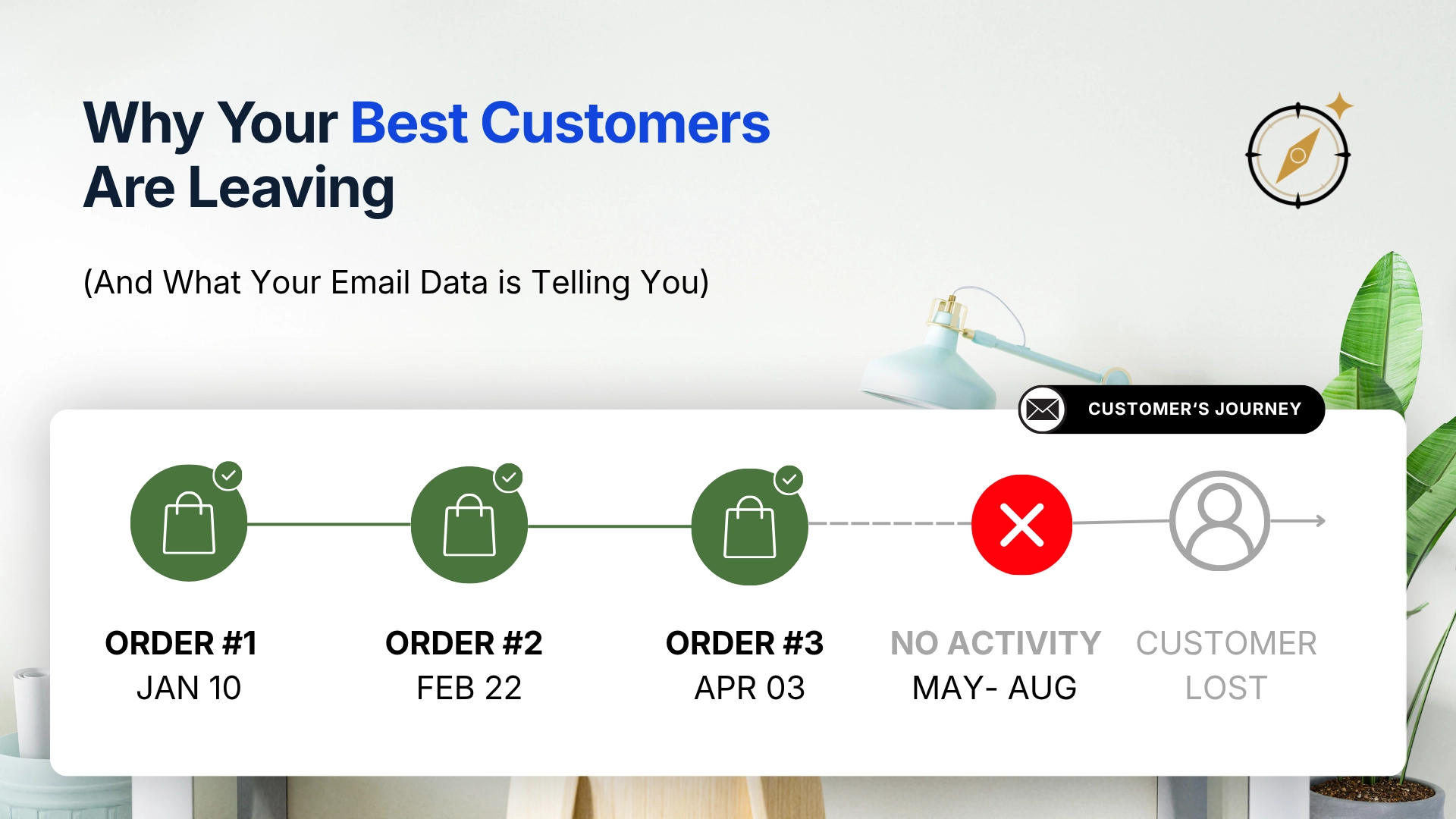
A customer buys on January 10, February 22, and April 3.
Historically, this customer buys every 40-60 days. If August arrives without another order, they are not just inactive. They are becoming an at-risk customer.
Waiting until December to react is usually too late. The useful intervention window was much earlier, when the purchase gap first started stretching beyond their normal pattern.
Signal 1: Email Engagement Drops Before Purchase Behavior Changes
Customers often stop engaging with email before they stop buying. Opens and clicks from a specific segment may decline 30-60 days before the purchase gap becomes obvious. This is the most actionable window.
What to check in Klaviyo: Build a segment of customers who have placed 2+ orders but have not opened or clicked any email in the last 45 days. If that segment is growing month over month, churn risk may be increasing.
Signal 2: Time Between Purchases Is Stretching
Every product category has a natural repurchase window – the typical time between order 1 and order 2 for customers who do come back. When you see a cohort approaching that window without purchasing, that is an early warning.
What to check in Shopify: Pull a customer cohort report. Look at what percentage of customers who bought in a given month returned within 60, 90, and 120 days. If those numbers are declining across consecutive cohorts, retention may be worsening.
Signal 3: Revenue From Your Top Segment Is Flat Or Declining
If you have a high-value customer segment built in Klaviyo, track the total revenue attributed to that segment month over month. A flat or declining number may mean the segment is shrinking, or the customers in it are buying less frequently.
Signal 4: Win-Back Flow Engagement Is Low
If your win-back flow has very low opens and clicks, it may mean customers are leaving earlier in the relationship than the win-back timing is designed to catch. It may also mean the win-back content is not compelling enough to pull attention back.
Signal 5: Campaign Engagement Stays Flat While List Size Grows
If subscriber growth increases but engagement from repeat customers stays flat or declines, existing customers may be disengaging while new subscribers temporarily mask the problem.
This is easy to miss because total sends, total opens, or total revenue may look stable. Segment-level engagement tells a clearer story.
The Churn Risk Segments Worth Building
Most Klaviyo accounts do not have churn risk segments. They have broad engagement segments, such as 30-day active or 90-day active, but nothing that specifically flags a high-value customer showing early signs of leaving.
These segments are worth building and monitoring monthly:
| Segment | Definition | Purpose |
|---|---|---|
| At-Risk VIPs | High-value customers, no purchase in 60-90 days | Early intervention before full churn |
| Disengaged Repeat Buyers | 2+ orders, no email engagement in 45 days | Re-engagement before the purchase gap widens |
| Lapsed High-Value | Top spenders, no purchase in 120+ days | Win-back campaign with higher-effort content |
| Champions | 3+ orders, purchased in last 90 days, engaged | Protect and reward. Do not over-market to these customers. |
The Champions segment is as important as the churn risk segments. These are your healthiest customer relationships. Over-mailing them, under-personalizing their experience, or treating them exactly like new subscribers is one of the fastest ways to push them toward the At-Risk bucket.
What Not To Do When A Good Customer Goes Quiet
The default response to customer churn, particularly in smaller ecommerce teams, is to send a discount: “We miss you. Here is 15% off.”
This approach has a few problems.
It trains customers to go quiet to get a deal. If the pattern repeats – disengage, receive discount, purchase, disengage again – you have created a discount-dependent relationship with your most valuable customers.
It does not address the reason they left. A discount does not fix irrelevant communication, poor timing, or a competitor who offered a better experience. It temporarily motivates a purchase without changing the underlying dynamic.
It is often too late. By the time a win-back discount hits a lapsed customer’s inbox, they may have already established a relationship with a competitor.
Discounts can have a place in win-back strategy, but they should usually be a later step, not the first move. The better approach is to re-engage with content that is relevant and timely before resorting to an incentive.
What To Do Instead: A Retention Framework For High-Value Customers
Retaining your best customers requires a different approach than retaining average customers. The communication they receive should reflect their history with the brand.
Step 1: Acknowledge The Relationship
High-value customers should receive different messaging than first-time buyers. This does not need to be elaborate. Even a small signal that the brand recognizes them changes the experience.
Klaviyo dynamic content blocks can help personalize email copy based on order count, lifetime value, or previous purchase behavior without building entirely separate flows.
Something as simple as “You have been with us since [first purchase date]” or “As someone who tried [product they bought], you might love [related product]” creates a more personal experience than a generic promotional blast.
Step 2: Create Reasons To Return That Match Their Purchase History
Rather than sending the same campaign to everyone, build campaigns that reference what a customer has already bought.
For example, a skincare brand sending a new arrivals campaign can segment it so customers who bought a specific moisturizer see recommendations that complement that product, instead of the same generic grid of bestsellers everyone else sees.
This is what relevant communication looks like in practice. It is not always technically complex. It requires intention.
Step 3: Time Outreach Around The Natural Repurchase Window
If you know that many repeat buyers place their second order between 45 and 75 days after their first, you can trigger a targeted email or flow around day 40 that is designed specifically for that decision window.
This timing should come from your own Shopify data whenever possible, rather than generic ecommerce benchmarks. Your category, price point, replenishment cycle, and product type all affect the right timing.
This is more useful than waiting for them to drift and then attempting a win-back.
In Klaviyo: Use a time-delay trigger after Placed Order to reach first-time buyers at the point in their timeline where a second purchase is most likely. This is different from a generic post-purchase flow. It is timed around behavior data, not just a fixed calendar.
Related: The Revenue You’re Losing Between First and Second Purchase
Step 4: Use A Graduated Re-Engagement Approach
For customers already showing signs of disengagement, a single re-engagement email rarely works. A graduated sequence is usually stronger:
| Step | Timing | Approach |
|---|---|---|
| Email 1 | Day 45 post-last-purchase | Soft check-in, relevant content |
| Email 2 | Day 60 | New arrivals or updated bestsellers |
| Email 3 | Day 75 | Direct ask: “Still interested?” with easy navigation back |
| Email 4 | Day 90 | Modest incentive as a final attempt |
| Suppression | Day 90+ no response | Move to suppressed or very low-frequency list |
The goal of each step is different. Early emails try to rebuild relevance. Later emails reduce friction. The final step acknowledges that continuing to email someone who is not responding can hurt deliverability without enough upside.
Step 5: Protect The Champions Segment Actively
The best retention strategy is not re-engaging churned customers. It is preventing churn in the first place. Your Champions segment – active, high-value, engaged – deserves the most intentional communication.
Consider:
- Giving them early access to new products before public announcement.
- Reducing promotional email frequency and increasing content email frequency.
- Sending campaigns that are distinctly different in tone from what the rest of the list receives.
This does not require a loyalty program or complex integration. It requires segmentation and different content decisions.
Klaviyo Implementation Checklist
Segments To Build
- Champions: 3+ orders, purchased last 90 days, email active.
- At-Risk VIPs: high lifetime value, no purchase in 60-90 days.
- Disengaged Repeat Buyers: 2+ orders, no email engagement in 45 days.
- Lapsed High-Value: top spenders, no purchase in 120+ days.
Flows To Audit Or Build
- Post-purchase flow: does it extend beyond 30 days for high-value customers?
- Repurchase timing flow: is there a trigger at the 45-60 day window for first-time buyers?
- Win-back flow: does it have a graduated structure with content first and incentive last?
- Sunset flow: are lapsed non-responders being suppressed instead of continuing to receive campaigns?
Campaign Behavior To Change
- Are high-value customers excluded from high-frequency promotional periods when appropriate?
- Are campaigns segmented so Champions receive different content than new subscribers?
- Is send frequency reviewed after heavy promotional periods, such as post-sale weeks?
Metrics To Track
| Metric | What To Watch For |
|---|---|
| Repeat purchase rate within 90 days | Declining performance may mean retention is weakening. |
| Champions segment size monthly | Shrinking may mean a retention problem is accelerating. |
| At-Risk VIP segment size monthly | Growing may mean churn risk is increasing. |
| Average time between purchases by cohort | Increasing may mean the natural repurchase window is widening. |
| Win-back flow open and conversion rate | Low performance may mean intervention timing is off or content is not relevant. |
| Revenue from top customer segment monthly | Flat or declining revenue may mean the high-value customer base is eroding. |
| Unsubscribe rate on campaign sends | Spikes may signal a frequency or relevance problem. |
Review these monthly alongside your standard flow metrics. The patterns across these numbers together tell a more complete story than any single metric can.
FAQ
How do I know if my churn rate is a problem or just normal?
Repeat purchase rates vary significantly by product category, price point, and purchase cycle. A consumable brand such as supplements, skincare, or food should expect a different repeat pattern than a furniture store. Rather than relying on broad industry averages, track your own cohort data over time. If the percentage of first-time buyers who return within 90 days is declining quarter over quarter, that is the signal to investigate.
What is the difference between a lapsed customer and an at-risk customer?
An at-risk customer is showing early warning signs but may still be recoverable through relevant communication. A lapsed customer has already moved beyond their normal purchase cycle and typically requires a dedicated re-engagement strategy.
Should I build a formal loyalty program to retain high-value customers?
A loyalty program can help, but it is not the first lever to pull. Many churn problems are caused by poor segmentation, generic communication, and bad timing. A points program does not fix those fundamentals. Get segmentation, flows, and relevance working first. If retention is still a problem after that, then a structured loyalty program becomes worth evaluating.
How often should I email my best customers?
This depends on your category and purchase cycle, but high-value customers are often the people most likely to disengage from repetitive promotional emails. A useful approach is to reduce promotional frequency for Champions and replace some of those sends with higher-quality, more relevant content. What “high-quality” means depends on your category, but it is usually less discount-heavy than what the rest of the list receives.
What is the right incentive to use in a win-back email?
Keep it modest and make it feel genuine rather than desperate. A small discount, free shipping, or relevant product gift with purchase can reduce friction without training customers to wait for aggressive discounts. Results vary by audience and category, so test different approaches with smaller segments before scaling.
What if my at-risk segment is very large?
If a large proportion of your past buyers fall into the at-risk or lapsed category, the issue is systemic. A single win-back campaign will not solve it. That usually points to a structural problem in the post-purchase journey: communication stops too early, campaigns are too generic, or the natural repurchase prompt is missing. Start by auditing your post-purchase flow and campaign segmentation before investing heavily in win-back campaigns.
Related Retention Guides
- The Revenue You’re Losing Between First and Second Purchase
- 7 Revenue Leaks I Find in Shopify Email Accounts
- Klaviyo Segmentation Mistakes That Hurt Open Rates
Review Method
This article is based on common Shopify and Klaviyo retention patterns. Individual results vary by product category, purchase cycle, customer behavior, list quality, and implementation quality. Use your own cohort, segment, and flow data before making major changes.
Key Takeaways
- Your best customers leave quietly. The warning signs are usually in your email engagement data before the purchase gap becomes obvious.
- Most churn comes from irrelevant communication, missing prompts to return, over-marketing, or a brand experience that stops evolving – not always product problems.
- Build churn risk segments in Klaviyo and monitor them monthly. A growing At-Risk VIP segment is an early warning you can act on.
- Do not default to discounts as a retention strategy. Re-engage with relevance first and use incentives as a later step.
- Protecting your Champions segment is usually more valuable than trying to recover customers who have already fully churned.
Last updated: June 2026. Platform features referenced are based on general Klaviyo and Shopify workflow patterns. Verify exact settings inside your own accounts before publishing changes.

Related guides
Best Email Marketing Software for Contractors (2026)
A practical comparison of Mailchimp, Constant Contact, Brevo, MailerLite, Kit, and field service marketing tools for contractors.
Best Email Marketing Software for Hair Salons & Spas (2026)
A practical comparison of Mailchimp, Constant Contact, Brevo, MailerLite, Kit, and booking-software marketing tools for salons and spas.
Best Email Marketing Software for Restaurants (2026)
A practical comparison of Mailchimp, Constant Contact, Brevo, MailerLite, Kit, and Toast Marketing for restaurant email marketing.