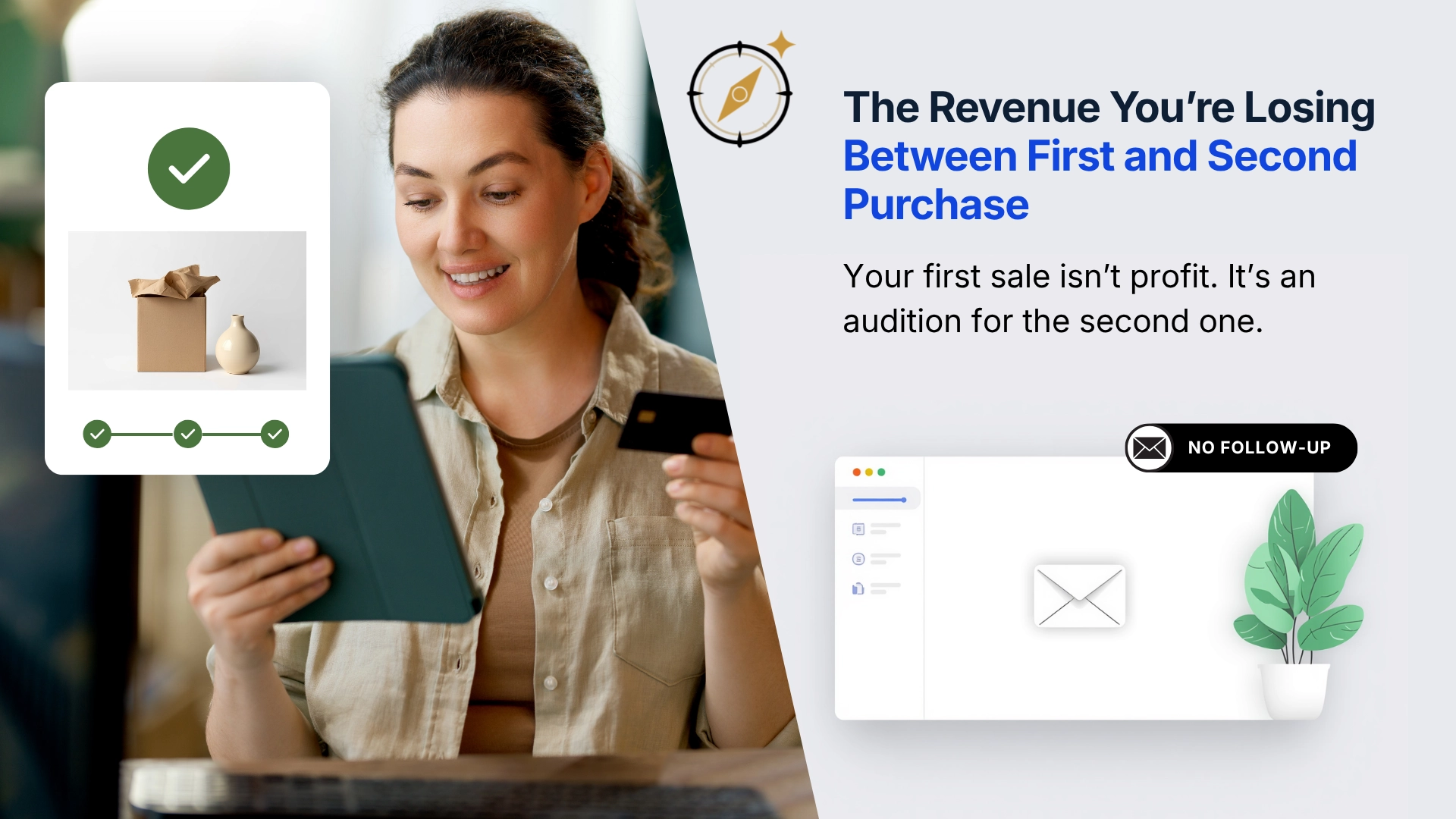
The Revenue You’re Losing Between First and Second Purchase
AT A GLANCE
The first sale is only the start. A better post-purchase system helps more first-time buyers become repeat customers.
Quick Summary
- Most Shopify stores focus heavily on acquiring new customers and much less on converting them into repeat buyers.
- The window between a customer’s first and second purchase is where revenue is often lost quietly.
- This is usually not a traffic problem. It is a post-purchase systems problem.
- A well-structured post-purchase email sequence in Klaviyo can improve the chance of a second purchase without increasing ad spend.
- This guide shows how to diagnose the gap, what causes it, and how to fix it with a practical retention framework.
Who This Guide Is For
This guide is designed for:
- Shopify store owners
- Ecommerce marketers using Klaviyo
- DTC brands with low repeat purchase rates
- Retention marketers and freelancers
- Stores with welcome and cart flows, but weak post-purchase follow-up
If you are spending to acquire first-time buyers but do not have a clear system for earning the second order, this is one of the first places to audit.
Introduction
Your first sale to a new customer costs money. Usually more than it looks like at first.
Between paid ads, creative costs, discounts, payment fees, and the time spent getting someone to trust the brand, many ecommerce stores break even or operate with thin margin on the first transaction. The stronger profit opportunity often comes from what happens next: the second purchase, the third purchase, and the repeat behavior that turns a one-time buyer into a valuable customer.
Most Shopify stores do not have a real system for that.
They send an order confirmation. Maybe a shipping update. Then nothing meaningful happens. No education. No product support. No reason for the customer to come back. The customer moves on, and the brand spends more money trying to find someone new.
That gap between the first and second purchase is one of the most expensive problems in ecommerce. It is also easy to miss unless you are looking for it.
This guide explains what happens inside that gap, why most founders miss it, and how to build a Klaviyo post-purchase system that gives customers a practical reason to buy again.
How This Problem Shows Up In A Shopify Store
Most store owners do not see this as a post-purchase problem at first. They see symptoms:
- Customer acquisition costs keep rising. More spend goes into ads, but margins do not improve.
- Revenue is inconsistent. Good months happen when promotions run. Quiet months happen when they do not.
- Klaviyo revenue feels lower than expected. Flows are live, but the numbers are not impressive.
- Repeat purchase rate is weak. A meaningful share of customers never comes back for a second order.
- Lifetime value plateaus. Average order value may be healthy, but customers are not buying again.
These are not always separate problems. In many stores, they point to the same issue: the post-purchase journey is missing, too short, or too focused on the wrong action.
What The Data Usually Shows
When reviewing Shopify and Klaviyo setups, a common pattern is:
- The welcome flow is running.
- The abandoned cart flow is active.
- The post-purchase flow either does not exist, stops after one email, or only contains a review request.
That last point matters. A review request is not a post-purchase strategy. It is one touchpoint. The customer needs help, context, reassurance, and a natural next step before the brand asks for more.
Related: Ecommerce Email Marketing Strategy Guide
Why Most Store Owners Miss This
This is not a laziness problem. Most founders and small ecommerce teams are genuinely busy. The post-purchase period also feels like it is already handled because the order confirmation and shipping emails are automated.
The real reasons this gap persists are more practical.
1. The Acquisition Mindset Dominates
When growth is tied to new customer volume, post-purchase retention gets treated as secondary. The assumption is: if they liked the product, they will come back.
Some will. Many will not without a useful reminder, a relevant recommendation, or a clear reason to return.
2. Klaviyo Flows Are Set Up For Conversion, Not Education
Most flows are built to drive an immediate action: purchase, click, coupon redemption, or review. Post-purchase sequences need a different goal. They should help the customer get value from what they bought, reduce buyer’s remorse, build trust, and create a reason to purchase again.
That requires a different kind of email. It is less aggressive and more helpful.
3. There Is No Clear Owner For Retention
In small ecommerce teams, everyone is responsible for growth, which often means no one owns what happens after the sale. Retention gets pushed to later because it feels less urgent than the next campaign, launch, or ad test.
4. Analytics Do Not Surface The Problem Clearly
Most store owners check traffic, conversion rate, revenue, and ROAS first. Repeat purchase rate and time to second purchase require a more deliberate look inside Shopify reports, Klaviyo customer data, or a spreadsheet export.
If you are not checking those numbers, you will not see the gap clearly.
Revenue Impact: What The Gap Is Costing You
Repeat customers are usually easier to convert than brand-new visitors. They already know the brand, have experienced the buying process, and have less uncertainty than a first-time customer.
When a first-time buyer never returns, you lose more than one order. You potentially lose:
- The second purchase revenue
- Future purchases from a customer who could have become loyal
- Referral value from a happy repeat buyer
- The chance to recover the acquisition cost already spent to win the first order
Here is a simple example.
If a store gets 500 new customers per month at an average order value of 2,000 INR or about $25, then every 5 percentage points of extra second-purchase conversion creates 25 additional repeat orders per month.
| Scenario | Calculation | Extra Monthly Revenue |
|---|---|---|
| 5 percentage point lift | 500 customers x 5% x 2,000 INR | 50,000 INR |
| 10 percentage point lift | 500 customers x 10% x 2,000 INR | 100,000 INR |
| 15 percentage point lift | 500 customers x 15% x 2,000 INR | 150,000 INR |
This is a rough estimate, not a guarantee. Results depend on product category, price point, margin, repurchase cycle, shipping experience, offer quality, and audience fit. But the logic is useful: improving second-purchase conversion can have a strong impact because the acquisition cost has already been paid.
Real-World Audit Checklist
Use this to diagnose where your post-purchase system currently stands.
| Area | Question | Good | Needs Work |
|---|---|---|---|
| Flow | Post-purchase flow live beyond order confirmation? | Yes | |
| Flow | More than two emails in the sequence? | Yes | |
| Content | Product education included? | Yes | |
| Content | Review request timed after product experience? | Yes | |
| Segmentation | First-time buyers separated from repeat buyers? | Yes | |
| Segmentation | Recent buyers excluded from aggressive promotions? | Yes | |
| Analytics | Repeat purchase rate tracked monthly? | Yes | |
| Analytics | Average time to second purchase reviewed? | Yes |
If several of these are missing, the gap between first and second purchase is probably a meaningful retention issue in your store.
How To Fix It: A Practical Post-Purchase Framework
The goal of your post-purchase system is not to “engage” customers in a vague way. It is to help them get value from the first purchase, build trust, and make the second purchase feel like a natural next step.
Here is a practical framework that works for many Shopify product categories.
Email 1: Confirmation + Brand Framing (Day 0-1)
This is often handled by Shopify. If you control the experience through Klaviyo, use it to go beyond logistics without selling too early.
Include:
- Order confirmation details
- One sentence on why the product is worth the wait
- A link to care instructions, usage tips, or an onboarding guide if relevant
- No hard upsell yet
Email 2: Product Education (Day 3-5)
This is one of the most underused emails in ecommerce.
Help the customer use what they bought. Include:
- How to get the best result from the product
- Common mistakes or setup tips
- A short video, diagram, or visual guide if helpful
- Light social proof, such as one useful review or customer quote
This email can reduce buyer’s remorse, reduce support questions, and build trust before the next sales message.
Email 3: Social Proof + Community (Day 7-10)
Reinforce the decision they already made. Show them other customers using or enjoying the product.
Include:
- Real customer photos or reviews if you have permission to use them
- A soft invitation to share their experience
- No hard sell
Email 4: Review Request (Day 10-14)
Now you ask. Not before.
Many brands ask for a review too early, sometimes before the customer has even received or used the product. The right timing depends on shipping speed and product type, but asking after the customer has had time to experience the product is usually more sensible.
Email 5: Cross-Sell Or Replenishment (Day 21-30)
This email gives the customer a natural next step.
- Consumables: replenishment reminder based on likely usage cycle.
- Apparel or accessories: complete-the-look or pairs-well-with recommendation.
- Digital or informational products: complementary product, upgrade, or next-level resource.
The recommendation should feel useful, not forced.
Email 6: Win-Back (Day 45-60, If No Second Purchase)
If the customer has not bought again, this is a structured reactivation attempt.
Use a clear reason to return: new arrivals, seasonal relevance, a helpful recommendation, or a modest incentive if margin allows it. Keep the tone honest. Avoid fake urgency.
Related: How to Improve Klaviyo Welcome Flow Performance
Klaviyo Implementation
Segments To Build
| Segment | Definition | Purpose |
|---|---|---|
| First-Time Buyers | Placed exactly 1 order | Feed into post-purchase messaging |
| Second-Time Buyers | Placed 2+ orders | Exclude from first-time buyer messaging |
| High-Value Customers | Top customers by lifetime spend | Trigger VIP treatment or loyalty content |
| Lapsed First-Time Buyers | 1 order, no repeat in 60+ days | Win-back targeting |
| Active Repeat Buyers | 2+ orders, recent order activity | Loyalty campaigns and retention content |
Flows To Build Or Audit
Post-Purchase Flow
Trigger: placed order, filtered to first-time buyers. Length: 5-6 emails over roughly 45-60 days. Goal: drive second purchase while improving product experience.
Replenishment Flow
Trigger: product-specific timing based on average usage cycle. Works best for consumables with predictable reorder patterns.
Win-Back Flow
Trigger: no purchase after 60 or 90 days, depending on your product cycle. Keep this separate from broader win-back messaging when possible.
Metrics To Monitor In Klaviyo
| Metric | Why It Matters |
|---|---|
| Revenue per recipient | Measures flow efficiency |
| Second purchase conversion rate | Core metric for this problem |
| Average days to second purchase | Shows whether timing is realistic |
| Flow revenue over 30/60/90 days | Tracks overall retention impact |
| Unsubscribe rate by email | Flags timing or content problems |
Check these monthly, not only when revenue looks weak.
Common Mistakes When Trying To Fix This
Sending too many emails too fast. A 10-email sequence over 14 days can create fatigue instead of loyalty. Space the messages around the customer’s real product experience.
Turning post-purchase into a promotional sequence. Discounting too early can train customers to wait for offers. Save incentives for later reactivation if needed.
Asking for reviews too early. Day 2 is often too early if the product has not arrived or has not been used. Match review timing to shipping and product usage.
Letting repeat buyers enter first-time buyer messaging. Bad segmentation makes the brand feel careless. First-time buyers and repeat buyers need different communication.
Measuring only immediate conversions. Some post-purchase impact appears 60-90 days later. Review second purchase rate and time to second purchase, not just week-one revenue.
Related: Klaviyo Segmentation Mistakes That Hurt Open Rates
Metrics To Track
Build a simple monthly report with these six numbers:
- Repeat purchase rate: what percentage of customers place a second order within your chosen time window?
- Time to second purchase: how long does it usually take from order 1 to order 2?
- Post-purchase flow revenue: how much revenue is the flow generating per month?
- Revenue per recipient: how efficiently does each email perform?
- Customer lifetime value: is 12-month LTV improving over time?
- Lapsed buyer rate: what percentage of first-time buyers never come back?
These numbers show whether your retention system is working or leaking.
FAQs
How long should a post-purchase flow be?
There is no universal answer, but many stores benefit from a 5-6 email sequence spread over 45-60 days. High-ticket or complex products may need more touchpoints. Simple consumables with short usage cycles may need fewer.
Should I offer a discount in my post-purchase flow?
Generally, not early in the sequence. A discount in email 1 or 2 can condition customers to wait for offers before buying again. If you use an incentive, it often makes more sense in the win-back stage after a meaningful period without a second order.
What if my product is not replenishable?
A replenishment flow only makes sense for consumables. For other categories, focus on cross-selling complementary products, introducing new arrivals, giving usage ideas, or building community. The goal is still to give the customer a reason to return.
How do I know if my post-purchase timing is right?
Pull your average time to second purchase from Klaviyo or Shopify analytics. Also compare your email timing against average shipping time. If your second email arrives before the customer has received or used the product, the timing is probably off.
Does this apply to Shopify stores with low traffic?
Yes. Low-traffic stores usually cannot afford to lose repeat buyers. Retention becomes more important when acquisition volume is limited.
Related Email Marketing Guides
- Ecommerce Email Marketing Strategy Guide
- Klaviyo Segmentation Mistakes That Hurt Open Rates
- How to Improve Klaviyo Welcome Flow Performance
- How to A/B Test Klaviyo Subject Lines
Key Takeaways
- The gap between first and second purchase is where many Shopify stores lose repeat revenue.
- Post-purchase email sequences are often underdeveloped, even in stores that use Klaviyo well.
- The fix is not more discounts or more emails. It is a better-timed sequence built around the customer’s actual product experience.
- Segmentation is critical. First-time buyers need different messaging than repeat buyers.
- Measure repeat purchase rate and time to second purchase monthly. If you are not tracking the gap, you will not see when it improves or worsens.
Practical Action Plan
Do this in the next 30 days:
Week 1: Audit Your Current State
Pull your repeat purchase rate from Shopify Analytics or Klaviyo. Calculate what percentage of first-time buyers placed a second order within 90 days.
Week 1: Review Your Post-Purchase Flow
Check how many emails it has, when they send, and whether anyone is entering the flow who should not be there.
Week 2: Build Or Rebuild Product Education
Create one email that genuinely helps the customer use the product better. This is usually the most underused email in the sequence.
Week 2: Fix The Review Request Timing
If you are asking before day 10, review whether the customer has realistically received and used the product by then.
Week 3: Set Up A Lapsed Buyer Segment
Create a segment for customers who placed one order but have not returned after your chosen time window, such as 60 or 90 days.
Week 4: Add A Cross-Sell Or Replenishment Email
Based on your product category, create one email that gives buyers a natural next step.
Ongoing: Track The Six Key Metrics Monthly
Review repeat purchase rate, time to second purchase, flow revenue, revenue per recipient, customer lifetime value, and lapsed buyer rate.
Conclusion
Most Shopify brands put nearly all of their energy into acquiring the first sale. The second sale, which is often cheaper and more predictable, gets much less attention.
That is the gap. And it is fixable.
You do not need a complex tech stack or a dedicated retention team to start. You need a clear post-purchase flow, clean first-time buyer segmentation, and a consistent process for reviewing what is working.
Start with the audit checklist. Within 30 minutes, you should know where your biggest post-purchase gap is.
Last updated: June 2026. Platform features referenced are based on general Klaviyo and Shopify workflow patterns. Verify exact settings inside your own accounts before publishing changes.

Related guides
Best Email Marketing Software for Contractors (2026)
A practical comparison of Mailchimp, Constant Contact, Brevo, MailerLite, Kit, and field service marketing tools for contractors.
Best Email Marketing Software for Hair Salons & Spas (2026)
A practical comparison of Mailchimp, Constant Contact, Brevo, MailerLite, Kit, and booking-software marketing tools for salons and spas.
Best Email Marketing Software for Restaurants (2026)
A practical comparison of Mailchimp, Constant Contact, Brevo, MailerLite, Kit, and Toast Marketing for restaurant email marketing.