The Hidden Cost of Sending Campaigns to Everyone on Your Shopify Email List
AT A GLANCE
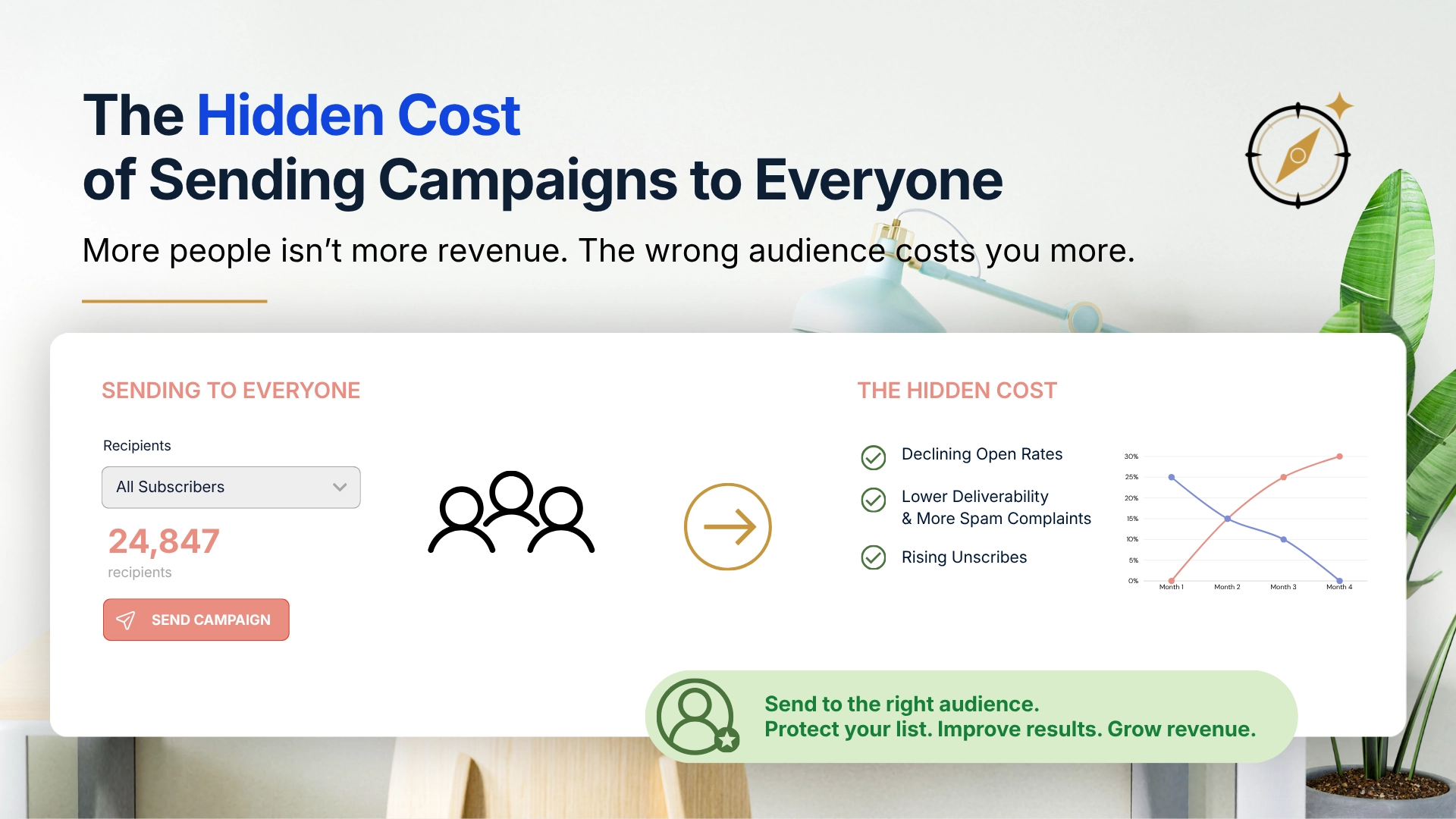
Full-list campaign sends can look efficient, but they often weaken deliverability and relevance. Segmenting protects the email channel over time.
Quick Summary
- Sending every campaign to your full subscriber list is one of the most common and quietly costly habits in Shopify email marketing.
- The costs are threefold: weaker engagement signals, wasted effort on uninterested contacts, and lower relevance for the subscribers who matter most.
- The fix is not complicated. It is a targeting discipline that adds a few extra minutes to each campaign send and compounds over time.
- This guide explains what happens when you hit send to all, how to measure the damage, and how to build a segmented sending practice that protects list health.
Introduction
There is a moment before every campaign send where many email marketers make the same quiet mistake.
The email is written. The design looks clean. The subject line feels right. Then, when it comes to the recipient field, they select the most obvious option: all subscribers, all customers, or the full list.
It feels like the responsible choice. More recipients means more reach. More reach means more opportunity. Why would you deliberately send to fewer people?
Because more people is not the same as more of the right people. In email marketing, sending to the wrong people does not just produce no result. It can make the next sends harder to deliver, harder to measure, and harder to trust.
This is the hidden cost many Shopify store owners do not fully account for: not only the obvious cost of one campaign underperforming, but the compounding cost of what list-blasting does to sender reputation, subscriber relationships, and long-term email performance.
This article explains what is actually happening when you send to everyone, how to measure the damage already done, and what a disciplined segmented sending practice looks like in Klaviyo.
What “Sending to Everyone” Actually Means
In most Klaviyo accounts, everyone is not a clean, homogeneous group. It is a mix of people at very different stages of their relationship with the brand:
- Subscribers who signed up last week and have not bought yet.
- Customers who purchased once two years ago and have not engaged since.
- Loyal repeat buyers who open almost every email.
- Contacts who have never opened a message but have not unsubscribed.
- People who bought during a sale and came for the discount, not the brand.
- Recent purchasers who completed an order three days ago.
- Subscribers acquired from a giveaway who may not have genuine interest in the product.
Every one of these people receives the same email: the same subject line, offer, call to action, and timing.
Most of them are not the right audience for that message. Some should actively be excluded, such as recent purchasers who just bought the product being promoted or unengaged contacts whose non-response will drag down your engagement signals.
25,000 subscribers
- 5,000 highly engaged subscribers.
- 7,000 occasionally engaged subscribers.
- 4,000 recent customers.
- 3,000 lapsed customers.
- 6,000 unengaged contacts.
Most campaigns are only relevant to a portion of this audience. That is why the full list can look like reach while behaving like noise.
The Three Real Costs of List Blasting
Not every campaign needs highly restrictive targeting. Large seasonal sales, major product launches, and important business announcements may justify broader sends.
The issue is making send to all the default rather than the exception. Broader distribution can be useful when there is a clear reason for it. It becomes expensive when it replaces normal campaign targeting.
Cost 1: Deliverability Damage
This is the most significant cost, and the one many store owners do not notice until it is already affecting performance.
Inbox providers evaluate sender reputation based on how recipients interact with emails. When you send to a large list that includes a high proportion of unengaged contacts, the aggregate engagement signal can look weak:
- Low open rates can signal that recipients do not find your emails worth opening.
- Low click rates can signal that even openers do not find the content relevant.
- Spam complaints can damage sender reputation, especially when they repeat across campaigns.
- High bounce rates from stale or invalid addresses can compound the problem.
These signals are not always visible immediately. They accumulate in the background. Over time, inbox providers may adjust filtering decisions based on those patterns. The result is that future emails, including ones sent to engaged subscribers, may be less likely to reach the inbox cleanly.
This is why a store can see open rates declining month over month without an obvious change in content quality. The list-blasting habit may have been weakening engagement signals in the background.
Deliverability thresholds and platform policies can change. Check Klaviyo’s current deliverability guidance and your own dashboard before acting on any specific complaint-rate threshold. The practical principle is stable: engagement quality matters more than raw reach.
Cost 2: Wasted Marketing Effort and Spend
Every email you send to a disengaged contact is effort with very little chance of return.
In Klaviyo, costs may be influenced by active profiles, email volume, or the plan structure you are on. Sending to thousands of unengaged or irrelevant contacts means you may be paying in time, resources, and platform usage to reach people who are unlikely to convert.
More importantly, it means the effort that went into writing, designing, and scheduling the campaign is partially wasted. The same creative work aimed at a more relevant audience can be much more useful because the message-to-recipient match is tighter.
The instinct is, “I paid for these contacts, so I should reach all of them.” The reality is that repeatedly reaching unengaged contacts can cost more than it returns once deliverability and list health are included in the calculation.
A store sends a campaign to 20,000 contacts. Only 6,000 have opened an email in the last 90 days. The remaining 14,000 generate little engagement while still contributing weak or negative deliverability signals.
The campaign appears larger, but the effective audience is much smaller.
Cost 3: Eroded Relevance With the Subscribers Who Matter
This is the subtlest cost, but it matters for retention.
Your best subscribers, the engaged customers who open, click, and buy regularly, are receiving the same content as everyone else. The same promotions aimed at lapsed contacts. The same generic subject lines designed for people who barely know the brand. The same cadence calibrated for the average of a highly mixed list.
Over time, this erodes the experience for the subscribers most worth keeping. A customer who bought three times in the past year may start noticing that emails feel impersonal, repetitive, or disconnected from what they have already bought.
They may not unsubscribe immediately. They just open less, click less, and buy less often. The engagement gap widens until they drift into an at-risk category, not because they disliked the brand, but because the communication never made them feel recognized.
How to Measure the Damage Already Done
Before fixing the habit, get a clear picture of current list health. These four checks are a practical starting point.
Check 1: Engaged vs. Total List Ratio
In Klaviyo, build a segment for people who opened or clicked any email in the last 90 days. Compare that segment’s size to your total subscriber count.
As a general estimate, if your engaged segment is meaningfully smaller than your total list, a large portion of your current sending volume may be reaching people unlikely to respond. The exact healthy ratio depends on your niche, acquisition sources, list age, and send frequency.
Check 2: Open Rate Trend Over 12 Months
Pull campaign open rate data for the past 12 months. Look at the directional trend, not one isolated month.
A gradual decline over time can be a deliverability signal, a content signal, a list-quality signal, or a mix of all three. If you have been sending to an unfiltered list consistently, the trend line is worth taking seriously.
Note: Apple Mail Privacy Protection can inflate open rates for some recipients. If open rates look healthy but clicks, revenue, or replies are weak, interpret open-rate data carefully.
Check 3: Spam Complaint Rate
Check your Klaviyo deliverability dashboard for spam complaint rates on recent campaigns. Warning flags, rising complaints, or repeated complaints across large sends can indicate that the list-blasting habit is contributing to poor list health.
Check 4: Revenue per Recipient vs. List Size
As your list grows, revenue per recipient should not collapse if targeting quality is improving. If your list is growing but revenue per recipient is declining, you may be adding contacts faster than you are qualifying them.
This metric is one of the clearest signs that list growth without targeting discipline is becoming a vanity metric rather than a business asset.
| Metric | What It Indicates |
|---|---|
| Engaged Segment Growth | More qualified subscribers entering the active audience. |
The Segmented Sending Framework
The solution to list-blasting is not simply sending fewer emails. It is sending the right emails to the right people.
The Five Audience Buckets
Before every campaign, identify which bucket the send is designed for and build the recipient segment accordingly.
| Audience Bucket | Definition | Use Case |
|---|---|---|
| Highly Engaged | Opened or clicked in the last 30 days | Launches, important announcements, high-priority sends. |
| Engaged | Opened or clicked in the last 90 days | Most standard promotional campaigns. |
| Warm Non-Purchasers | Subscribed, no purchase, some engagement | First-purchase education or conversion campaigns. |
| Lapsed Customers | Purchased before, but no recent engagement | Re-engagement and soft win-back campaigns. |
| Cold or Unengaged | No meaningful engagement in 180+ days | Final re-engagement before suppression. |
Most promotional campaigns should go to an engaged segment, not the full list. Win-back campaigns should go to lapsed or cold contacts. Your best customers should rarely receive the same send as your cold contacts.
Standard Exclusions for Every Campaign Send
Regardless of audience bucket, these exclusions should become normal practice.
Always consider excluding:
- Recent purchasers, usually people who bought in the last 7-14 days depending on what you are promoting.
- Anyone currently in an active abandoned cart or post-purchase flow.
- Suppressed, unsubscribed, or bounced addresses. Klaviyo handles much of this automatically, but it is still worth checking list hygiene.
Exclude situationally:
- High-value active customers from heavy promotional blasts. Send them a differentiated version instead.
- Contacts in the middle of a win-back sequence, so you do not interrupt the sequence with an unrelated campaign.
The 10-Minute Pre-Send Checklist
- Who is this campaign actually for? Be more specific than “our customers.”
- Which named segment am I sending to?
- Who should be excluded?
- Is the content relevant to this specific audience?
- What is the expected recipient count? If it matches the full list size, double-check the targeting.
This checklist takes a few minutes. It prevents a habit that can compound in cost for years.
Building the Core Segments in Klaviyo
These are the segments worth having permanently built and maintained.
Engagement Segments
Highly Engaged, 30-day: opened or clicked email in the last 30 days. Use this for launches, important announcements, and first sends in a campaign series.
Engaged, 90-day: opened or clicked email in the last 90 days. Use this for standard promotional campaigns and most regular sends.
Warm Non-Purchasers: has not placed an order and opened or clicked in the last 60 days. Use this for first-purchase campaigns and product education.
Lapse and Re-Engagement Segments
Lapsed, recent: last purchase or engagement was roughly 90-180 days ago. Use this for soft win-back campaigns.
Lapsed, cold: no open, click, or purchase in 180+ days. Use this for a final re-engagement attempt before suppression.
Purchase-Based Segments
Recent Purchasers, exclude: placed an order in the last 14 days. Use this as a common suppression segment for promotional sends.
First-Time Buyers: exactly one order placed. Use this for second-purchase campaigns and post-purchase education.
Repeat Buyers: two or more orders placed. Use this for loyalty content, early access, and higher-value campaign targeting.
Once these segments are built, targeting each campaign takes minutes instead of hours.
What Happens to Your Metrics When You Segment Properly
The shift after moving to segmented sending varies by store, list size, list quality, and how long the list-blasting habit has been running.
What often improves:
- Open rates, because you are reaching people more likely to engage.
- Click rates, because the content is more relevant to the audience receiving it.
- Revenue per recipient, because targeting quality improves.
- Deliverability signals, because inbox providers see stronger engagement over time.
- Unsubscribe rates, because relevant communication usually produces fewer annoyed subscribers.
What may appear to decline initially:
- Raw reach numbers, because you are sending to fewer people per campaign.
- Total campaign revenue from a single send, because smaller send volume can reduce absolute revenue in the short term.
This is why many store owners resist segmentation. A campaign sent to 20,000 people may generate more total revenue than the same campaign sent to 8,000, even if the smaller audience produces better revenue per recipient.
The better long-term metric is email channel health over time: revenue per recipient, repeat engagement, unsubscribes, complaints, deliverability, and repeat purchase behavior.
How Long Does It Take to Recover Deliverability?
If list-blasting has been the norm for a long time, deliverability recovery is not instant. Inbox providers adjust filtering decisions gradually based on sustained engagement signals.
A general recovery timeline may look like this, but results vary significantly by list size, complaint history, sending volume, mailbox-provider mix, and current reputation:
- 30 days: engagement metrics may begin improving on targeted sends.
- 60-90 days: inbox placement may begin improving as sustained engagement signals accumulate.
- 90-180 days: sender reputation may improve for stores with moderate damage.
- 6-12 months: deeper recovery may be needed for lists with significant historical deliverability issues.
Recovery timelines vary significantly depending on complaint history, list quality, sending frequency, and inbox provider mix. These timeframes are general estimates, not guarantees.
The recovery timeline is usually better when combined with list cleaning, such as suppressing contacts who have not opened or clicked in a long period after a re-engagement attempt.
Common Mistakes When Transitioning to Segmented Sending
Treating segmentation as a one-time setup. Segments need to be reviewed as the list evolves. Review definitions quarterly, especially if acquisition sources or send frequency change.
Building segments but still defaulting to all subscribers under time pressure. Segmentation discipline only works if it is consistently applied. Put the pre-send checklist directly inside the campaign workflow.
Segmenting the audience but not the content. Sending generic content to a well-defined segment only solves half the problem. The targeting and message should work together.
Suppressing too aggressively too quickly. Moving too fast can shrink send volume before better acquisition and engagement have filled the gap. Phase it in with smart targeting, re-engagement, then suppression of non-responders.
Ignoring list growth quality. If you keep adding low-quality subscribers through unrelated giveaways, purchased lists, or incentives that attract the wrong audience, the problem replenishes itself.
FAQ
Won’t sending to fewer people just reduce my total revenue?
In the very short term, a smaller send volume can mean lower absolute revenue from that campaign. But over time, segmented sending can protect deliverability, improve relevance, and reduce list fatigue. Optimize for email channel health and revenue over months, not only one campaign’s reach.
How do I handle a large sale event?
For major sale events, you can send to a broader audience than a standard campaign, but broader still does not have to mean everyone. Send to your engaged segment first, exclude recent purchasers, and consider a separate version for high-value customers.
Should I ever send to my full list?
Occasionally, yes. Major sales, major product launches, or important business announcements may justify broader distribution. Even then, exclusions such as recent purchasers, suppressed contacts, and people in active flows should still apply.
Should I suppress contacts who were once engaged but have gone cold?
Not immediately. Run a re-engagement campaign first. Contacts who engage can move back into the active audience. Contacts who do not respond after one or two attempts can usually be suppressed with more confidence.
Does segmentation matter if my list is small?
Yes. A small list is sensitive to engagement quality. A few hundred unengaged contacts can still weaken aggregate engagement signals. Small lists benefit from good targeting and list hygiene early.
How do I know when my segmentation is good enough?
A practical baseline is this: your main campaign audience is usually an engaged 90-day segment, recent purchasers are excluded from promotional sends, and win-back campaigns only go to genuinely lapsed contacts. From there, product-interest and purchase-category segments can add more precision.
Key Takeaways
- Sending campaigns to the entire list can damage engagement signals, waste effort on uninterested contacts, and weaken relevance for valuable subscribers.
- The damage is cumulative. It can show up as declining open rates, lower revenue per recipient, more unsubscribes, and deliverability issues.
- The fix is a targeting discipline, not a platform change. Build core segments, add standard exclusions, and run a pre-send checklist before every campaign.
- Revenue per recipient matters more than total recipients reached. A smaller, better-matched audience can be healthier for the email channel than a broad mixed send.
- Deliverability recovery takes time. The sooner the habit changes, the easier the recovery usually is.
Practical Action Plan
This Week
- Build your engaged 90-day segment in Klaviyo if you do not have it already.
- Pull your current engaged-to-total list ratio. If the engaged audience is much smaller than the total list, prioritize list health.
- Check your last three campaign sends. Were they sent to the full list? Pull revenue per recipient for each as your baseline.
In the Next 30 Days
- Send your next campaign to the engaged 90-day segment only, with recent purchasers excluded.
- Build the core segments from this article and name them consistently.
- Add the pre-send checklist to your campaign brief or approval workflow.
In the Next 90 Days
- Run a re-engagement campaign for contacts who have not engaged in 90-180 days. Suppress non-responders after the sequence completes.
- Review Klaviyo’s deliverability dashboard monthly. Watch complaint rates, bounce rates, and engagement trends.
- Assess list acquisition quality. Check whether new subscribers are coming from sources likely to produce genuinely interested contacts.
Related Guides
- Why Discounts Are Hiding Bigger Problems in Your Shopify Store
- The Most Valuable Segment Most Shopify Stores Don’t Have
- 7 Revenue Leaks I Find in Shopify Email Accounts
- Why Your Best Customers Are Leaving
Review Method
This guide is based on common Shopify and Klaviyo email marketing patterns. Exact thresholds, recovery timelines, and segment definitions depend on your category, list quality, sending history, purchase cycle, and current Klaviyo account data. Verify current Klaviyo deliverability guidance before making major suppression or sending-policy changes.
Conclusion
Sending to everyone feels like doing more. In practice, it often produces less: less engagement, less relevance, weaker deliverability, and eventually less confidence in email as a channel.
The stores that get the most from email marketing are not always the ones with the biggest lists. They are the ones with the healthiest lists, where most contacts are genuinely interested and campaigns reach people likely to respond.
That shift does not require a sophisticated analytics setup or a dedicated email team. It requires consistent targeting, a few well-maintained segments, and the willingness to send to the right people instead of everyone.
The value compounds from the first targeted send.
Last updated: June 2026. Platform features referenced are based on general Klaviyo and Shopify workflow patterns. Verify exact settings inside your own accounts before publishing changes.

Related guides

Best Email Marketing Software for Contractors (2026)
A practical comparison of Mailchimp, Constant Contact, Brevo, MailerLite, Kit, and field service marketing tools for contractors.
Best Email Marketing Software for Hair Salons & Spas (2026)
A practical comparison of Mailchimp, Constant Contact, Brevo, MailerLite, Kit, and booking-software marketing tools for salons and spas.
Best Email Marketing Software for Restaurants (2026)
A practical comparison of Mailchimp, Constant Contact, Brevo, MailerLite, Kit, and Toast Marketing for restaurant email marketing.