Why Discounts Are Hiding Bigger Problems in Your Shopify Store
AT A GLANCE
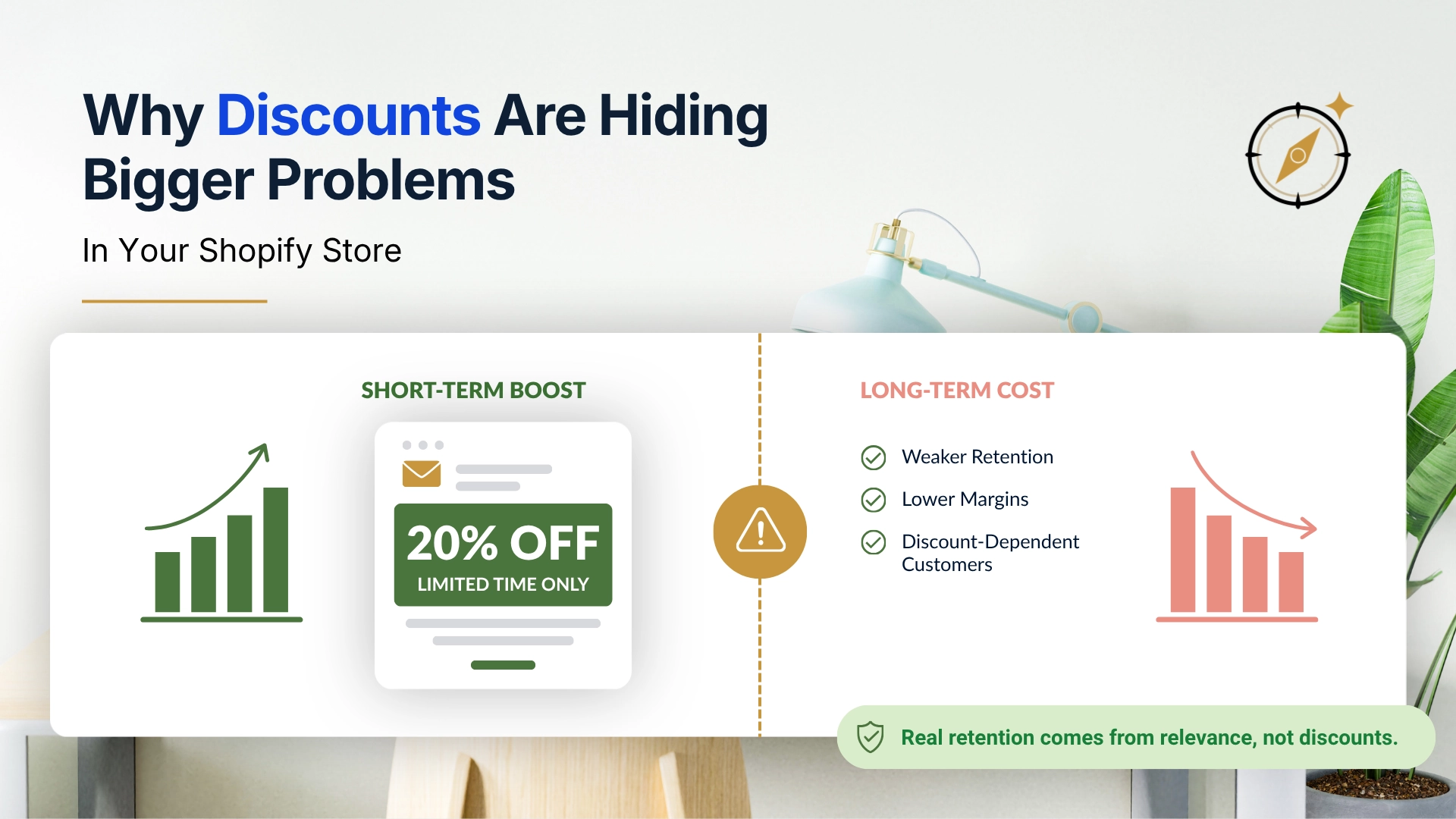
Discounts can lift revenue quickly, but they often hide deeper retention problems. Build the systems that make offers less necessary.
Quick Summary
- Discounts can generate short-term revenue, but they often mask structural problems in segmentation, flows, and customer communication.
- When discounts become the default retention tool, they can train customers to wait for offers, erode margins, and attract buyers who only return with an incentive.
- The underlying problems discounts tend to hide, such as weak post-purchase sequences, poor segmentation, and irrelevant campaigns, are fixable without sacrificing margin.
- This article covers what discounts can and cannot do, what problems they typically conceal, and what to build instead.
Introduction
Discounts work. That is the problem.
When a store runs a sale, revenue spikes. Open rates go up. Conversion rates improve. The numbers look good for a week, sometimes two. Because discounts work in the short term, they often become the go-to tool whenever revenue needs a lift.
Slow month? Send a discount. Abandoned cart recovery not converting? Add a coupon. Win-back campaign underperforming? Increase the offer. Retention feeling weak? Run a loyalty sale.
Each decision can feel reasonable on its own. Together, they create a pattern that is quietly expensive: a customer base trained to wait for offers, a margin structure dependent on promotions, and a set of retention problems that never get diagnosed because the discount is always there to cover them.
The goal of this article is not to argue that discounts are always wrong. They are not. But in many Shopify stores, they are used as a first resort when they should be a later one. In the process, they obscure problems that may be costing more than the discount itself.
What Discounts Actually Do and Don’t Do
Before diagnosing what discounts hide, it is worth being precise about what they actually accomplish.
What discounts do well:
- Lower the barrier to a first purchase for price-sensitive customers.
- Create genuine urgency during seasonal or clearance events.
- Recover a subset of genuinely price-motivated cart abandoners.
- Reward loyalty when used deliberately and sparingly for high-value customers.
- Move excess inventory at a controlled cost.
What discounts do not do:
- Build brand loyalty on their own.
- Solve a segmentation problem.
- Fix a weak post-purchase sequence.
- Improve deliverability.
- Create relevance where there is none.
- Turn a one-time discount buyer into a repeat customer by default.
The distinction matters because many stores use discounts for goals they are not suited to. A coupon in a win-back email does not fix the reason the customer stopped engaging. A discount in a welcome flow does not replace brand storytelling and product education. An abandoned cart incentive does not address why the customer abandoned if the real issue was trust, not price.
The 5 Problems Discounts Most Commonly Hide
Not every store that uses discounts has a discount dependency problem. The issue appears when promotions become the primary mechanism for driving revenue rather than one tool among many.
Problem 1: A Broken or Missing Post-Purchase Sequence
When a store has no meaningful post-purchase communication, customers buy, receive their order, and hear nothing until the next promotional email arrives. The store then interprets the silence as “customers need more incentive to come back” and adds a coupon to the next campaign.
But the real problem is not always the price point. It is often the absence of communication during the window when the customer was most receptive: the 7 to 30 days after their first purchase when they are using the product, forming their opinion, and deciding whether the brand is worth returning to.
A discount can temporarily pull a lapsed customer back. A well-built post-purchase sequence helps keep them from lapsing in the first place.
What to look for: If your repeat purchase rate is low and your primary re-engagement tool is a discount code, the post-purchase sequence is likely one of the underlying problems.
Problem 2: Campaigns Going to the Wrong Audience
Sending the same promotional campaign to your entire subscriber list produces mediocre overall results. The aggregate open rate and conversion rate look uninspiring, so the instinct is to add a stronger offer.
But the offer is not always the problem. The audience may be.
An engaged subscriber who has been considering a purchase for two weeks may not need a 20% discount to convert. They may need the right message at the right time. An unengaged subscriber who has not opened an email in four months may not convert reliably regardless of the offer size.
What to look for: If you keep increasing discounts to improve campaign performance but click rates and conversion rates are not improving proportionally, segmentation is worth fixing before the offer.
Problem 3: Deliverability Issues Suppressing Reach
A store with deliverability problems sends campaigns that do not reliably reach the inbox. Open rates look low. Campaign revenue underperforms. The response is often to make the subject line more compelling or the offer more aggressive.
Neither fix helps much if the emails are not reaching the inbox in the first place.
Discount-heavy subject lines can also push emails further into promotional filtering. The fix that seems logical, a bigger offer or louder subject line, can compound the underlying problem.
What to look for: If open rates have declined gradually over 6-12 months despite consistent content quality, investigate deliverability before adjusting the discount strategy further.
Problem 4: A Discount-Conditioned Customer Base
This develops slowly, which is why it is easy to miss.
When a store relies on promotional emails as its primary campaign type, customers learn the pattern. They start to anticipate it. They delay purchases because an offer is probably coming. They wait for the final cart recovery coupon. They hold out for the win-back discount.
The store interprets this as “customers only respond to discounts.” But the communication pattern trained them to behave that way.
One clear warning sign: customers buy during every sale but rarely purchase between promotions.
The diagnostic question is simple: if you sent a campaign with no discount, what would happen? In a healthier email program, a well-targeted, relevant campaign can still generate meaningful revenue without an incentive.
What to look for: Compare revenue per recipient on discount campaigns versus non-discount campaigns. If non-promotional campaigns generate almost no revenue, discount conditioning may have set in.
Problem 5: Weak Brand Positioning and Value Communication
Sometimes a store over-relies on discounts because it has not clearly communicated why its products are worth full price.
When customers cannot understand why one brand is worth more than a cheaper alternative, price becomes the primary decision factor. Discounts temporarily remove that friction, but they do not build the case for full-price loyalty.
Product education, brand story, behind-the-scenes communication, and customer proof all build value perception over time. This might include ingredient education, styling advice, setup tutorials, customer stories, or behind-the-scenes product development.
It is slower than a coupon, but it creates a different kind of customer: one who buys because they understand the product, not only because the math worked that week.
What to look for: If your email content is mostly offers, sales, and product pushes, the brand value case is not being made consistently.
What Discounting Actually Costs: The Margin Arithmetic
It is worth being direct about the financial side of discount dependency because it is often underestimated.
Product price: ₹2,000
Gross margin: 50%
Full price sale: ₹2,000 revenue and ₹1,000 margin.
20% discount: ₹1,600 revenue and ₹600 margin.
Margin lost: 40%.
A 20% discount does not cost only 20% of revenue. In this simplified example, it costs 40% of the margin on that transaction. At scale, across a large portion of the customer base, the compounding effect on profitability can be significant, especially when many of those discounted purchases might have happened at full price with better communication and timing.
This is not an argument against discounting. It is an argument for understanding the cost before making it the default tool.
The Discount Decision Framework
Not all discounts are equal. Use this practical framework to decide when a discount is the right tool and when it may be masking a deeper problem.
Discounts are best used for: seasonal sales, inventory clearance, final-stage win-back attempts, and occasional loyalty rewards.
Discounts are not best used for: fixing segmentation, replacing post-purchase flows, solving deliverability problems, or driving every campaign.
| Scenario | Is a Discount Appropriate? | What to Consider |
|---|---|---|
| First-time purchase incentive | Yes, with limits | Keep it modest. Do not lead with the maximum discount. |
| Abandoned cart recovery, email 1 | No | Try relevance and trust signals first. |
| Abandoned cart recovery, final email | Sometimes | Only if earlier emails did not convert. |
| Post-purchase cross-sell | No | Relevance and timing should do the work here. |
| Win-back, early emails | No | Content and relevance first. |
| Win-back, final email | Yes, modest | Use as a later attempt after content failed. |
| Seasonal sale or clearance | Yes | This is a legitimate use case. |
| Campaign to entire list | Question the premise | Fix segmentation first. |
| Cold subscriber re-engagement | Maybe | A modest incentive can work, but clean the list too. |
| High-value customer retention | Rarely | These customers often need recognition more than price incentives. |
What to Build Instead: A Non-Discount Retention Stack
If discounts have been the primary retention tool, replacing them does not mean removing all offers immediately. It means building the communication infrastructure that makes offers less necessary over time.
1. A Structured Post-Purchase Sequence
The strongest replacement for a “come back and here is a coupon” email is a post-purchase sequence that keeps the customer engaged during the 45-60 days after their first purchase.
Related: What Happens After a Customer Buys?
2. Segmented Campaigns That Match Communication to Audience
A campaign sent to the right audience with relevant content can outperform a heavily discounted campaign sent to the wrong people. Better segmentation reduces the need for offers to compensate for poor targeting.
Related: The Most Valuable Segment Most Shopify Stores Don’t Have
3. Content That Builds the Case for Full-Price Value
Product education emails, behind-the-scenes content, customer stories, and transparent brand communication all build value perception. Customers who understand why your product is worth what it costs are less dependent on discounts to justify a purchase.
4. Timing-Based Triggers Instead of Offer-Based Triggers
A well-timed replenishment email does not always need a discount. A cross-sell email that references what the customer bought can be more relevant than a generic percentage-off blast.
5. Genuine VIP Treatment for Your Best Customers
Your high-value active customers do not necessarily need a bigger discount. They need to feel recognized. Early access, personalized recommendations, and communication that acknowledges their history can build loyalty without costing margin.
How to Wean a Discount-Conditioned List Off Offers
If your customer base has already been conditioned to expect discounts, pulling back requires a deliberate transition rather than a sudden stop.
Step 1: Reduce, do not eliminate. Move from weekly promotional sends to bi-weekly and use the space between for educational, brand-building, or product storytelling emails.
Step 2: Mix in value-based campaigns at full price. Run a campaign for a product you believe in, with strong copy and a clear reason to buy, without a discount. Track revenue per recipient.
Step 3: Reserve discounts for genuine occasions. Use discounts for real seasonal clearance, a genuine milestone sale, or a thoughtful loyalty reward instead of weekly revenue pressure.
Step 4: Build the alternative infrastructure in parallel. Build the post-purchase sequences, segmentation, and content calendar that make discounts less necessary.
Metrics to Watch During the Transition
| Metric | What You Are Looking For |
|---|---|
| Percentage of campaigns using discounts | Should decline over time without hurting revenue. |
| Revenue per recipient, non-promotional campaigns | Should improve as content quality and targeting improve. |
| Gross margin per email-attributed sale | Should increase as discount frequency decreases. |
| Repeat purchase rate, non-discounted buyers | Customers acquired without a discount may have different retention profiles. |
| Unsubscribe rate on content campaigns | High unsubscribes may mean the list was acquired primarily for deals. |
| Abandoned cart recovery rate without discount | Baseline for email 1 before adding incentive later. |
| Win-back conversion rate, content vs discount email | Helps show what is actually driving recovery. |
FAQ
Can a store become too dependent on discounts?
Yes. A common warning sign is when revenue drops sharply every time promotions stop. Healthy retention systems continue generating sales between major offers because customers buy for reasons beyond price alone.
Are welcome discounts worth it? Does every Shopify store need one?
Welcome discounts are common because they lower the barrier to a first purchase. The question is how large and how prominent the offer should be. A deep welcome discount can attract price-sensitive buyers who churn quickly. A smaller offer, supported by brand context and product education, may attract a different type of subscriber. Test both approaches and compare the retention profile of customers acquired each way.
What if our category is highly price-competitive?
Price-competitive categories make this harder, not impossible. The goal is to create enough brand differentiation through communication, education, and customer experience that price becomes one factor among several rather than the only one.
Our abandoned cart recovery rate is low. Should we add a discount to the first email?
Not immediately. First check whether the email arrives quickly enough, references the specific product left behind, and addresses common objections such as shipping cost, returns, trust, or social proof. If those are in place and conversion is still low, test a modest incentive in the second or third email.
How do we know if we have conditioned customers to expect discounts?
Run two comparable campaigns in the same month: one with a discount and one without, to similar audience segments. Compare revenue per recipient. If the non-discount campaign generates very little revenue compared with the discount campaign, conditioning may be a factor.
Is it ever appropriate to give high-value customers a discount?
Yes, but context matters. A discount offered as a genuine loyalty reward or early access moment feels different from the same coupon sent to the entire list. Use discounts with this segment sparingly and frame them as recognition rather than mass promotion.
Key Takeaways
- Discounts work in the short term but often mask deeper problems: missing sequences, poor segmentation, weak brand communication, and deliverability issues.
- When discounts become the default retention tool, they can condition customers to wait for offers, erode margins, and attract buyers who churn when the incentive disappears.
- A discount can cost a much larger percentage of margin than the headline percentage suggests.
- The alternative is not removing every offer. It is building post-purchase sequences, segmentation, content strategy, and timing-based triggers that make offers less necessary.
- Use discounts deliberately: for real seasonal moments, as a later win-back step, or as a thoughtful reward, not as the default answer to every retention challenge.
Practical Action Plan
This Week
- Pull your last 10 campaign sends and count how many included a discount or promotional offer.
- Compare average revenue per recipient on your last 3 discount campaigns versus your last 3 non-discount campaigns.
- Review your abandoned cart flow. Check whether a discount appears in email 1 or is reserved for a later send.
In the Next 30 Days
- Replace one promotional campaign with a content-focused email and track engagement and revenue per recipient.
- Add a suppression to your next discount campaign that excludes customers who purchased within the last 14 days.
- Audit your welcome offer. Check whether the discount is supported by brand context and value communication.
In the Next 90 Days
- Build or strengthen the non-discount retention infrastructure: post-purchase sequence, segmentation, and content calendar.
- Test abandoned cart email 1 without a discount for 30 days. Add a modest incentive later only if the first emails underperform.
- Set a target for the ratio of promotional to non-promotional campaigns. A practical starting point is no more than 60% offer-driven sends, then adjust based on your category and audience data.
Related Retention Guides
- The Most Valuable Segment Most Shopify Stores Don’t Have
- Why Your Best Customers Are Leaving
- 7 Revenue Leaks I Find in Shopify Email Accounts
- What Happens After a Customer Buys?
- The Revenue You’re Losing Between First and Second Purchase
Review Method
This guide is based on common Shopify and Klaviyo retention patterns. Exact discount strategy depends on product margins, category norms, list quality, customer acquisition source, purchase cycle, and implementation quality. Use your own revenue, margin, and retention data before changing discount policy.
Conclusion
Discounts are a tool. Like most tools, they work well when used for the right job at the right time and poorly when they become a habit applied to every situation.
The stores that over-rely on discounts are usually not doing it because they believe it is the best strategy. They do it because discounts produce visible short-term results, while the underlying problems are harder to see until margin erosion and customer conditioning become too large to ignore.
The fix is structural. Build the sequences that keep customers engaged without requiring an offer. Segment campaigns so the right message reaches the right person. Communicate value consistently enough that full-price purchases feel reasonable to your audience.
That is what durable retention looks like. It is slower to build than a sale. It lasts longer too.
Last updated: June 2026. Platform features referenced are based on general Klaviyo and Shopify workflow patterns. Verify exact settings inside your own accounts before publishing changes.

Related guides

Best Email Marketing Software for Contractors (2026)
A practical comparison of Mailchimp, Constant Contact, Brevo, MailerLite, Kit, and field service marketing tools for contractors.
Best Email Marketing Software for Hair Salons & Spas (2026)
A practical comparison of Mailchimp, Constant Contact, Brevo, MailerLite, Kit, and booking-software marketing tools for salons and spas.
Best Email Marketing Software for Restaurants (2026)
A practical comparison of Mailchimp, Constant Contact, Brevo, MailerLite, Kit, and Toast Marketing for restaurant email marketing.