What Happens After a Customer Buys?
AT A GLANCE
The post-purchase gap is where many first-time buyers quietly drift. A better sequence helps turn the first order into a real customer relationship.
Quick Summary
- The period immediately after a purchase is one of the highest-leverage windows in the customer relationship, and many Shopify stores waste it.
- What typically happens: order confirmation, shipping notification, then silence until the next promotional campaign.
- What should happen: a structured post-purchase sequence that educates, builds trust, requests feedback at the right time, and creates a natural path back to the store.
- This is not about sending more emails. It is about sending the right emails at the right moments, when the customer is most receptive.
- This article covers what the post-purchase window should look like, how to build it in Klaviyo, and what most brands get wrong.
Introduction
Think about the last time you bought something online from a brand you had not tried before.
You placed the order. You got a confirmation email. You got a shipping notification. Then, if the brand was like many Shopify stores, you heard nothing until they sent a sale announcement two months later, addressed to you like you were a stranger.
That gap in the middle is where the customer relationship either takes root or quietly disappears.
The post-purchase window, roughly the 60 days after a customer’s first order, is one of the most underutilized periods in ecommerce email marketing. It is when the customer is attentive, waiting for their product, curious about the brand they just trusted, and forming an impression that will shape whether they ever buy again.
Many brands fill that window with nothing.
This article is about what should happen after a customer buys, why it matters more than many founders realize, and how to build a post-purchase system that strengthens the relationship instead of letting it fade.
What Most Shopify Stores Actually Do After a Sale
When reviewing post-purchase setups across Shopify stores, the same pattern appears consistently.
While every store is different, a recurring pattern appears:
- Order confirmations are configured correctly.
- Shipping notifications are active.
- Product education is missing.
- Review timing is poorly aligned.
- No structured path exists toward the second purchase.
What exists:
- An order confirmation, usually sent automatically by Shopify.
- A shipping notification, also typically Shopify-native.
- Sometimes a delivery confirmation.
What is missing:
- Any communication between delivery and the next promotional campaign.
- Product education or usage guidance.
- A check-in that acknowledges the customer had a real experience with the product.
- A review request timed appropriately, not on day two and not two months later.
- A natural bridge to the second purchase.
The result is a customer who receives their order, has a decent experience with the product, and then gets re-added to the general campaign list. They receive the same promotional emails as someone who subscribed yesterday and has never bought anything.
That is not a retention strategy. It is a missed opportunity that compounds every month.
Why the Post-Purchase Window Is Your Highest-Leverage Period
There is a practical reason to focus here before any other part of the email system.
At the moment of purchase and in the days immediately following, the customer is:
- Paying attention. They are tracking their order and checking their inbox for updates.
- Emotionally invested. They have committed money to your product, which creates a natural openness to information about how to get the most from what they bought.
- Forming a lasting impression. The first few weeks with a product, and the communication that surrounds it, can shape whether a customer feels good about their decision or develops quiet buyer’s remorse.
- More receptive to relevant cross-sell. A customer who just bought and had a positive experience is more likely to consider a complementary product than a cold subscriber who has not tested your brand yet.
For many ecommerce brands, the first order covers acquisition costs. The second order is often where the customer relationship starts becoming significantly more profitable.
These dynamics are not present at the same intensity at every other point in the customer lifecycle. The post-purchase window is different, and treating it like an afterthought is a common ecommerce revenue mistake.
What Should Actually Happen After a Customer Buys
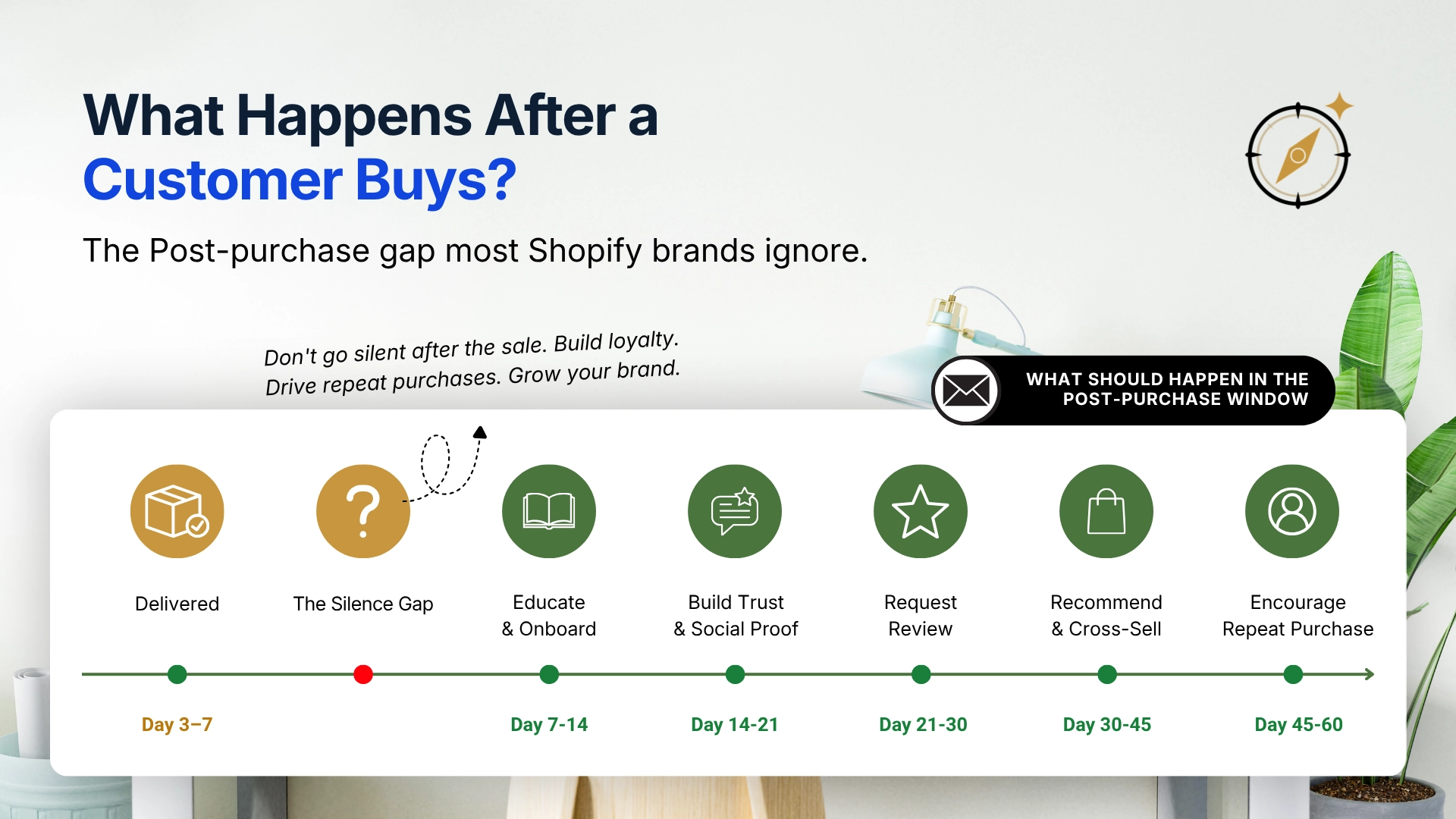
Here is a practical framework for structuring the post-purchase window. The timing below is a general guide. Adjust it based on your average shipping time, product type, and purchase cycle.
Day 0: Order Confirmation
Day 3-5: Shipping / Pre-Delivery
Day 7-10: Product Education
Day 10-14: Social Proof
Day 14: Review Request
Day 21-30: Cross-Sell
Day 45-60: Win-Back
Phase 1: The Delivery Window, Day 0 to Day 7
This phase is about logistics and first impression. The customer is waiting for their order. Every touchpoint during this period shapes their expectation.
Day 0-1: Order Confirmation
Most stores handle this through Shopify’s native system, which is fine for the logistics content. If you control this email through Klaviyo, you can go slightly beyond transactional content.
A small addition that works well: one sentence that reframes the wait. Something like “Here is what to look for when your order arrives” or “A quick note on getting the most from [product]” starts the relationship on a more personal footing.
Day 3-5: Pre-Delivery or Shipping Update
If your shipping times are longer than 5 days, a mid-shipping check-in can reduce “where is my order” support contacts and create another useful brand touchpoint during the waiting period.
This email does not need to be elaborate. A shipping update with one piece of useful information, such as setup tips or what to have ready, is enough.
Phase 2: The Usage Window, Day 7 to Day 21
This is the most underused phase. The customer has received their product. They are using it. They are forming their real opinion.
Day 7-10: Product Education Email
This is one of the most impactful emails many stores are missing. Its purpose is simple: help the customer get more value from the product they just bought.
Depending on your category, this might look like:
- A “how to get the most from [product]” guide for a skincare or supplement brand.
- Care instructions and styling tips for an apparel brand.
- Setup and integration guidance for a tech or home goods brand.
- Recipe or usage ideas for a food brand.
The customer is actively engaging with the product right now. An email that helps them use it better arrives at the right moment, reduces buyer’s remorse, and builds goodwill.
Day 10-14: Social Proof and Community
Once the customer has had a week or two with the product, reinforcing their decision with social proof serves a different purpose than pre-purchase social proof.
Pre-purchase social proof answers: “Can I trust this brand?” Post-purchase social proof answers: “Did I make a good decision?”
This email can show real customers, real reviews, user-generated content, or a simple invitation into the brand community.
Phase 3: The Relationship Window, Day 14 to Day 45
The product has been received and used. The customer’s initial excitement has settled into a normal relationship with the brand. This phase is about deepening that relationship and creating a reason to return.
Day 14: Review Request
This is where many stores get the timing wrong. They ask too early, before the product has arrived or been used meaningfully, or wait so long that the customer has forgotten the details of the experience.
Day 14 is a reasonable general timing for physical products with a 3-7 day shipping window. For products with a longer experience curve, such as supplements or skincare, push this later. Match the timing to when the customer can honestly evaluate what they bought.
Day 21-30: Cross-Sell or Replenishment
By this point, the customer has had a complete experience with the product. If it went well, this is a natural window for a second purchase prompt.
Structure this email around relevance, not pressure. For replenishment products, frame it around the usage timeline. For non-replenishment products, frame it around what naturally complements what they bought.
Day 45-60: Win-Back if No Second Purchase
If the customer has not returned by this point, a gentle re-engagement is worth attempting before they drift further.
Keep this email short. Acknowledge it has been a while. Give them a clear, easy reason to return: new arrivals, a seasonal hook, or a modest incentive if nothing else has worked. Avoid manufacturing urgency that is not real.
If this email does not produce engagement, move the customer to a lower-frequency list. Continuing to email someone who is not responding at full campaign frequency can hurt deliverability without enough upside.
The Complete Post-Purchase Sequence at a Glance
| Timing | Purpose | Goal | |
|---|---|---|---|
| Order Confirmation | Day 0 | Logistics + brief brand note | Set expectations |
| Shipping or Pre-Delivery | Day 3-5 | Update + useful context | Reduce anxiety, add value |
| Product Education | Day 7-10 | Help them use the product | Reduce remorse, build trust |
| Social Proof + Community | Day 10-14 | Reinforce purchase decision | Loyalty, engagement |
| Review Request | Day 14 | Gather authentic feedback | Social proof, insight |
| Cross-Sell or Replenishment | Day 21-30 | Create path to second purchase | Revenue, retention |
| Win-Back | Day 45-60 | Re-engage if no second purchase | Recover drifting customers |
Building This in Klaviyo
The Trigger
Use the Placed Order metric as your flow trigger. This fires when a purchase is completed, regardless of whether the customer is new or returning.
Add a filter at the flow entry point to separate first-time buyers from repeat buyers. The sequence described here is designed for first-time buyers. Repeat buyers should have a different, shorter acknowledgment that does not send them through messaging designed for someone who does not know the brand yet.
Filter to add at entry: Number of orders placed equals 1. This keeps the flow focused on first-time buyers.
Key Flow Settings to Configure
Smart sending: Turn off smart sending for the first email if it is used for order confirmation. It should send regardless of whether the customer received another email recently. For subsequent emails, smart sending can stay on.
Recipient exclusions: Suppress anyone who has placed a second order from receiving the cross-sell and win-back emails. There is no reason to send a “haven’t heard from you” message to someone who already came back.
Exit conditions: If a customer places a second order at any point during the sequence, exit them from the remaining first-time buyer flow and route them into a repeat buyer sequence instead.
Segments to Build Alongside the Flow
| Segment | Definition | Use |
|---|---|---|
| In Post-Purchase Flow | Placed 1 order, order in last 60 days | Monitor who is currently in the sequence |
| Post-Purchase Converted | Placed 2+ orders within 60 days of first | Track second-purchase conversion rate |
| Post-Purchase Not Converted | Placed 1 order, 60+ days ago, no second purchase | Feed into broader win-back efforts |
| Second Purchase Achieved | 2+ orders within 90 days | Measure retention improvement |
These segments give you a clear picture of how the flow is performing structurally, not just at the individual email level.
Metrics to Monitor in Klaviyo
| Metric | What It Tells You |
|---|---|
| Flow revenue over 30 days | Whether the sequence is generating meaningful attributed revenue |
| Revenue per recipient by email | Which emails in the sequence drive purchases |
| Second-purchase conversion rate within 60 days | Whether first-time buyers are returning after the sequence |
| Review request click rate | Whether the review ask timing is right for your audience |
| Cross-sell email conversion rate | Whether the product recommendation is relevant and well-timed |
| Win-back email open rate | Whether the sequence is catching people before they fully disengage |
Check these monthly. A low revenue per recipient on the cross-sell email usually means the recommendation is not relevant or the timing is off. A low review request click rate often means the ask arrived before the customer had enough experience with the product.
Common Mistakes in Post-Purchase Sequences
Treating order confirmation as the entire post-purchase experience. Many brands assume Shopify notifications are sufficient. They are necessary. They are not a retention strategy.
Asking for a review too early. A review request on day 2, before the product has arrived, can feel tone-deaf and transactional. Wait until the customer has genuinely experienced the product.
Making every email a sell. The post-purchase window builds goodwill only if some communication is genuinely about the customer’s experience, not the next promotion.
Sending repeat buyers through the same flow as first-time buyers. A customer on their fourth order does not need a brand introduction. Build filters that recognize purchase history.
Not personalizing the cross-sell. A generic “you might also like” grid is usually weaker than a recommendation that references what the customer actually bought.
Ending the sequence too early. A 14-day post-purchase flow catches the early window but misses the 30-45 day period when the customer may be making the next purchase decision.
Ignoring the sequence after it is built. Product lines change. Shipping times shift. The review timing that worked 18 months ago may not work now. Review the sequence quarterly.
What Good Post-Purchase Communication Actually Feels Like
The standard is simple: when a customer receives one of these emails, they should feel like the brand is paying attention to where they are in their experience, not just sending messages on a timer.
That means:
- The education email arrives when the product has likely been delivered, not before.
- The review request arrives when they have had enough time to form a real opinion.
- The cross-sell references what they bought, not just what the brand wants to sell.
- The tone across the sequence feels consistent and human, not template-heavy and corporate.
None of this requires advanced personalization technology. It requires deliberate timing, relevant content, and the discipline to treat the post-purchase period as a distinct phase of the customer relationship.
FAQ
Do I need Klaviyo to build a post-purchase sequence, or can I use Shopify Email?
You can build a basic post-purchase sequence in Shopify Email, but Klaviyo gives you more control over segmentation, flow filters, exit conditions, A/B testing, and revenue attribution. For stores serious about email as a retention channel, Klaviyo is usually the more capable tool. That said, even a simple 3-email post-purchase sequence in Shopify Email is better than no sequence at all.
How long should the post-purchase sequence be?
For many Shopify stores, 5-6 emails spread over 45-60 days is a practical starting point. For products with longer usage cycles, such as supplements, skincare, or high-consideration purchases, extending to 8-10 emails over 90 days can be appropriate. Start with the core sequence and expand based on what the data shows.
Should post-purchase emails stop after the first month?
Usually no. The ideal duration depends on shipping time, product type, repurchase cycle, and customer behavior. Many stores benefit from maintaining light-touch communication through the first 60-90 days, especially when the second purchase window is longer than 30 days.
Should every email in the sequence have a discount or incentive?
No. A post-purchase sequence that leads with discounts trains customers to expect them. Reserve any incentive for the win-back email at day 45-60, and only if the customer has not returned. The earlier emails should earn the next purchase through relevance and trust, not price reduction.
What if my product does not have obvious education content?
Every product has something worth communicating after purchase. A clothing brand can share care instructions and styling suggestions. A home goods brand can share installation tips or complementary decor ideas. A gift brand can share how to present or package the item. Think about what question the customer is most likely to have in the first week of owning your product, and answer it.
How do I know if my post-purchase sequence is working?
Track two numbers first: second-purchase conversion rate and revenue attributed to the post-purchase flow. Set a baseline before making changes. Review quarterly. If the second-purchase rate is improving across cohorts, the sequence is doing its job.
Key Takeaways
- The 60 days after a first purchase are one of the highest-leverage periods in the customer relationship, and many Shopify stores send almost nothing during that window.
- A post-purchase sequence is not about filling the inbox. It is about sending the right communication at the right moment.
- First-time buyers and repeat buyers should be in different sequences.
- Timing matters more than frequency. A sequence that sends fewer emails at the right moments can outperform a high-frequency sequence with poorly timed sends.
- Review and update the sequence quarterly. A flow built for one product line or shipping window may not fit changes that happen later.
Practical Action Plan
This Week
- Open Klaviyo and check whether you have a post-purchase flow beyond order confirmation.
- If a flow exists, count the emails and map their timing. Note any gaps, especially between day 7 and day 30.
- Check whether first-time buyers and repeat buyers are being filtered correctly at the flow entry point.
In the Next 30 Days
- Build or add the product education email at day 7-10. This is often the highest-impact single email stores are missing.
- Fix the review request timing if it is currently on day 1 or day 2. Move it to day 14 or later when appropriate.
- Add exit conditions so customers who place a second order mid-sequence are removed from the first-time buyer flow.
In the Next 90 Days
- Extend the sequence to include a cross-sell or replenishment email at day 21-30.
- Add the win-back email at day 45-60 for customers who have not returned.
- Build the three monitoring segments: in-flow, converted, and not converted. Start tracking second-purchase conversion rate by cohort.
Related Retention Guides
- The Revenue You’re Losing Between First and Second Purchase
- 7 Revenue Leaks I Find in Shopify Email Accounts
- Why Your Best Customers Are Leaving
Review Method
This article is based on common Shopify and Klaviyo post-purchase retention patterns. Exact timing and results vary by product category, average shipping time, purchase cycle, customer behavior, list quality, and implementation quality. Use your own Shopify and Klaviyo data before making major changes.
Conclusion
Most stores think about email marketing in terms of campaigns: what to send, when to send it, and how to get the open. That lens misses some of the most valuable communication a brand can send: the emails that follow a first purchase and help determine whether that customer ever comes back.
The post-purchase window does not require a large team or a complex automation stack. It requires a clear understanding of what a customer experiences after they buy, and a deliberate system for staying relevant during that experience.
Order confirmation. Product education. Social proof. A well-timed review ask. A natural path to the next purchase.
That is the sequence. It is not complicated. But many stores still are not building it.
Last updated: June 2026. Platform features referenced are based on general Klaviyo and Shopify workflow patterns. Verify exact settings inside your own accounts before publishing changes.

Related guides

Best Email Marketing Software for Contractors (2026)
A practical comparison of Mailchimp, Constant Contact, Brevo, MailerLite, Kit, and field service marketing tools for contractors.
Best Email Marketing Software for Hair Salons & Spas (2026)
A practical comparison of Mailchimp, Constant Contact, Brevo, MailerLite, Kit, and booking-software marketing tools for salons and spas.
Best Email Marketing Software for Restaurants (2026)
A practical comparison of Mailchimp, Constant Contact, Brevo, MailerLite, Kit, and Toast Marketing for restaurant email marketing.