The 9 Email Marketing KPIs That Actually Matter for Shopify Stores
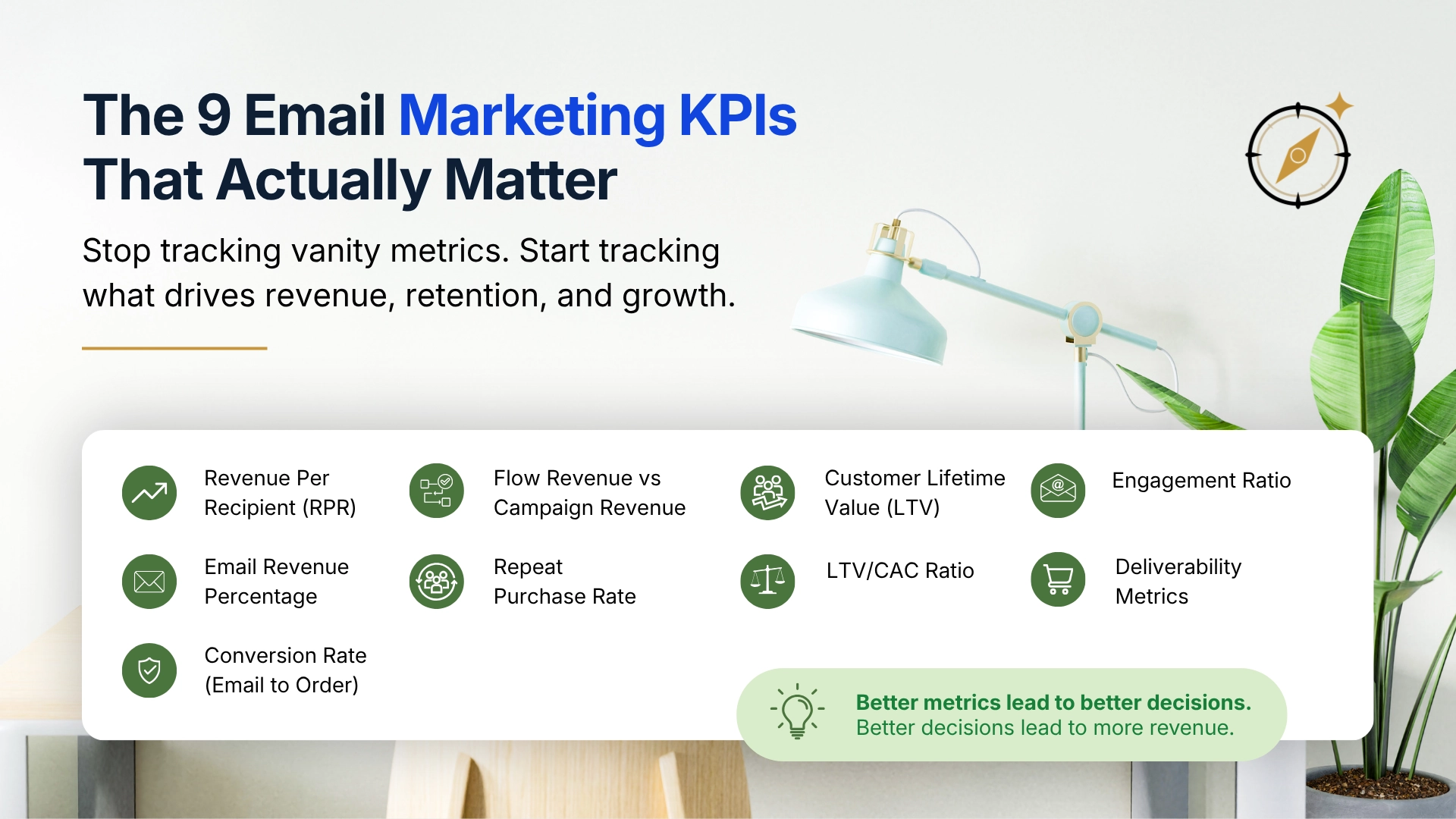
AT A GLANCE
The strongest email reporting setup connects campaign activity to revenue, retention, LTV, acquisition efficiency, and deliverability health.
Quick Summary
- Open rates and click rates are useful signals, not business metrics.
- The KPIs that actually matter connect email activity to revenue, retention, and customer value.
- Revenue Per Recipient, Repeat Purchase Rate, and Flow Revenue are among the most undertracked metrics in Shopify stores.
- LTV:CAC Ratio tells you whether your acquisition and retention systems are working together.
- Deliverability metrics matter more than most brands realise because poor inbox placement quietly kills performance.
Introduction
Most Shopify stores track their email performance the same way: open rates, click rates, unsubscribes. The dashboard looks healthy. Campaigns go out. The numbers move.
But email revenue stays flat.
The issue is not that those metrics are wrong. It is that they are incomplete. Open rates tell you whether a subject line worked. They do not tell you whether your email programme is actually building a business.
This article covers the 9 email marketing KPIs that give Shopify store owners a clearer, more useful picture of performance, from revenue attribution to customer lifetime value to deliverability health. If you are already past the basics and want to track what actually drives decisions, this is where to start.
Why Most Shopify Stores Track the Wrong Email Metrics
There is nothing wrong with monitoring open rates or click-through rates. They are useful for diagnosing individual campaigns and spotting engagement trends.
The problem is when they become the primary measure of success.
A 45% open rate on a campaign that generated no sales is not a win. A 22% open rate on a flow that consistently drives repeat purchases may be exactly what you want. The headline metric looks worse. The business outcome is better.
Shifting focus toward revenue and retention metrics changes how you evaluate your email programme and what you decide to improve.
The 9 Email Marketing KPIs That Actually Matter
Business Health
LTV:CAC
↓
Customer Lifetime Value
↓
Repeat Purchase Rate
↓
Email Revenue %
↓
Flow Revenue
↓
Revenue Per Recipient
↓
Conversion Rate
↓
Engagement Ratio
↓
Open Rate / Click Rate
The higher you move up this hierarchy, the closer the metric gets to actual business performance. Open and click rates still matter, but they are signals, not the final outcome.
1. Revenue Per Recipient (RPR)
Revenue Per Recipient measures how much revenue a campaign or flow generates for every person it is sent to. It normalises performance across sends of different sizes, which makes it one of the most useful comparison metrics available.
How to calculate it:
Total email revenue / total recipients = RPR
If a campaign sent to 10,000 subscribers generates GBP 2,000, your RPR is GBP 0.20.
RPR is particularly useful for comparing flows against campaigns, or for evaluating whether a segment is worth continuing to engage. A small, highly targeted segment with a strong RPR often outperforms a broad send, even with far fewer recipients.
Benchmarks vary by industry, product price point, and send frequency. Treat your own historical data as the most relevant reference.
2. Email Revenue Percentage
This metric answers a simple question: what share of total store revenue comes from email?
How to calculate it:
Email revenue / total store revenue x 100
For many Shopify stores with an established email programme, email contributes a meaningful share of total revenue. A commonly cited range is 20-40%, though actual results vary significantly based on product category, traffic sources, customer lifecycle, attribution settings, and programme maturity.
Your own historical performance is usually a more useful benchmark than any industry average.
If email is contributing very little, it often signals one of three things: underinvestment in flows, poor list health, or weak segmentation.
If the number looks unusually high, it is worth reviewing whether the attribution window is inflating performance. This is a common issue when email attribution settings are too generous.
3. Flow Revenue vs Campaign Revenue Split
Flows, or automated sequences, and campaigns, or one-off sends, serve different purposes. Tracking them separately gives you a clearer picture of where your email revenue is actually coming from.
Flows tend to be more consistent. They run in the background, target people at specific moments in their journey, and do not require ongoing effort to generate revenue. A well-built abandoned cart flow or post-purchase sequence will produce revenue every week without a single manual send.
Campaigns are higher-effort and more variable. They require planning, execution, and a healthy enough list to send to regularly.
A programme that leans entirely on campaigns for revenue is usually one that has not invested enough in automation. A programme where flows generate a stable base of revenue, with campaigns adding volume on top, is generally in better shape.
4. Repeat Purchase Rate
Repeat Purchase Rate measures the percentage of customers who come back and buy again. It is a direct indicator of how well your retention systems are working.
How to calculate it:
Customers with 2+ orders / total customers x 100
In many ecommerce categories, the second purchase is one of the strongest signals of long-term customer value. A customer who buys twice is usually more likely to buy again than a first-time buyer is to place a second order.
Email plays a direct role here. Post-purchase flows, replenishment reminders, and loyalty-focused campaigns are all designed to move customers from one-time buyers toward repeat purchasers.
Why It Matters
Repeat purchase rate is one of the clearest indicators that your email programme is influencing customer behaviour rather than simply generating one-time sales.
If your repeat purchase rate is low, it is worth asking whether your email programme is doing anything meaningful between purchases, or just waiting for customers to come back on their own.
5. Customer Lifetime Value (LTV)
LTV is the total revenue a customer is expected to generate over their relationship with your brand. It is one of the most important numbers in ecommerce, and email directly influences it.
There are different ways to calculate LTV. A simple version is:
Average Order Value x purchase frequency x average customer lifespan = LTV
Email’s role is to increase both purchase frequency and lifespan. A retention programme built around relevant, well-timed emails can extend the window in which a customer stays active and increase how often they buy within that window.
What Increases LTV?
- Better post-purchase flows
- Replenishment campaigns
- Product education
- Cross-sell sequences
- Retention-focused segmentation
LTV is also useful for evaluating how much you can afford to spend acquiring a customer in the first place, which leads to the next metric.
6. LTV:CAC Ratio
LTV:CAC compares the value of a customer against the cost of acquiring them. It is a ratio that tells you whether your acquisition and retention systems are working together efficiently.
LTV / Customer Acquisition Cost = LTV:CAC Ratio
A 3:1 LTV:CAC ratio is a commonly referenced benchmark in ecommerce and SaaS discussions, but the ideal ratio depends on margins, growth stage, cash flow requirements, and business model.
Some brands intentionally operate below this level while investing aggressively in growth, while others require a higher ratio to remain profitable.
Email matters here because it directly improves LTV. A brand spending heavily on paid acquisition but investing little in retention is constantly fighting a leaking bucket: bringing customers in through one end while they quietly leave through the other.
When your email programme is working, LTV goes up. And the same acquisition cost starts to look much more manageable.
7. Engagement Ratio (Active vs Total List Size)
List size is a vanity metric. Engaged list size is what actually matters.
Engagement Ratio measures what percentage of your total list is actively engaging with your emails, typically defined as opening or clicking within the last 30, 60, or 90 days depending on your send frequency.
Engaged subscribers / total list size x 100 = Engagement Ratio
A list of 50,000 with 8,000 engaged subscribers is not the same as a list of 20,000 with 15,000 engaged subscribers. The second list will usually outperform on almost every metric and will often have better deliverability.
This is also the metric that drives sensible segmentation. Knowing your engagement ratio helps you decide who to send campaigns to, when to suppress lapsed subscribers, and how aggressively to run re-engagement sequences.
8. Deliverability Metrics
Deliverability is often treated as a technical concern separate from marketing performance. In practice, it directly affects every metric on this list.
If your emails are not reaching the inbox, your open rates are artificially low, your revenue attribution is incomplete, and your flows are underperforming, often without any obvious indication in your dashboard.
Key deliverability signals to monitor:
- Bounce rate: Hard bounces can indicate list hygiene problems.
- Spam complaint rate: Complaints are one of the clearest signals that inbox providers may reduce trust in your sends.
- Open rate by domain: A sharp drop in Gmail or Outlook open rates can indicate placement problems before your overall numbers reflect it.
- List growth vs list decay: Are you adding engaged subscribers faster than you are losing them?
SPF, DKIM, and DMARC authentication records are foundational. If those are not configured correctly, deliverability problems can follow regardless of content quality.
Deliverability Checklist
- SPF is configured correctly.
- DKIM is configured correctly.
- DMARC is configured correctly.
- Complaint rate is low.
- The list is clean and regularly reviewed.
- Engagement ratio is healthy enough for regular campaign sending.
9. Conversion Rate by Flow and Campaign
Click-through rate tells you how many people clicked. Conversion rate tells you how many people bought.
Tracking conversion rate at the flow and campaign level, not just in aggregate, reveals where the drop-off actually happens. A flow with a high click rate but low conversion rate often has a landing page problem, a product-offer mismatch, or a timing issue.
Conversion Rate = orders attributed to email / total recipients x 100
Attribution windows matter here. If you have adjusted your Klaviyo attribution settings, keep that in mind when comparing performance across time periods or against broader references.
How to Prioritise These Metrics
Not every store needs to track all nine of these from day one. A useful way to think about it:
If you are early-stage or rebuilding your programme:
Start with Flow Revenue, Repeat Purchase Rate, and Deliverability Metrics. These three give you the clearest signal of whether your foundational systems are working.
If you have an established programme:
Add RPR, Email Revenue Percentage, and Engagement Ratio. These help you optimise what you already have.
If you are evaluating paid acquisition alongside retention:
LTV:CAC and Customer Lifetime Value become essential. They connect your email programme to the broader economics of the business.
A Note on Attribution
Klaviyo and Shopify will often show different revenue numbers. This is not necessarily a bug. It is usually a reflection of how each platform attributes conversions.
Klaviyo uses attribution windows to connect email activity with revenue. Shopify reports on actual order data. GA4 uses a different model again.
None of them are automatically wrong. They are measuring different things.
The most practical approach is to use Klaviyo for directional performance, such as comparing flows, identifying trends, and evaluating segments, while using Shopify order data as your source of truth for actual revenue. When the two are in significant disagreement, the attribution window settings are usually the first place to look.
The goal is consistency, not perfect agreement. Use the same measurement framework over time so trends remain meaningful, instead of chasing exact matches between platforms.
FAQ
Which KPI should I improve first?
For most Shopify stores, start with Flow Revenue, Repeat Purchase Rate, and Engagement Ratio. These metrics usually reveal the highest-impact opportunities because they show whether your automation, customer retention, and active list quality are strong enough.
What email metrics should I track in Klaviyo?
For Shopify stores, the most useful metrics to track in Klaviyo are Flow Revenue, Revenue Per Recipient, campaign conversion rates, and engagement ratios by segment. Open and click rates are useful for diagnosing individual sends, but revenue and retention metrics drive better decisions.
What is a good email open rate for Shopify?
Open rates vary significantly by list quality, segment, and industry. Since Apple Mail Privacy Protection changed how open rates are measured, open rates have become less reliable as an absolute benchmark. Focus on click-to-open rate and conversion rate as stronger engagement signals.
How do I improve Repeat Purchase Rate with email?
Post-purchase flows are the most direct lever. A well-structured sequence starting immediately after the first order and continuing over the following weeks can introduce your other products, build brand familiarity, and create natural reasons to return. Replenishment reminders work well for consumable products.
Why does Klaviyo show different revenue than Shopify?
Different attribution models. Klaviyo attributes revenue within configured click or open windows, while Shopify records actual order revenue. Cross-device purchases, returning customers, and attribution window settings all contribute to the gap. Use both as complementary data sources rather than expecting them to match exactly.
What is Revenue Per Recipient and how do I improve it?
RPR divides total email revenue by total recipients. To improve it, focus on segmentation, flow optimisation, and list hygiene. The goal is to send more relevant emails to the people most likely to act, without letting unengaged subscribers dilute performance.
A Note on Benchmarks
Industry benchmarks can provide useful context, but they should not be treated as targets. Product category, pricing, purchase frequency, attribution settings, and customer behaviour all influence performance.
When evaluating email KPIs, your own historical trends are often more valuable than comparing yourself to a generic industry average.
Key Takeaways
- Open rates and click rates are diagnostic tools, not business metrics.
- Revenue Per Recipient is one of the most useful comparison metrics for evaluating campaigns and flows across different send sizes.
- Email Revenue Percentage benchmarks vary, so context matters.
- Repeat Purchase Rate is a direct signal of whether your retention systems are working.
- LTV:CAC connects your email programme to acquisition efficiency. A 3:1 ratio is a common reference point, not a guarantee.
- Engagement Ratio matters more than list size. A smaller, engaged list can outperform a large, disengaged one.
- Deliverability affects every other metric. Monitoring bounces, complaints, and authentication settings is not optional.
- Klaviyo and Shopify will show different revenue numbers. That is expected. Use each source for what it is best at.
Related Guides
- Shopify Email Audit: What I Check First
- The Revenue You’re Losing Between First and Second Purchase
- Why Paid Ads Can’t Fix Broken Retention
- The Hidden Cost of Sending Campaigns to Everyone
- My Shopify Email Segmentation Strategy
Review Method
This guide is based on practical Shopify and Klaviyo email reporting workflows. Metric usefulness depends on product category, purchase cycle, margins, attribution settings, list quality, and available customer data. Use your own Shopify and Klaviyo reports before making major strategy changes.
Conclusion
Most Shopify stores are not struggling because of a lack of email activity. They are struggling because they are measuring the wrong things and optimising for metrics that feel good but do not move the business.
Shifting focus toward revenue attribution, retention signals, and deliverability health gives you a much clearer picture of what is actually working. It also makes it easier to identify the specific areas worth improving, whether that is building out flows, cleaning a disengaged list, or fixing attribution settings that are inflating your numbers.
Email is one of the highest-leverage channels available to Shopify brands. Tracking it properly is how you make the most of it.
Last updated: June 2026. Platform features and attribution settings can change, so verify current Klaviyo, Shopify, and analytics settings inside your own accounts.

Related guides

Best Email Marketing Software for Contractors (2026)
A practical comparison of Mailchimp, Constant Contact, Brevo, MailerLite, Kit, and field service marketing tools for contractors.

Best Email Marketing Software for Hair Salons & Spas (2026)
A practical comparison of Mailchimp, Constant Contact, Brevo, MailerLite, Kit, and booking-software marketing tools for salons and spas.

Best Email Marketing Software for Restaurants (2026)
A practical comparison of Mailchimp, Constant Contact, Brevo, MailerLite, Kit, and Toast Marketing for restaurant email marketing.