The Silent Revenue Leak Inside Most Welcome Flows
AT A GLANCE
Most welcome flows are active but underbuilt. The opportunity is in extending the sequence beyond discount delivery and building a clearer path to first purchase.
Quick Summary
- The welcome flow is one of the highest-engagement sequences a Shopify store sends, and many brands underuse it.
- The common failure is simple: a discount delivery email, one or two generic follow-ups, then silence.
- Revenue leaks from welcome flows through poor timing, weak content sequence, missing emails, no buyer branching, and unclear paths to first purchase.
- This guide explains where the leak happens, what a stronger welcome flow looks like, and how to build it in Klaviyo.
Introduction
If you could choose one email sequence to get right above all others, it should be the welcome flow.
Not because it is the most technically complex. Because it operates at the moment of maximum attention.
A new subscriber has just opted in. They chose to give your brand their email address. In an inbox where attention is scarce, that is a meaningful signal. They are curious, open, and paying closer attention to your emails right now than they probably will at any other point in the customer lifecycle.
What many brands do with that window is surprisingly thin: send a discount code, follow up once or twice with something generic, then let the subscriber drift into the general campaign list. From there, the initial curiosity fades and the relationship becomes transactional at best.
That is the leak. Not a dramatic system failure, but a quiet failure to use the highest-leverage email window available.
This guide is about where the revenue goes and what to build instead.
What Most Welcome Flows Actually Look Like
When auditing Shopify email accounts, the welcome flow is usually present. It is one of the first automations Klaviyo recommends, and many stores set it up early. The problem is not the existence of the flow. It is what is inside it.
The typical welcome flow structure looks something like this:
Email 1, day 0-1: discount delivery. “Here is your 10% off.” Sometimes with a brief welcome note.
Email 2, day 2-3: a generic follow-up. “Do not forget your discount.” Or a bestseller showcase with no narrative context.
Email 3, day 5-7, if it exists: a light social proof email or collection highlight. Usually the last email in the sequence.
Then the subscriber enters the general campaign list.
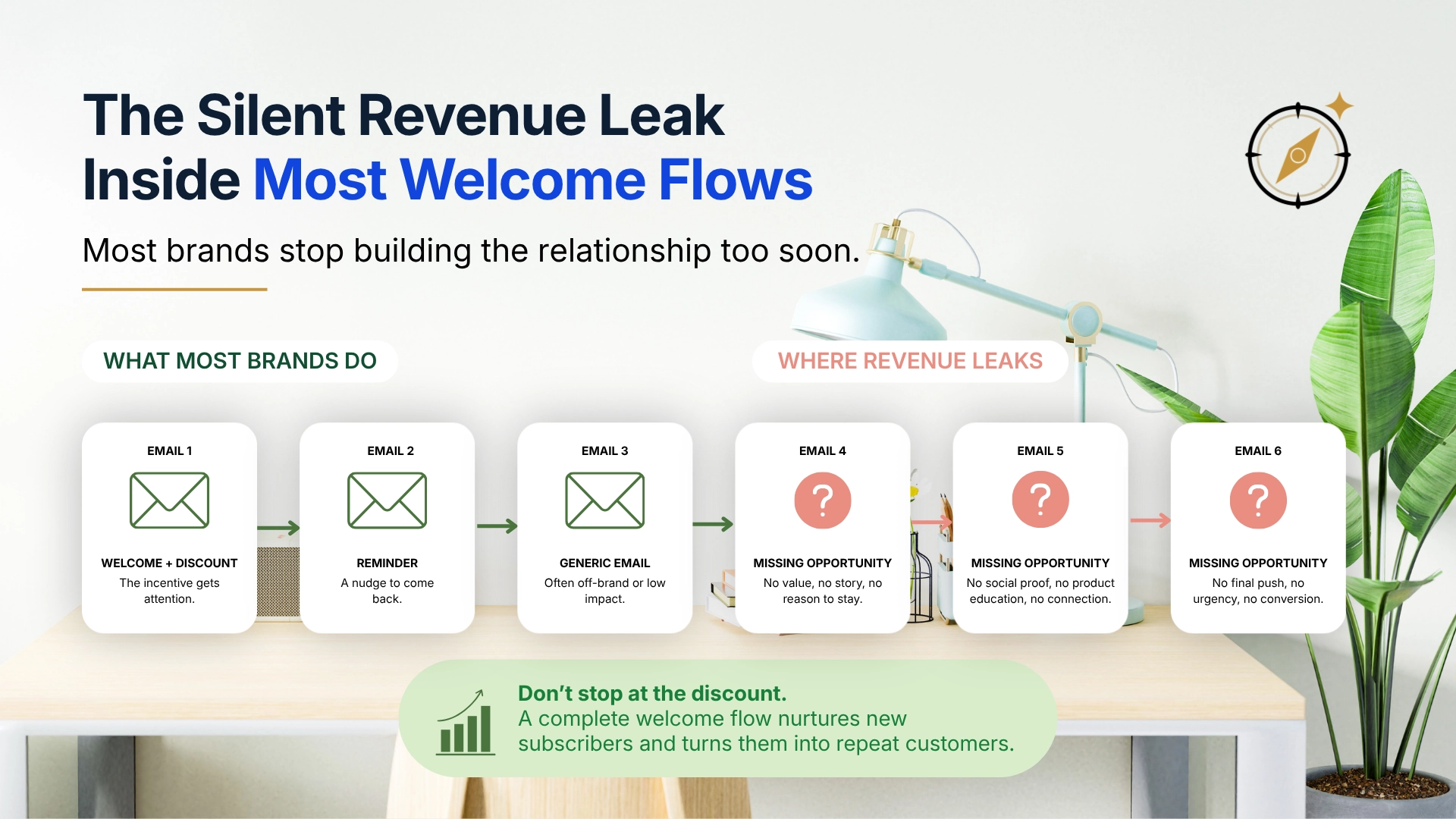
Email 1: discount -> Email 2: reminder -> Email 3: generic product email -> end.
Revenue opportunity is lost because the sequence stops before enough trust, education, and product context have been built.
What is missing:
- A meaningful brand story.
- Product education or context that explains why the product matters.
- A logical progression that builds toward a purchase decision.
- Differentiation between subscribers who bought during the flow and those who did not.
- A clear, well-timed final conversion push before the sequence ends.
The result is a welcome flow that captures the discount-motivated purchase but leaves meaningful revenue from interested subscribers who needed more context, more trust, and a slightly longer runway before buying.
A Strong Audit Signal
While every store is different, one recurring pattern appears often: the welcome flow exists, it is technically live, and email 1 generates most of the revenue while the rest of the sequence contributes very little.
That is usually a sign the flow is ending too early, relying too heavily on the discount, or not building enough trust before the purchase decision.
The 6 Specific Leaks Inside Most Welcome Flows
Leak 1: The Discount Is Doing All the Work
When the discount dominates email 1 and the rest of the sequence has no compelling narrative, the welcome flow mostly converts subscribers who were going to buy immediately anyway. Everyone else receives a discount they do not use, then gets increasingly irrelevant follow-up emails before drifting away.
A discount reduces purchase friction. It works best when the subscriber already understands why they want the product. Many new subscribers do not yet have that clarity. They opted in because something caught their attention, but they have not formed a strong reason to buy.
The welcome flow’s job is to build that reason. When the discount leads and the story follows weakly, the interested-but-not-yet-convinced subscriber is easy to lose.
Leak 2: The Flow Is Too Short
A welcome flow that ends at email 2 or 3, usually within the first 5-7 days, abandons the subscriber before the relationship has had time to develop.
Many people who eventually convert from a welcome sequence do not buy on day 1 or day 3. They need more touchpoints, more context, and a clearer moment of decision.
The ideal length depends on product complexity, average order value, and buying cycle. A simple impulse purchase and a higher-consideration product may need different welcome timelines.
A flow that ends before those subscribers are ready pushes them into the general campaign list, where the welcome-to-brand context disappears.
Leak 3: No Narrative Progression
Many welcome sequences are collections of emails, not true sequences. Each email could be sent in almost any order without changing the experience. There is no buildup, no logical progression, and no sense that email 3 naturally follows email 2.
A good welcome sequence tells a story. It moves from why the brand exists, to what makes the product different, to proof that it works, to why now is the right time to try it.
When there is no narrative thread, subscribers receive a series of unrelated brand messages that do not add up to a compelling reason to buy.
Leak 4: Buyers and Non-Buyers Are Treated Identically
One common technical failure is that a subscriber places a first order mid-flow and then continues receiving welcome emails designed to persuade them to make a first purchase.
That is awkward at best and off-putting at worst. A customer who just bought may receive an email encouraging them to use a welcome discount before it expires. The email signals that the brand does not know who they are.
This is one of the easiest fixes in Klaviyo and one of the most commonly missed.
The moment a subscriber becomes a buyer, the welcome flow’s job is done. They should exit the welcome sequence and enter the post-purchase sequence, where the message shifts from “convince them to buy” to “support and retain someone who just bought.”
Leak 5: The Discount Expiry Is Either Too Aggressive or Too Vague
Urgency is a legitimate conversion tool. Poorly executed urgency either burns credibility or fails to create a decision moment.
Too aggressive: a 24-hour expiry in the first email, before the subscriber has explored the store, understood the product, or absorbed brand context.
Too vague: no clear expiry, or a vague limited-time note that creates no real urgency.
A practical approach is to give subscribers enough time to explore, then create a clear and honest deadline. A 7-day discount window with a reminder around day 5 or 6 is often more useful than manufactured pressure at the start. Exact timing depends on product type, offer, and audience behavior.
Leak 6: No Clear Path to the First Purchase
Some welcome flows are good at brand storytelling and product education but fail to translate interest into a purchase because the path forward is unclear.
This often shows up as:
- Emails that link to the homepage rather than a specific collection or product.
- CTAs that say “shop now” without specifying what to shop for.
- No recommendation based on what the subscriber signed up for or browsed before opting in.
Every email in the welcome sequence should have a clear next step. For most emails, that step is a specific product or collection, not the homepage.
What a High-Performing Welcome Flow Actually Looks Like
Here is a 6-email welcome structure that addresses the six leaks above. Timing and content should be adapted to your product category, buying cycle, average order value, and brand voice.
Email 1: Welcome + Discount Delivery
Timing: day 0, send immediately.
Purpose: deliver the incentive, introduce the brand in one genuine sentence, and set expectations.
- Show the discount code clearly.
- Include one specific line on why the brand exists.
- Link to a clear starting point, such as a best-selling collection or start-here page.
- State the discount expiry window if one exists.
Email 2: Brand Story or Why This Matters
Timing: day 1-2.
Purpose: give the subscriber a reason to care beyond the discount.
This is the email many welcome flows skip. It does not need to be long. It needs specificity: what problem the product solves, what makes the brand different, and why a customer should pay attention.
Email 3: Product Education or Bestseller Deep Dive
Timing: day 3-4.
Purpose: help the subscriber understand what to buy and why it is worth it.
Focus on one product or a small curated collection. Show what makes it different, how to use it, and what people often misunderstand.
Email 4: Social Proof and Community
Timing: day 5-6.
Purpose: build trust before the final conversion push.
Use reviews, customer photos, or specific proof that answers new-subscriber concerns such as quality, shipping, results timeline, or product fit.
Email 5: Discount Expiry Reminder
Timing: day 6-7.
Purpose: create the decision moment.
This should be direct and honest: the offer expires soon, here is the specific product or collection to start with, and here is one final reassurance.
Email 6: Post-Discount Follow-Up for Non-Buyers
Timing: day 10-12.
Purpose: recover interested subscribers who did not buy during the discount window without immediately offering another discount.
Reframe the value of the product at full price. Use a different angle than previous emails, such as a customer story, use case, or product feature not yet highlighted.
The Buyer Branching Logic in Klaviyo
The technical fix for buyers continuing to receive first-purchase welcome emails is a conditional split inside the flow.
After email 2 or 3, once enough time has passed for a purchase to occur, add this condition:
Has the person placed an order since entering this flow?
Yes: exit the welcome flow and route to post-purchase communication.
No: continue through the remaining welcome emails.
This split should appear before any email that references the discount as unclaimed or treats the subscriber as a non-buyer.
At flow entry, also consider splitting subscribers by signup source: product-specific popup, homepage popup, or content/blog opt-in. Even basic form-level segmentation can make email 3 more relevant.
Welcome Flow Metrics: What to Monitor
| Metric | What It Tells You |
|---|---|
| Email 1 open rate | Baseline engagement for new subscribers. |
| Email-by-email open rate drop-off | Where subscribers disengage. |
| Flow conversion rate | What percentage of welcome subscribers become buyers. |
| Revenue per recipient | Overall efficiency of the sequence. |
| Revenue by email | Which email is actually driving purchases. |
| Discount redemption rate | How many subscribers use the welcome offer. |
| Email 6 engagement | Whether non-buyer follow-up recovers any interest. |
| Unsubscribe rate by email | Whether a specific email has a content or timing problem. |
A healthy welcome flow often shows strong engagement on emails 1 and 2, a gradual natural decline across the sequence, and some conversion activity beyond email 1. If conversion is clustered almost entirely at email 1, the sequence may not be doing enough relationship-building work.
Common Mistakes When Rebuilding a Welcome Flow
Rebuilding the entire flow at once. If the flow is already live, changing every email at once makes it hard to tell which change mattered.
Making every email a conversion push. Six discount reminders is not a welcome flow. Relationship-building emails make the conversion emails stronger.
Using the same template for every message. Visual variety helps signal that each email has a distinct purpose.
Not testing subject lines. Welcome flows run continuously, so a subject line improvement can compound over time.
Setting it up and never reviewing it. Product availability, discount offers, and brand positioning change. Review the sequence quarterly.
FAQ
Should the welcome flow send to everyone who subscribes?
Ideally, no. Existing customers should usually enter post-purchase communication rather than the first-purchase welcome sequence. Use flow filters so people who have already placed an order are excluded from the welcome flow.
How large should the welcome discount be?
This depends on category, margin, and acquisition strategy. A smaller welcome offer supported by strong brand story and product education may attract better long-term customers than a larger discount with minimal context. Test based on your own retention data.
What if we do not offer a welcome discount?
That can work, especially in premium or high-perceived-value categories. In that case, the welcome flow needs stronger brand story, education, and social proof because the discount is not doing the conversion work.
Our welcome flow open rates are high but conversions are low. What is wrong?
High opens with low conversions usually point to a content or path-to-purchase problem. Review emails 3 and 5 first, and check whether CTAs link to specific products or collections rather than the homepage.
How long should the welcome discount be valid?
Seven days is a practical starting point for many Shopify stores. For higher-consideration products, 10-14 days may be more reasonable. The key is a clear reminder before expiry, not vague urgency.
Should every Shopify store have a 6-email welcome flow?
Not necessarily. The exact number depends on product complexity, purchase cycle, and customer behavior. The more important principle is that the sequence should build trust, educate, and create a clear path to purchase rather than ending after one or two discount reminders.
Key Takeaways
- The welcome flow is one of the highest-engagement sequences in a Shopify email account, but many brands underuse it.
- The main leaks are discount over-reliance, short sequences, weak narrative, no buyer branching, poorly timed urgency, and unclear CTAs.
- A stronger welcome sequence builds the relationship across discount delivery, brand story, product education, social proof, urgency, and non-buyer follow-up.
- The buyer/non-buyer split in Klaviyo is essential. Buyers should leave the welcome sequence and move into post-purchase communication.
- Review the welcome flow quarterly so it reflects current offers, products, and brand messaging.
Practical Action Plan
This Week
- Open your welcome flow in Klaviyo. Count the emails, map the timing, and pull revenue per recipient.
- Check whether a conditional split exists for mid-flow buyers.
- Pull email-by-email open rate and conversion drop-off to find where the sequence weakens.
In the Next 30 Days
- Add or rebuild the brand story email.
- Fix discount expiry timing if it is currently too aggressive or too vague.
- Update CTAs to link to specific collections or products instead of the homepage.
In the Next 90 Days
- Build the full sequence if the current flow ends too early.
- Add basic entry-point segmentation by signup form or source.
- Run one subject line test on email 3 or email 5 and let it collect enough data before changing again.
Related Guides
- What Happens After a Customer Buys?
- 7 Revenue Leaks I Find in Shopify Email Accounts
- The Hidden Cost of Sending Campaigns to Everyone
- Why Discounts Are Hiding Bigger Problems in Your Shopify Store
Review Method
This framework is based on common welcome flow patterns observed across Shopify and Klaviyo accounts. Results vary by product category, audience quality, offer strength, purchase cycle, margin structure, and implementation quality. Use your own Klaviyo and Shopify data before changing flow timing or offer strategy.
Conclusion
The welcome flow is one sequence almost every Shopify store has, many stores underinvest in, and nearly every store can improve.
The leaks inside it are not dramatic. They are the quiet failure to use the highest-attention window in the customer relationship for anything more than discount delivery.
The fix is a structured sequence that earns each email with the one before it: brand story, product education, social proof, clear urgency, and a follow-up for subscribers who needed more time.
That is what the welcome window is for. Many stores are still only using the first part of it.
Last updated: June 2026. Platform features referenced are based on general Klaviyo and Shopify workflow patterns. Verify exact settings inside your own accounts before publishing changes.

Related guides

Best Email Marketing Software for Contractors (2026)
A practical comparison of Mailchimp, Constant Contact, Brevo, MailerLite, Kit, and field service marketing tools for contractors.
Best Email Marketing Software for Hair Salons & Spas (2026)
A practical comparison of Mailchimp, Constant Contact, Brevo, MailerLite, Kit, and booking-software marketing tools for salons and spas.
Best Email Marketing Software for Restaurants (2026)
A practical comparison of Mailchimp, Constant Contact, Brevo, MailerLite, Kit, and Toast Marketing for restaurant email marketing.