My Shopify Email Segmentation Strategy (And Why Deliverability Depends on It)
AT A GLANCE
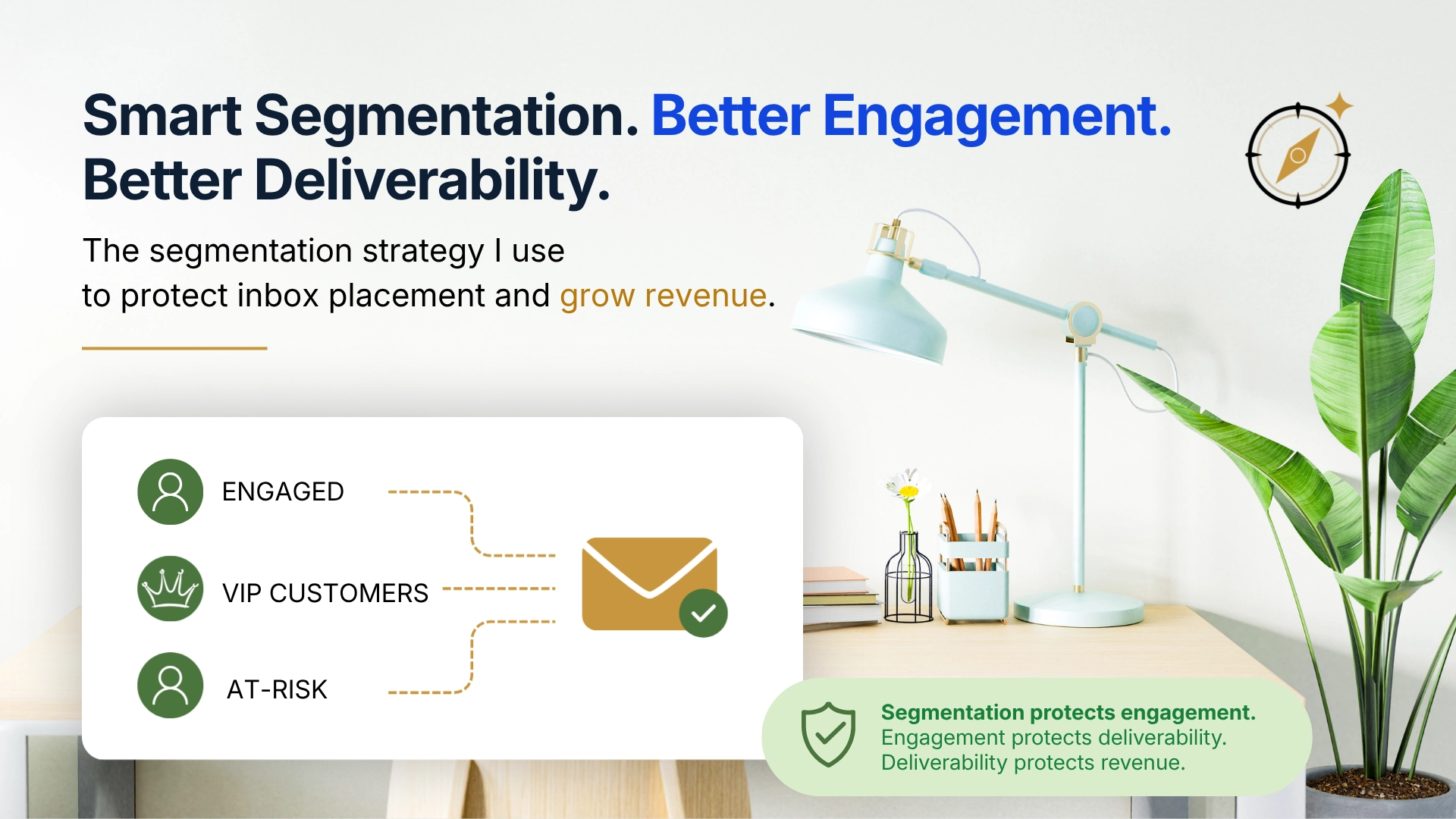
Segmentation protects deliverability by keeping campaigns focused on the people most likely to engage.
Quick Summary
- Deliverability problems are often segmentation problems in disguise.
- Sending the same campaign to your entire list is one of the fastest ways to damage inbox placement.
- Core segments such as engaged subscribers, recent purchasers, VIPs, and at-risk customers form the foundation of a functioning programme.
- SPF, DKIM, and DMARC authentication are baseline requirements.
- A clear suppression and sunset policy helps keep your engaged list healthy over time.
Introduction
Most deliverability conversations start in the wrong place.
Brands notice that open rates are dropping, or that a campaign underperformed, and they go looking for a technical fix: checking authentication settings, adjusting send times, or worrying about subject line spam triggers.
Those things matter. But in many Shopify stores, the root cause of deliverability problems is simpler: they are sending to the wrong people.
Inbox providers like Gmail and Outlook decide where to place your emails based heavily on how recipients engage with them. When you send campaigns to a broad, largely disengaged list, engagement rates drop. When engagement drops consistently, inbox placement can follow. By the time you notice the problem in your metrics, it may already have been compounding for weeks or months.
This article covers the email segmentation strategy I use for Shopify stores: the core segments, how they connect to deliverability, and the suppression framework that keeps list health from quietly deteriorating over time.
Why Deliverability Depends on Segmentation
Deliverability is not just a technical problem. It is a relevance problem.
Inbox providers use engagement signals such as opens, clicks, replies, and moves to inbox to determine whether your emails belong in the inbox or the spam folder. The more people engage with your emails, the more consistently your messages get delivered. The more people ignore or delete them, the more your sender reputation can erode.
Sending a campaign to 40,000 subscribers when only 8,000 of them have engaged in the last 90 days does not just waste the send. It actively dilutes your engagement rate and signals to inbox providers that your content may not be worth prioritising.
Good segmentation solves this by making sure you are primarily sending to people who are likely to engage. That keeps engagement rates stronger, which helps protect inbox placement, which keeps your revenue-generating sends performing as they should.
Send to everyone
Lower engagement -> weaker reputation -> inbox placement drops -> revenue drops.
Smart segmentation
Higher engagement -> stronger reputation -> better inbox placement -> more revenue.
The Core Segmentation Framework
These are the segments I build first in a Shopify email account. They cover the full customer lifecycle and give you the foundation for both campaigns and deliverability management.
Engaged 30-Day Subscribers
Definition: Subscribers who have opened or clicked at least one email in the last 30 days.
This is your most active segment. These are people paying attention right now. They are often the most likely to convert and the most valuable for maintaining sender reputation.
Use this segment for: new product launches, time-sensitive campaigns, and highest-priority sends.
Engaged 90-Day Subscribers
Definition: Subscribers who have opened or clicked within the last 90 days but not necessarily in the last 30.
This segment is still engaged, just at a lower frequency. Including them in campaigns is generally reasonable, but it is worth monitoring whether their engagement holds over time or continues to decline.
Use this segment for: regular campaign sends, promotional campaigns, and content-driven emails.
The combination of your 30-day and 90-day engaged segments forms your core sendable list. For many stores, this is who campaigns should go to by default.
Recent Purchasers (Last 30-90 Days)
Definition: Customers who have placed an order in the last 30 to 90 days, regardless of email engagement.
Recent buyers are in an active relationship with your brand. Even if they have not opened a campaign recently, they are worth treating separately because they are more likely to respond to product recommendations, cross-sells, and loyalty-focused messaging.
Post-purchase flows handle most of the communication with this group automatically. But for campaigns, segmenting recent purchasers allows you to tailor messaging to where they are in their journey rather than sending them the same generic promotion as everyone else.
First-Time Buyers
Definition: Customers with exactly one completed order.
The first-to-second purchase gap is where many Shopify stores lose customers quietly. A first-time buyer has not yet formed a habit around your brand. They have not established a reason to come back.
Identifying this segment separately lets you target them with content designed specifically to drive a second purchase, whether that is a well-timed recommendation, an introduction to products they have not seen yet, or a loyalty incentive.
Repeat Buyers
Definition: Customers with two or more completed orders.
These are some of your most valuable customers. They have already demonstrated that they will buy again, which makes them significantly more likely to keep buying than a cold subscriber.
Repeat buyers respond well to VIP-style messaging, early access to new products, and loyalty recognition. They are also a strong audience for higher-AOV products and upsells.
VIP Customers
Definition: Typically your top 10-20% of customers by total spend or order frequency, depending on your store’s revenue distribution.
The threshold for VIP varies by store. In a high-ticket store, VIP might mean three or more orders or a total spend above a certain amount. In a lower-AOV store, it might be defined primarily by order frequency.
VIPs warrant different treatment: more personalised messaging, exclusive access, and higher-touch communication. They are also the segment most worth protecting from generic batch-and-blast campaigns that could erode their experience with the brand.
Why VIP Segments Matter
Most stores spend a significant amount of time and money acquiring customers. VIP customers have already demonstrated trust in the brand.
Protecting and retaining them is usually more profitable than acquiring additional first-time buyers, especially when acquisition costs are rising or margins are tight.
At-Risk VIP Customers
Definition: Previously high-value customers whose purchase activity or email engagement has declined significantly in the last 60-120 days.
This segment often gets overlooked because the customers in it do not look alarming at first glance. They are still technically in your database. But they represent significant potential lost revenue if they churn completely.
This is often the highest-value retention segment in the account because these customers have already proven they can generate meaningful revenue.
At-risk VIP flows typically combine a genuine re-engagement attempt with an exit decision. That might include acknowledging the gap, offering a relevant incentive, or introducing something new. If they do not re-engage after a targeted sequence, they move toward suppression rather than staying on a list they have stopped responding to.
Lapsed Customers
Definition: Customers who have not purchased in a defined period, typically 120 to 180+ days, adjusted for your store’s average purchase cycle.
Not all lapsed customers are worth re-engaging with the same effort. A lapsed VIP warrants a dedicated win-back flow. A lapsed one-time buyer who never engaged with your emails after purchase may be better moved toward a suppression decision earlier.
Keeping lapsed customers in your active send pool indefinitely is one of the more common list health mistakes. It inflates your list size, dilutes engagement rates, and gradually damages deliverability.
The Deliverability Framework
Segmentation handles the relevance side of deliverability. These technical foundations handle the authentication and reputation side. Both matter.
SPF (Sender Policy Framework)
SPF is a DNS record that specifies which mail servers are authorised to send email on behalf of your domain. Without it, receiving servers have no way to verify that your emails are legitimately from you.
If you are sending through Klaviyo using a custom domain, SPF needs to be configured correctly in your DNS settings. Klaviyo’s documentation covers the specific records required.
DKIM (DomainKeys Identified Mail)
DKIM adds a cryptographic signature to your outgoing emails that receiving servers use to verify the message has not been altered in transit. It is a second layer of authentication that inbox providers expect to see from legitimate senders.
Like SPF, DKIM is configured through your DNS settings. Klaviyo provides the DKIM records you need to add when setting up a custom sending domain.
DMARC (Domain-based Message Authentication, Reporting and Conformance)
DMARC builds on SPF and DKIM by giving you a policy for what happens when authentication checks fail: monitor, quarantine, or reject. It also provides reporting, so you can see authentication results across your sending infrastructure.
A DMARC policy at p=none is a starting point that allows you to monitor without affecting deliverability. Moving to p=quarantine or p=reject should only happen after you have confirmed that legitimate email is passing authentication consistently.
Google and Yahoo introduced stricter sender requirements for bulk senders in 2024, including DMARC requirements. Verify the current requirements against the official provider documentation before making DNS changes.
Engagement Signals
Beyond authentication, inbox providers weigh engagement heavily. The segments above are the practical tool for managing this, but it is worth being explicit about what inbox providers are looking for:
- Opens and clicks indicate active interest.
- Replies are a strong positive signal, though rare in ecommerce email.
- Marking as spam is one of the most damaging signals you can receive.
- Deleting without opening repeatedly signals disengagement.
Keeping spam complaint rates low is important. A commonly monitored threshold is around 0.1%, but exact risk depends on list quality, mailbox provider, sending history, and volume.
Sunset Policy
A sunset policy defines when a subscriber gets suppressed from future sends based on inactivity.
There is no universal rule for this. It depends on your send frequency and your product’s natural purchase cycle. A store that sends three campaigns a week has a different baseline for inactive than one that sends twice a month.
A common starting framework:
- No engagement in 90 days: Move to a reduced send cadence or a re-engagement sequence.
- No engagement in 180 days: Suppress from campaigns unless they have purchased recently.
- No engagement in 12 months with no purchase history: Consider removing from the active list entirely.
The right inactivity window depends on your product category. A skincare brand, furniture brand, and coffee subscription brand should not use identical sunset timelines.
Suppressing unengaged subscribers can feel counterintuitive because your list size goes down. But your engagement rates can improve, your sender reputation is better protected, and your actual results become easier to read. The subscribers who remain are the ones who matter.
Suppression Strategy
Suppression is distinct from unsubscribing. Suppressed contacts remain in your system but do not receive campaigns. This matters because:
- Hard bounces should be suppressed immediately to protect sender reputation.
- Spam complainants should be suppressed as soon as they are identified.
- Unengaged subscribers who have gone through a sunset flow should be suppressed rather than deleted, in case they return to activity through a purchase.
Klaviyo handles much of this automatically for hard bounces and unsubscribes. For custom suppression logic, such as sunsetting inactive subscribers, you need to build the segment and suppress it manually or set up a flow to handle it.
Many stores continue sending campaigns to inactive subscribers because they do not want list size to shrink. Inbox providers care far more about engagement than list size.
How Segmentation and Deliverability Work Together
Here is the practical picture of how these two systems reinforce each other.
When you send campaigns only to your engaged 90-day segment, your open and click rates stay higher than they would if you sent to everyone. Higher engagement signals tell inbox providers your emails are welcome. Better inbox placement means more of your emails actually get seen. More emails seen leads to more revenue from each send.
Contrast that with sending to your full list of 40,000 every time. The 30,000 people who have not engaged in months drag your engagement rate down. Inbox providers notice. Your deliverability slowly degrades. The revenue you thought you were generating from those extra sends may not materialise, and the damage to your sender reputation is real.
The stores that treat segmentation as a deliverability tool, not just a personalisation tool, tend to see more consistent performance over time.
FAQ
How many segments do I actually need for a Shopify store?
You do not need all of these from day one. Start with Engaged 90-Day Subscribers as your default campaign audience, plus Recent Purchasers and First-Time Buyers for targeted sends. Build out VIP and at-risk segments once you have enough purchase history to define them meaningfully.
Does segmenting my list hurt my deliverability by reducing send volume?
Short-term, your reach narrows. Long-term, your engagement rates can improve, which is what inbox providers are actually measuring. Sending to fewer, more engaged people often outperforms sending to a larger disengaged list.
How do I set up these segments in Klaviyo?
Each segment is built using Klaviyo’s segment builder with conditions based on email activity and purchase data pulled from your Shopify integration. The exact conditions depend on your account setup, event names, and current Klaviyo interface.
What is a realistic timeline to see deliverability improve after fixing segmentation?
Results vary depending on how damaged your sender reputation is. For many stores making significant segmentation improvements, meaningful changes in inbox placement can take several weeks. Use this as a general observation, not a guarantee.
Should I send every campaign to my engaged 90-day segment?
Not always. Some campaigns may be better suited to recent purchasers, VIP customers, or first-time buyers.
The engaged 90-day segment is a useful default audience, not a universal rule.
Should I delete unengaged subscribers or suppress them?
Suppression is generally preferable to deletion. Suppressed contacts stay in your system, so if they purchase again later you have their history. Deletion is permanent and removes context that might be useful down the line.
Key Takeaways
- Deliverability problems are often segmentation problems. Sending to disengaged subscribers signals low relevance to inbox providers.
- The default campaign audience should usually be your engaged 90-day segment, not your full list.
- Core segments to build first include Engaged 30-Day, Engaged 90-Day, Recent Purchasers, First-Time Buyers, Repeat Buyers, VIPs, At-Risk VIPs, and Lapsed Customers.
- SPF, DKIM, and DMARC authentication are baseline requirements, not optional extras.
- A sunset policy that suppresses unengaged subscribers helps keep list health from deteriorating over time. Smaller engaged list is usually better than a larger disengaged list.
- Spam complaint rate is one of the most important deliverability signals to monitor.
Related Guides
- The 9 Email Marketing KPIs That Actually Matter for Shopify Stores
- The Hidden Cost of Sending Campaigns to Everyone
- Shopify Email Audit: What I Check First
- The Most Valuable Segment Most Shopify Stores Don’t Have
Review Method
This guide is based on practical Shopify and Klaviyo segmentation workflows, common ecommerce lifecycle segments, and deliverability hygiene principles. Exact segment definitions should be adapted to your product category, send frequency, purchase cycle, list quality, and current Klaviyo setup.
Conclusion
Segmentation and deliverability are not separate workstreams. They are the same problem approached from different angles.
Sending relevant emails to people who are likely to engage protects your sender reputation. A protected sender reputation means your emails reach the inbox. Emails that reach the inbox generate the revenue your programme is supposed to produce.
The stores that understand this connection and build their segmentation strategy around it tend to have email programmes that perform consistently over time, not just when a big promotion goes out.
If your deliverability has been inconsistent, or your campaign performance feels unpredictable, the list itself is usually the first place to look.
Last updated: June 2026. Platform requirements and Klaviyo interface details can change, so verify current documentation before changing DNS records, suppression logic, or sender settings.

Related guides

Best Email Marketing Software for Contractors (2026)
A practical comparison of Mailchimp, Constant Contact, Brevo, MailerLite, Kit, and field service marketing tools for contractors.
Best Email Marketing Software for Hair Salons & Spas (2026)
A practical comparison of Mailchimp, Constant Contact, Brevo, MailerLite, Kit, and booking-software marketing tools for salons and spas.
Best Email Marketing Software for Restaurants (2026)
A practical comparison of Mailchimp, Constant Contact, Brevo, MailerLite, Kit, and Toast Marketing for restaurant email marketing.