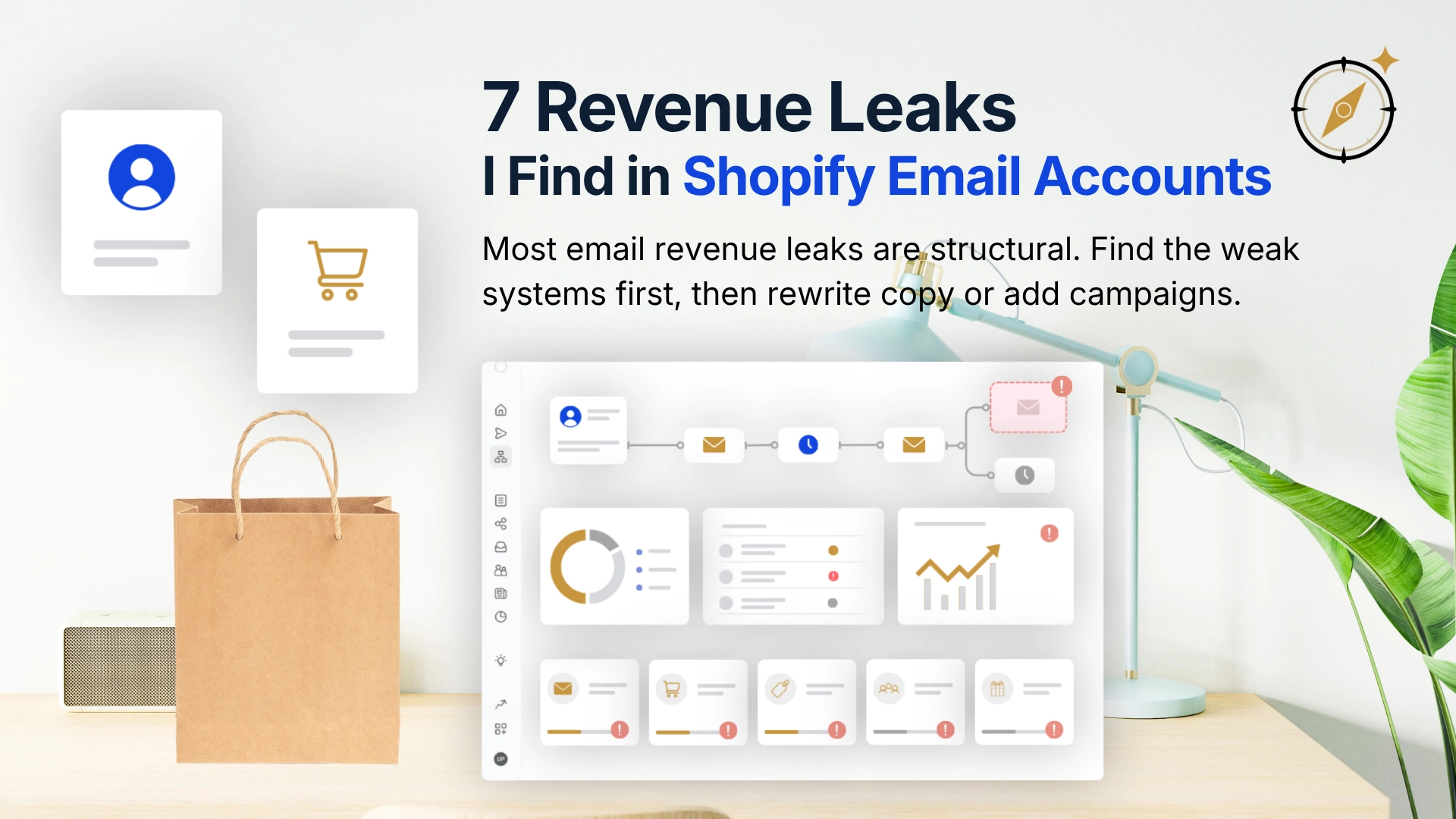
7 Revenue Leaks I Find in Shopify Email Accounts
AT A GLANCE
Most email revenue leaks are structural. Find the weak systems first, then rewrite copy or add campaigns.
Quick Summary
- Most Shopify stores are not losing email revenue because of one broken campaign. The leak is usually inside the email system.
- The most common revenue leaks are structural: short flows, incomplete cart recovery, weak segmentation, poor timing, and metrics no one is watching.
- These problems are fixable without changing platforms or hiring a large team.
- This guide walks through each leak, what it looks like inside Klaviyo, and what to fix first.
Who This Guide Is For
This guide is designed for:
- Shopify store owners using Klaviyo
- Ecommerce marketers auditing email performance
- Retention marketing freelancers and agencies
- Stores with flows live, but weak email revenue
- Brands that want a practical Klaviyo audit checklist
If email feels busy but not profitable enough, this guide will help you find the places revenue may be leaking.
Introduction
When reviewing a Shopify email account, the goal is not to find one dramatic thing that is broken. It is to map the places where revenue quietly slips out of the system.
Most accounts do not have one catastrophic problem. They have several smaller ones. Each is manageable on its own, but together they explain why email can feel like it is not working even when the list is growing and campaigns are going out regularly.
The patterns repeat across many ecommerce setups: flows that stop too early, campaigns sent to too many people, post-purchase silence, deliverability issues, and reporting that focuses on open rate instead of revenue quality.
Here are seven revenue leaks worth checking in a Shopify/Klaviyo account, plus what to do about each one.
What I Typically See During Audits
Every store is different, but a recurring pattern appears in many Shopify email accounts:
- Welcome flows with only 1-2 emails.
- Cart recovery sequences missing key follow-ups.
- No post-purchase education.
- Campaigns sent to the entire list.
- Little or no segmentation beyond subscriber and customer.
- Revenue attribution focused on open rates instead of business outcomes.
The exact numbers vary by niche, traffic volume, purchase cycle, and list quality, but the underlying issues are surprisingly consistent.
Leak 1: The Welcome Flow Stops Too Soon
What It Looks Like
The store has a welcome flow. It sends one or two emails, usually a discount delivery and a generic brand intro, then stops. After that, new subscribers either fall into the general campaign list or hear nothing for weeks.
Why It Is A Problem
A new subscriber is usually at their highest point of interest right after opting in. The brand is fresh, the offer is relevant, and they are still in exploration mode.
Cutting the welcome sequence short means you leave that window open, then let it close without giving the subscriber enough context to buy.
What To Check In Klaviyo
- Open the welcome flow and count the emails.
- Check how many days the sequence spans.
- Review the drop-off in opens and clicks after email 1.
- Check whether flow revenue is coming from only the first email.
The Fix
For many Shopify stores, a useful welcome flow runs 4-6 emails over roughly 10-14 days. The sequence can move through:
- Welcome and offer delivery
- Brand story and why it matters
- Product education or bestseller spotlight
- Social proof
- Final reminder or invitation to explore further
The right length depends on product complexity and buying cycle. Some stores may need fewer emails, while higher-consideration products may benefit from additional education.
Each email should have a clear purpose. If you cannot explain why an email exists, it probably needs to be rewritten or removed.
Related: Klaviyo welcome flow performance
Leak 2: Abandoned Cart Recovery Is Incomplete
What It Looks Like
The abandoned cart flow exists, but it only sends one email. Sometimes it sends two. The recovery window is short, the copy is generic, and the flow is treated as done because something is technically live.
Why It Is A Problem
Cart abandonment is a high-intent moment. People who abandon carts are not always uninterested. Many are distracted, comparing options, checking shipping, or unsure about the product.
A single reminder only addresses one version of that problem. A better sequence can address hesitation, social proof, product questions, and timing.
What To Check In Klaviyo
- How many emails are in the abandoned cart flow?
- What is the timing between emails?
- Does email 2 use a different angle from email 1?
- Are recent purchasers excluded from the flow?
- What is the revenue per recipient for this flow?
The Fix
A practical abandoned cart sequence often starts with three emails:
| Timing | Angle | |
|---|---|---|
| Email 1 | 1 hour after abandonment | Gentle reminder, no discount |
| Email 2 | 24 hours after abandonment | Address objections and add social proof |
| Email 3 | 48-72 hours after abandonment | Final nudge, optional modest incentive |
The copy should reference the product left behind where possible. Klaviyo dynamic product blocks can make this more relevant than a generic “you forgot something” email.
Leak 3: No Post-Purchase Sequence Beyond Order Confirmation
What It Looks Like
A customer buys. They receive an order confirmation, usually from Shopify. They receive a shipping notification. Then nothing meaningful happens until the next promotional campaign reaches them alongside everyone else.
Why It Is A Problem
The post-purchase period is one of the best opportunities to build loyalty, reduce buyer’s remorse, educate the customer, and create a natural path to the second purchase.
For many Shopify brands, the second purchase is where customer acquisition costs begin to make financial sense.
Doing nothing in this window is a common retention failure. The customer has trusted the brand once, but the brand has not helped them get more value from that first purchase.
What To Check In Klaviyo
- Is there a post-purchase flow triggered after “Placed Order”?
- Does it separate first-time buyers from repeat buyers?
- Does it include product education, not just a review request?
- Is the review request timed after the customer has likely received and used the product?
The Fix
Build a post-purchase sequence around the real customer journey:
- Order confirmation with a short brand note: day 0.
- Product education or usage tips: day 3-5.
- Social proof and community: day 7-10.
- Review request: day 10-14, depending on shipping and product type.
- Cross-sell or replenishment prompt: day 21-30.
- Win-back if no second purchase: day 45-60.
The goal is not to fill the inbox. It is to give the customer a reason to feel good about the purchase and a natural path back to the store.
Related: The Revenue You’re Losing Between First and Second Purchase
Leak 4: Campaigns Go To The Entire List
What It Looks Like
A new product launches. A seasonal sale goes live. A new blog post goes out. The campaign gets sent to every subscriber: engaged contacts, recent purchasers, people who have not opened in months, and everyone in between.
Why It Is A Problem
Full-list sending creates two problems.
First, it can hurt deliverability over time because a large share of recipients may ignore the email. Inbox providers use engagement signals when deciding where future emails land.
Second, it creates poor customer experience. A customer who bought three days ago may not need a discount campaign. A subscriber who has not engaged in 180 days probably should not receive your highest-volume promotional sends.
Example: a customer who purchased yesterday does not need a “10% off your first order” promotion. Segmentation prevents these mismatches.
What To Check In Klaviyo
- Are campaigns segmented before sending, or sent to “All Subscribers”?
- How large is your 90-day engaged segment compared with the full list?
- Are bounce rates or spam complaints increasing?
- Do promotional sends exclude recent purchasers?
The Fix
Before every campaign, define who should receive it:
| Campaign Type | Recommended Audience |
|---|---|
| Promotional sale | Engaged 90-day subscribers, excluding recent purchasers |
| New product launch | Engaged subscribers and relevant interest segments |
| Content or education | Broader engaged list, including cooling subscribers where appropriate |
| Win-back campaign | Unengaged 60-180 day subscribers only |
| VIP offer | High-value customer segment only |
This takes extra planning, but it protects deliverability and makes campaigns more relevant.
Related: Klaviyo segmentation mistakes
Leak 5: Deliverability Is Quietly Broken
What It Looks Like
Open rates have declined gradually. The list is growing, but email revenue is not keeping up. Campaigns feel like they are underperforming without one obvious reason.
Many store owners assume this is a content problem. Sometimes it is an inbox-placement problem.
Why It Is A Problem
If emails are not reaching the inbox, copy improvements have limited impact. Deliverability issues often build slowly, which makes them easy to miss until performance has already weakened.
What To Check
- Is SPF set up and verified for your sending domain?
- Is DKIM configured correctly?
- Is a DMARC policy in place?
- Are there bounce rate spikes or complaint warnings in Klaviyo?
- When did you last clean or suppress inactive contacts?
- Are you using a custom sending domain?
Quick Deliverability Check
- SPF verified.
- DKIM verified.
- DMARC active.
- Custom sending domain enabled where appropriate.
- No recent complaint spikes.
The Fix
Start with the technical foundation:
- Set up SPF, DKIM, and DMARC on your domain.
- Switch to a custom sending domain in Klaviyo if appropriate for your account.
- Run a list review before sending more volume to inactive contacts.
- Build a sunset or re-engagement flow for cold subscribers before suppressing them.
Deliverability is less visible than campaign strategy, but it is foundational. If you suspect it is a problem, fix this before increasing send volume.
Leak 6: No Segmentation Beyond Subscriber And Customer
What It Looks Like
The Klaviyo account has two meaningful groups: people who signed up and people who bought. Maybe there is a basic VIP tag. Everything else, such as product interest, purchase frequency, engagement level, or spending level, is unused.
Why It Is A Problem
Every subscriber is at a different stage with the brand. Treating them identically makes email feel generic because it is generic.
A customer who has bought five times does not need the same message as someone who signed up for a discount code last week and never purchased.
Why Segmentation Matters
Segmentation improves relevance. Relevance improves engagement. Better engagement supports stronger deliverability and, over time, better revenue performance.
What To Check In Klaviyo
- How many active segments do you have?
- Do you have a high-value customer segment based on order count or lifetime spend?
- Do you have 30, 60, and 90-day engagement segments?
- Do you have first-time buyers separated from repeat buyers?
- Are product category interests tracked where relevant?
The Fix
Build these six segments as a starting point:
| Segment | Definition |
|---|---|
| Highly Engaged | Opened or clicked in the last 30 days |
| Engaged | Opened or clicked in the last 90 days |
| Cold | No open or click in 90-180 days |
| First-Time Buyers | Exactly 1 order placed |
| Repeat Buyers | 2 or more orders placed |
| High-Value Customers | Top customers by lifetime revenue or order count |
Once these exist, campaign targeting becomes much more intentional.
Leak 7: Nobody Is Watching The Metrics That Matter
What It Looks Like
The store owner checks open rates after every send. If open rates look decent, email is considered healthy. If they drop, the first assumption is that the subject line is weak.
Open rate is useful, but it should not be the primary measure of email success.
Why It Is A Problem
Open rate became less reliable after Apple Mail Privacy Protection rolled out in 2021 because some opens can be inflated by automated email preloading. It is still a directional signal, but it should not be treated as the main business metric.
A high open rate with low revenue may mean the offer is weak, the audience is wrong, or the landing page is not converting. You only see that when you track deeper metrics.
What To Track Instead
| Metric | What It Tells You |
|---|---|
| Revenue per recipient | How efficiently each email generates revenue |
| Click-to-conversion rate | Whether people who engage are actually buying |
| Flow revenue over 30/60/90 days | Whether automations are doing their job |
| Repeat purchase rate | Whether email is supporting loyalty, not just one-time sales |
| List growth rate vs. revenue growth rate | Whether a growing list is becoming more valuable |
| Unsubscribe rate by email | Where content or timing is creating friction |
Build a simple monthly reporting habit. Pull these numbers, compare them with the previous month, and look for patterns. You do not need a sophisticated analytics stack to start.
Related: A/B test Klaviyo subject lines
The Full Audit Checklist
Use this when reviewing any Shopify email account.
Flows
- Welcome flow has 4+ emails and spans roughly 10-14 days.
- Abandoned cart has 3 emails and recent purchasers are excluded.
- Post-purchase flow exists and includes product education.
- Browse abandonment is set up and triggered correctly.
- Win-back is active for lapsed buyers.
- Sunset or re-engagement flow suppresses cold contacts after a clear attempt to re-engage.
Campaigns
- Campaigns are sent to targeted segments, not the full list by default.
- Recent purchasers are excluded from promotional sends.
- Send cadence is consistent and not only used when sales are slow.
- Campaign calendar exists at least 30 days ahead.
Deliverability
- SPF, DKIM, and DMARC are configured.
- Custom sending domain is reviewed for the Klaviyo account.
- List hygiene has been reviewed recently.
- Bounce and spam complaint trends are monitored.
Segmentation
- Engagement segments are built for 30, 60, and 90-day activity.
- First-time buyer segment is active.
- High-value customer segment is built.
- Product interest segmentation is used where relevant.
Analytics
- Revenue per recipient is tracked for key flows.
- Repeat purchase rate is monitored monthly.
- Flow performance is reviewed quarterly.
- Open rate is not the only metric being used.
Common Mistakes When Fixing These Leaks
Trying to fix everything at once. Prioritize by likely revenue impact. Welcome flow, abandoned cart, post-purchase, and deliverability issues usually deserve early attention.
Rebuilding flows before diagnosing them. A low-performing flow might need one timing change, one rewritten email, or a better filter, not a complete rebuild.
Adding discounts to solve engagement problems. If flows are not converting, the instinct is often to add a coupon. This can erode margin and train customers to wait for offers. Improve relevance, timing, and copy first.
Cleaning the list too aggressively. Suppressing everyone who has not opened in 90 days may remove people who could still re-engage. Run a structured re-engagement sequence before broad suppression.
Fixing deliverability without fixing content. Technical fixes can improve inbox placement, but if the emails are still generic or poorly timed, the revenue lift may be limited.
Metrics To Track After Fixing These Leaks
Set a baseline before changing too much, then compare over the next 30, 60, and 90 days.
- Revenue from automated flows: is it growing month over month?
- Revenue per recipient for welcome flow: how efficiently does the sequence convert new subscribers?
- Revenue per recipient for abandoned cart: is the highest-intent flow doing enough work?
- Repeat purchase rate: track at 60-day and 90-day windows.
- Engaged list size vs. total list size: a healthier ratio can indicate better list hygiene.
- Spam complaint trend: watch for any campaign or flow that creates complaints.
- Unsubscribe rate: spikes on specific emails flag a content, timing, or audience issue.
Small improvements across several areas can produce a meaningfully different revenue picture over time. Results depend on product category, list quality, purchase cycle, margins, and execution.
FAQs
Which of these 7 leaks should I fix first?
Start with whatever is most clearly costing revenue right now. For many stores, that is either an underdeveloped abandoned cart flow, a weak welcome flow, or campaigns going to the full list. If you are not sure, pull your Klaviyo flow revenue report and find the automations generating near-zero revenue.
How long does it take to see results after fixing these issues?
Flows such as abandoned cart and welcome can show directional results within 30 days because they trigger on customer behavior. Deliverability improvements usually take longer because sender reputation changes gradually. Segmentation improvements show up over multiple campaign sends.
Do I need a large email list for these fixes to matter?
No. These are structural problems that affect stores of different sizes. The revenue impact scales with list size and order value, but the principles apply even to smaller Shopify stores.
Can I audit my own account, or do I need a specialist?
You can audit most of this yourself if you have access to Klaviyo, Shopify reports, and enough time to review the flows carefully. A specialist may help with prioritization and implementation speed, but the checklist is designed to be self-administered.
What if my open rates are high but revenue is still low?
High opens with low revenue usually means the offer is weak, the audience is not the right fit, the email does not earn the click, or the destination page is not converting. Pull click rate, click-to-conversion rate, and revenue per recipient to see where the drop-off starts.
Which flow should generate the most revenue?
For many Shopify stores, abandoned cart, welcome, and post-purchase flows are typically the highest-impact automations. Exact results depend on traffic, product type, price point, purchase cycle, and how well each flow is built.
Related Email Marketing Guides
- The Revenue You’re Losing Between First and Second Purchase
- Ecommerce email marketing strategy
- Klaviyo segmentation mistakes
- Klaviyo welcome flow performance
- A/B test Klaviyo subject lines
Key Takeaways
- The 7 common Shopify email revenue leaks are short welcome flows, incomplete cart recovery, no post-purchase sequence, full-list campaign sends, deliverability issues, minimal segmentation, and weak metrics tracking.
- Most of these fixes do not require a new platform. They require better structure and a regular audit habit.
- Fix flows before chasing more campaigns. Automations work continuously when they are built well.
- Deliverability is foundational. If emails are not reaching the inbox, everything else has limited impact.
- Open rate is a directional signal, not a complete business metric. Revenue per recipient and repeat purchase rate are more useful for judging email performance.
Practical Action Plan
This Week
- Run the audit checklist above on your Klaviyo account.
- Pull your flow revenue report and identify flows generating little or no revenue.
- Check whether SPF, DKIM, and DMARC are configured for your sending domain.
In The Next 30 Days
- Prioritize the top two leaks by likely revenue impact.
- Build or rebuild your abandoned cart flow to three emails if it is shorter.
- Create an engaged 90-day segment and use it for your next campaign instead of the full list.
In The Next 90 Days
- Work through all seven leak fixes systematically.
- Set up the six core segments from Leak 6.
- Build a monthly metrics review habit and look for patterns over time.
Review Method
This article is based on common patterns observed during Shopify and Klaviyo account reviews. Individual results vary based on product category, traffic sources, customer behavior, list quality, and implementation quality.
Conclusion
Most Shopify email accounts are not completely broken. They are usually leaking.
The issues described here often come from things that were set up quickly, never revisited, or never built because running a store leaves little time for systematic review.
That is what makes these leaks common. It is also what makes them fixable.
You do not need to overhaul the entire email system at once. Find which of these seven problems exists in your account, address them in order of likely revenue impact, and build a habit of reviewing performance regularly.
Revenue leaks rarely announce themselves. They show up gradually in lower repeat purchase rates, weaker flow performance, and rising acquisition costs. The sooner you identify them, the easier they are to fix.
The stores with the strongest email revenue are not always the ones with the most creative campaigns. Often, they are the ones with the tightest systems.
Last updated: June 2026. Platform features referenced are based on general Klaviyo and Shopify workflow patterns. Verify exact settings inside your own accounts before publishing changes.

Related guides

Best Email Marketing Software for Contractors (2026)
A practical comparison of Mailchimp, Constant Contact, Brevo, MailerLite, Kit, and field service marketing tools for contractors.
Best Email Marketing Software for Hair Salons & Spas (2026)
A practical comparison of Mailchimp, Constant Contact, Brevo, MailerLite, Kit, and booking-software marketing tools for salons and spas.
Best Email Marketing Software for Restaurants (2026)
A practical comparison of Mailchimp, Constant Contact, Brevo, MailerLite, Kit, and Toast Marketing for restaurant email marketing.