How Accurate Is Klaviyo Tracking? Here’s What I Trust (And What I Double-Check)
AT A GLANCE
Klaviyo is useful for trends and comparisons, while Shopify should remain the source of truth for actual revenue.
Quick Summary
- Klaviyo tracking is useful, but every number needs to be understood in context.
- Flow and campaign revenue trends are reliable for directional decisions. Absolute revenue figures less so.
- Klaviyo and Shopify will almost always show different revenue numbers. That is expected, not a bug.
- Attribution windows, cross-device purchases, and returning customers all contribute to the gap.
- Use Klaviyo for trends and comparisons. Use Shopify order data as your revenue source of truth.
Introduction
At some point, almost every Shopify store owner running email through Klaviyo runs into the same moment of confusion.
They open Klaviyo and see revenue attributed to email last month. They open Shopify and the number looks different. They check GA4 and it is different again. Three platforms, three numbers, no obvious explanation.
This is not always a sign that something is broken. It is a reflection of how attribution works, and how differently each platform measures it.
Klaviyo tracking is genuinely useful. I rely on it regularly for evaluating flow performance, comparing campaigns, and understanding engagement trends. But there are specific things I trust without much hesitation, and specific things I always cross-reference before drawing conclusions.
This article breaks down both.
What Klaviyo Is Actually Measuring
Before getting into what to trust and what to verify, it helps to understand what Klaviyo is actually doing when it attributes revenue to an email.
When someone receives an email from you and then places an order on your Shopify store, Klaviyo attributes that order to the email, provided the order happens within Klaviyo’s attribution window.
Klaviyo’s current default email attribution window is 5 days for both opens and clicks. These settings can be adjusted in your account’s attribution settings, so always check your own configuration before comparing historical performance.
So if someone clicks a link in your email on Monday and places an order on Wednesday, Klaviyo can attribute that order to the email. If they open or click an email and purchase outside your configured lookback window, that order may not be attributed to the original email.
These are reasonable defaults for many ecommerce stores. But they are still a model: an approximation of cause and effect, not a direct record of it.
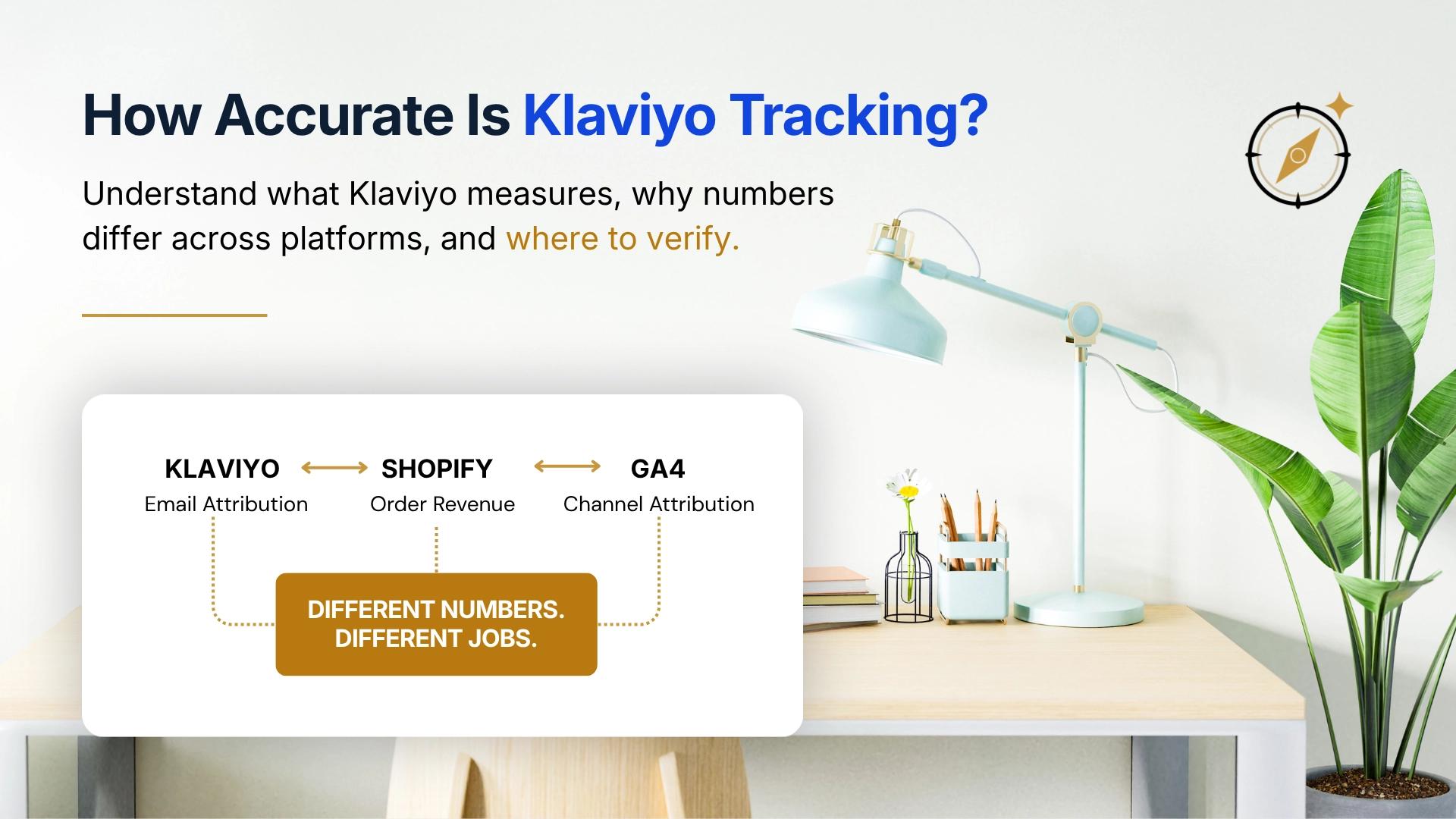
Attribution Comparison
Customer journey: Email click -> website visit -> Google search -> purchase.
Klaviyo: Email attribution.
Shopify: Order revenue.
GA4: Multi-touch journey.
What I Trust in Klaviyo
Flow Revenue Trends
If your welcome flow generated more revenue this month than last month, the trend is meaningful. The absolute number is worth understanding in context, but the direction tells you something real about how the flow is performing relative to your list growth and engagement.
Trends are usually more useful than absolute values because attribution models remain relatively consistent over time.
Flow revenue trends are one of the more useful signals Klaviyo gives you because the conditions are relatively stable. The same trigger fires, the same sequence runs, and the same attribution logic applies. When trends shift significantly, something meaningful has changed, either in the flow itself, in the list feeding into it, or in the product or offer it is connected to.
Campaign Revenue Trends Over Time
Individual campaign performance varies a lot because audiences, offers, and timing change. But revenue trends across campaigns over weeks and months are worth paying attention to.
If campaign revenue per recipient has been declining steadily over three months, that is a signal worth investigating. If a particular segment consistently outperforms others, that pattern is real. The trend is more useful than any single data point.
Relative Performance Comparisons
Klaviyo is particularly useful for comparing performance within the platform: Flow A versus Flow B, Segment 1 versus Segment 2, Campaign Version A versus Version B in a test.
Because the attribution logic is consistent across both sides of the comparison, the relative difference is meaningful even if the absolute numbers are imperfect. If your abandoned cart flow has a much stronger conversion rate than your browse abandonment flow, that gap is actionable regardless of how each number compares to an external benchmark.
Engagement Metrics
Open rates, click rates, click-to-open rates, unsubscribe rates, and complaint rates are tracked directly within Klaviyo and do not depend on cross-platform revenue attribution. They are useful signals for diagnosing individual sends and monitoring list health over time.
Keep in mind that open rates have been affected by Apple Mail Privacy Protection since 2021, which can preload email content and register opens without proving that a person actively read the email. Click rate and click-to-open rate are often better engagement signals for that reason.
Deliverability Signals
Bounce rates, spam complaint rates, and unsubscribe rates are tracked at the account and list level in Klaviyo. These are dependable figures because they reflect email infrastructure and subscriber actions rather than modelled revenue attribution. Monitor them consistently.
What I Double-Check
Absolute Revenue Attribution
The total revenue Klaviyo reports for a campaign or flow is where I apply the most scrutiny. Attribution models are imperfect by design. They are trying to assign credit for a complex, multi-touchpoint customer journey to a single channel.
A customer might open an email, browse the site, leave, see a retargeting ad two days later, come back through a Google search, and then buy. Klaviyo may attribute that order to the email if the click window is still open. Shopify records it as an order. GA4 might attribute it to organic search or paid ads depending on its model.
None of them are necessarily wrong. They are each measuring something different.
Attribution tools assign credit. Order systems record transactions. Those are fundamentally different jobs.
When I need to understand actual revenue, I go to Shopify order data first.
Revenue When Attribution Windows Have Been Changed
If you or a previous manager adjusted Klaviyo’s attribution windows, any performance data before and after that change is not directly comparable. A longer attribution window will capture more orders and show higher revenue, not because email performance improved, but because the measurement changed.
This is worth checking before drawing conclusions from historical performance data, especially in accounts that have had multiple people managing them.
Revenue on High-Traffic Promotional Periods
During BFCM, a major sale, or any period where multiple channels are running simultaneously, Klaviyo’s attributed revenue can look particularly strong. This is partly real because email can drive genuine revenue during promotions, and partly a function of attribution overlap.
When paid ads, organic social, SMS, and email are all running at the same time, the same purchase can theoretically be attributed to each channel under its own model. Klaviyo may claim the email click. Meta may claim the ad impression. GA4 will record whatever its model gives credit to.
During these periods, I treat Klaviyo revenue as directional rather than definitive, and cross-reference with Shopify order data to understand what actually happened.
Revenue for New or Recently Changed Flows
When a flow is new or has been significantly edited, the first few weeks of data should be treated cautiously. Klaviyo needs a sufficient sample before performance metrics stabilise. Small sample sizes produce wide variance.
Give new flows time before making optimisation decisions based on their numbers.
Cross-Device Purchases
Klaviyo tracks email engagement and website behaviour through a cookie set when someone clicks a link from your email. If a customer opens an email on their phone, does not click, and then buys on their laptop later the same day, that purchase may not be attributed to email because the cookie was never set on the device where the purchase happened.
This means Klaviyo can under-attribute email’s influence on revenue in some cases, particularly for stores where mobile email open rates are high but desktop conversion is common.
This limitation affects nearly every attribution platform, not just Klaviyo.
It is difficult to quantify exactly how much this affects your numbers, but it is worth knowing it exists.
Why Klaviyo and Shopify Show Different Numbers
This comes up frequently enough that it is worth addressing directly.
Klaviyo attributes revenue within an attribution window based on email engagement. Shopify records actual orders.
The gap between them is caused by a combination of factors:
Attribution windows: Orders that fall within Klaviyo’s window get attributed to email. Orders placed by the same customer outside the window do not, even if the email influenced the decision.
Returning customers: If a loyal customer who is on your email list makes a purchase, Klaviyo may attribute it to the last email they received. Whether email actually influenced that purchase is debatable. Shopify records it as a standard order.
Multi-channel overlap: When multiple channels are running simultaneously, attribution is contested. Klaviyo gives credit to email. Other platforms may claim the same order for their own channel.
Cancelled or refunded orders: Klaviyo may attribute an order that later gets cancelled or refunded. Shopify will update to reflect the actual order status. This can create discrepancies, particularly for stores with higher return rates.
The practical approach is to stop expecting them to match and start using each source for what it is best at: Klaviyo for email performance evaluation, Shopify for actual revenue reporting.
How GA4 Fits Into This
GA4 adds a third layer with its own attribution model. It is useful for understanding the broader channel picture: how email compares to paid, organic, and direct traffic in driving conversions.
But GA4 introduces further complexity into the attribution picture because it requires correct UTM parameters on email links to identify email traffic correctly.
If your Klaviyo campaigns and flows are not using consistent UTM parameters, GA4 may misattribute email-driven traffic to direct or organic channels. That can make email look weaker in GA4 than it actually is.
If you are trying to reconcile GA4 data with Klaviyo, checking UTM consistency is the first step.
Common UTM Structure
- utm_source: klaviyo
- utm_medium: email
- utm_campaign: campaign_name
A Practical Framework for Using Klaviyo Data
Use Klaviyo for:
- Comparing flow performance over time
- A/B testing campaigns and evaluating relative results
- Monitoring engagement health such as click rates, unsubscribes, and complaint rates
- Identifying which segments drive the strongest response
- Directional revenue trends across flows and campaigns
Use Shopify for:
- Actual revenue reporting
- Order counts and customer purchase history
- Refund and cancellation-adjusted revenue figures
- Source of truth for LTV and repeat purchase calculations
Use GA4 for:
- Cross-channel attribution and channel comparison
- Assisted conversion analysis
- Traffic source understanding, with correct UTM parameters in place
No single platform gives you the complete picture. Using them together, and understanding what each one is measuring, is where the clearest view comes from.
FAQs
Why does Klaviyo show more revenue than Shopify?
Klaviyo attributes revenue based on email engagement within an attribution window. That can include orders Shopify categorises differently or purchases from returning customers whose purchase may have been influenced by email but not directly caused by it. Attribution window settings, multi-channel overlap, and cross-device tracking gaps all contribute to the difference.
What is Klaviyo’s default attribution window?
Klaviyo’s current default email attribution window is 5 days for both opens and clicks. Account settings can be customized, so it is worth checking your own configuration before comparing historical data.
Should I change Klaviyo’s attribution window?
It depends on your store’s purchase cycle. A longer cycle, where customers research for several days before buying, might warrant a longer click window. For many standard ecommerce stores, the defaults are a reasonable starting point. If you do change them, document the date so you can account for it when reviewing historical trends.
How do I reconcile Klaviyo and GA4 revenue data?
Start by checking UTM parameters. Every link in your Klaviyo campaigns and flows should have consistent UTM tags, such as utm_source=klaviyo, utm_medium=email, and a campaign or flow identifier. Without these, GA4 cannot correctly identify email traffic. After confirming UTMs are in place, accept that some gap between platforms is normal. The goal is directional consistency, not an exact match.
Can I trust Klaviyo A/B test results?
For many standard tests, such as subject lines, send time, and content variations, Klaviyo can be useful for relative comparisons when the sample size is large enough and the test runs long enough. Be cautious with very small lists where variance is high.
Which platform should I use for monthly reporting?
For most Shopify stores, use Shopify for revenue reporting, Klaviyo for email performance reporting, and GA4 for channel comparison. Using all three together provides the clearest picture.
Attribution Reality Check
No attribution platform can perfectly determine why every purchase happened.
Attribution models estimate influence using rules and available data.
The goal is not perfect accuracy. The goal is consistent measurement that supports better decisions.
Key Takeaways
- Klaviyo tracking is useful for trends, relative comparisons, and engagement metrics. It is less useful as an absolute revenue source of truth.
- Klaviyo and Shopify showing different revenue numbers is expected because they measure different things using different methodologies.
- Klaviyo’s current default email attribution window is 5 days for both opens and clicks, but account settings can be customized.
- If attribution windows have been changed, check your account configuration before comparing historical performance.
- Apple Mail Privacy Protection has made open rates less reliable as an absolute metric. Click behaviour is usually more useful for engagement analysis.
- Cross-device purchases can be under-attributed to email in Klaviyo.
- Use Klaviyo for email performance evaluation. Use Shopify for revenue reporting. Use GA4 for cross-channel context with UTM parameters in place.
- During multi-channel promotional periods, treat Klaviyo revenue as directional rather than definitive.
Conclusion
Klaviyo gives you a lot of useful data. The key is knowing what each number is actually telling you.
The stores that get the most value out of Klaviyo reporting are the ones that use it for what it is good at: tracking trends, evaluating relative performance, and monitoring list health. They cross-reference with Shopify and GA4 when they need a fuller picture.
Trying to reconcile every number across every platform is usually not the best use of time. Understanding why the numbers differ, and using each platform’s data appropriately, is where the clarity actually comes from.
If your Klaviyo and Shopify numbers look significantly different and you are not sure why, attribution window settings and UTM configuration are two of the first places to check.
Suggested Internal Links
- The 9 Email Marketing KPIs That Actually Matter for Shopify Stores
- My Shopify Email Segmentation Strategy (And Why Deliverability Depends on It)
- Shopify Email Audit: What I Check First
- Why Paid Ads Can’t Fix Broken Retention
Review Method
This guide is based on practical ecommerce email reporting workflows and common Klaviyo, Shopify, and GA4 attribution discrepancies. Platform interfaces and attribution settings can change, so verify current Klaviyo, Shopify, GA4, and Apple documentation before making reporting or account-setting decisions.

Related guides

Best Email Marketing Software for Contractors (2026)
A practical comparison of Mailchimp, Constant Contact, Brevo, MailerLite, Kit, and field service marketing tools for contractors.

Best Email Marketing Software for Hair Salons & Spas (2026)
A practical comparison of Mailchimp, Constant Contact, Brevo, MailerLite, Kit, and booking-software marketing tools for salons and spas.

Best Email Marketing Software for Restaurants (2026)
A practical comparison of Mailchimp, Constant Contact, Brevo, MailerLite, Kit, and Toast Marketing for restaurant email marketing.