How to Improve Klaviyo Welcome Flow Performance
AT A GLANCE
A practical framework for improving welcome flow performance with better timing, copy, segmentation, and conditional logic.
Quick Summary
- Most welcome flows underperform because they deliver a discount and stop. The brand case is never made.
- Welcome flow performance improves most when email timing, sequence logic, and segmentation are adjusted together, not in isolation.
- Email 1 should deliver the offer and set expectations; emails 2 and 3 should build trust.
- Conditional splits based on engagement are where most of the performance uplift lives.
- Benchmarks are useful as directional checks, but results depend on industry, list quality, offer type, and signup source.
Who This Guide Is For
This guide is designed for:
- Shopify store owners using Klaviyo
- Ecommerce email marketers
- Klaviyo freelancers
- Retention marketing agencies
- Brands with low-performing welcome flows
If your welcome flow currently consists of one discount email and little else, this guide will have the biggest impact.
Introduction
The welcome flow is the highest-leverage sequence in Klaviyo. New subscribers are more engaged than they will ever be. They just opted in, the brand is fresh, and the incentive is still relevant. If the flow does not convert them during that window, recovering them later costs significantly more effort.
Most Shopify brands know this. Most still have welcome flows that underperform.
The reason is usually not the offer. It is the sequence logic around the offer. The discount gets delivered. The follow-up emails are generic. The flow treats every subscriber the same regardless of whether they opened, clicked, or purchased. And the brand story, the actual reason someone should buy from this store rather than a cheaper competitor, never gets told.
This guide covers how to improve Klaviyo welcome flow performance across timing, copy structure, segmentation, and conditional logic. Not as a checklist to run through once, but as a framework for diagnosing exactly where your flow is losing people.
What a High-Performing Welcome Flow Actually Does
Before getting into optimization, it is worth being clear on what the welcome flow is trying to accomplish, because “deliver the discount” is only part of it.
A well-built welcome flow does three things:
1. Converts first-time buyers while intent is highest. The first 48-72 hours after signup are when purchase probability is usually at its peak. The flow should capture that window with a clear offer, low friction, and relevant product context.
2. Builds enough brand trust to convert non-buyers later. Not everyone buys on the first email. The follow-up sequence needs to give subscribers a reason to stay engaged through social proof, brand story, or product education.
3. Sets expectations for the ongoing relationship. What kind of emails will they get? How often? What is the value? Welcome flows that establish this context upfront tend to create a cleaner long-term subscriber experience.
Most underperforming welcome flows partially cover point 1 and ignore points 2 and 3 entirely.
Real Example: One Welcome Flow Mistake I See Often
A common setup looks like this:
Email 1: 15% off coupon
Email 2: Reminder about the coupon
Email 3: Final reminder about the coupon
The problem is that every email is asking for a purchase without giving the subscriber a reason to trust the brand.
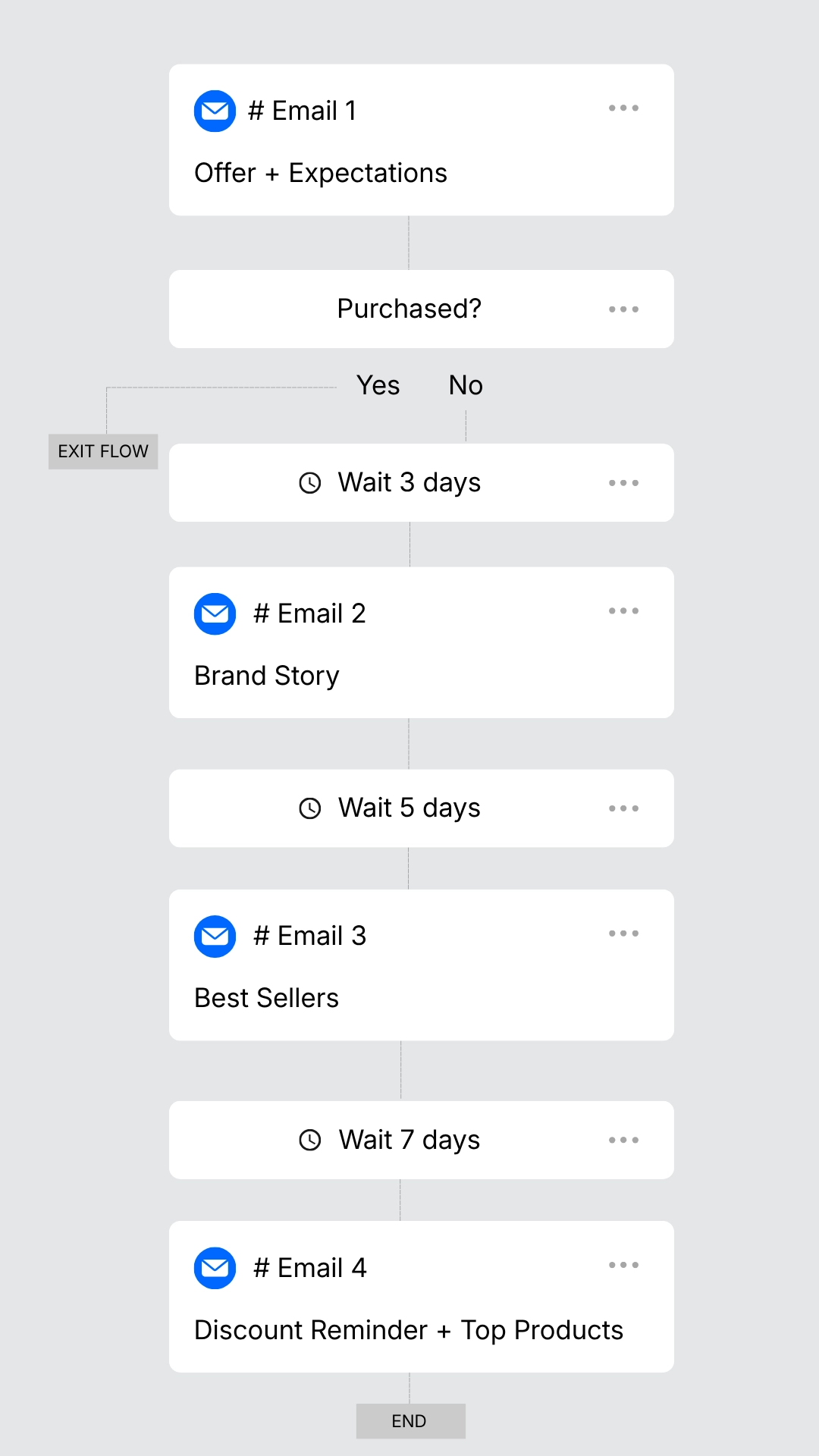
A stronger sequence would be:
Email 1: Offer + expectations
Email 2: Brand story
Email 3: Best sellers
Email 4: Reminder + product recommendations
The offer stays the same. The customer experience improves dramatically.
Quick Welcome Flow Audit
| Question | Good | Needs Work |
|---|---|---|
| At least 3 emails? | ✓ | |
| Brand story included? | ✓ | |
| Purchase suppression enabled? | ✓ | |
| Conditional splits used? | ✓ | |
| Product education email included? | ✓ | |
| Welcome flow reviewed in last 90 days? | ✓ |
Common Welcome Flow Mistakes
Sending Only One or Two Emails
A single discount email is not a welcome flow. It is a coupon delivery. A two-email sequence where the second email is just a reminder of the expiring discount is barely better.
The welcome flow is the only sequence where you have guaranteed high attention from a new subscriber. Using it to send one promotional email and then moving them to the general campaign list is a missed opportunity.
A minimum viable welcome flow is three emails. Many stronger flows run four to five, depending on product type, purchase cycle, and unsubscribe behavior.
The Brand Story Is Missing
Most welcome flows treat the subscriber as a transaction in progress. The discount is the whole pitch. But for stores with meaningful brand differentiation, none of that difference is communicated.
Subscribers who understand why a brand exists and what makes it different are more likely to remember it after the discount window closes.
Email 2 or 3 is where this belongs. Not a long essay. A short, specific, honest explanation of what makes this brand worth buying from.
No Conditional Logic Based on Engagement
Sending the same sequence to someone who opened and clicked Email 1 as someone who never opened it is a structural mistake. Those are two different people in two different states of intent, and they need different follow-up.
Many welcome flows in Klaviyo do not use conditional splits. Adding engagement-based branching, even a simple opened versus did-not-open split, is often one of the highest-impact improvements.
Discount Expiry Without Context
Many flows send a “your discount expires soon” email as Email 3 or 4. It can work. It can also produce unsubscribes when the subscriber feels pressured rather than helped.
The difference is context. “Your 15% off expires Sunday” reads as pressure. “Still thinking it over? Your 15% off is valid through Sunday, and here are the three products customers buy most” reads as helpful. Same urgency, different framing.
Welcome Flow Structure: What Works
Email 1: The Offer + Expectation Setting
Timing: Immediately on signup, ideally within 5 minutes.
Goal: Deliver the offer, confirm the subscription, and set expectations.
This email has one job: get the subscriber from inbox to website with the offer in hand. Keep it focused.
What to include:
- The discount code, clearly visible. Do not bury it in a paragraph.
- One sentence acknowledging what they signed up for.
- A brief line on what to expect from future emails.
- A single CTA to shop.
What to avoid: product overload, long brand stories, and multiple CTAs. The first email should be the simplest one in the sequence.
Subject line approach: Direct over clever. “Here’s your 15% off” often performs better than a vague welcome message for first-email intent. Test both against your own list.
Email 2: The Brand Case
Timing: 1-2 days after Email 1, sent to subscribers who did not purchase.
Goal: Give non-buyers a reason to trust the brand before the discount expires.
This is the email many welcome flows are missing.
It does not need to be long. Around 150-200 words can be enough. What it needs is specificity. Avoid vague lines like “we are passionate about quality.” Use concrete proof, a real product differentiator, a short founding detail, or a customer quote that addresses a true hesitation.
The goal is trust, not pressure. Persuasion pushes toward a purchase. Trust makes the purchase feel safe once the subscriber is ready.
Related: How I Create Klaviyo Email Drafts Faster
Email 3: Product Education or Best Sellers
Timing: 2-3 days after Email 2, sent to subscribers who did not purchase.
Goal: Reduce decision friction with product context.
Subscribers who have not bought yet often have not bought because they are not sure what to start with. A best sellers email, a “how to choose” guide, or a product breakdown organized by use case can reduce that friction.
This works especially well for stores with a wide catalog or technically complex products, such as skincare routines, coffee equipment, supplement stacks, or apparel with multiple fits.
Keep the CTA to one product or one category. Sending them to the full catalog from this email usually creates too many options and not enough guidance.
Email 4: Final Reminder (Optional)
Timing: 1 day before discount expiry, sent to subscribers who did not purchase.
Goal: Capture last-minute buyers without alienating non-buyers.
If your discount has a set expiry, a reminder email is worth testing. Keep the tone informational rather than pressured.
One practical addition that can improve this email is a “most popular right now” product block below the expiry reminder. Some subscribers click through from product context rather than urgency messaging.
Segmentation and Conditional Logic
This is where most of the performance uplift lives, and where many welcome flows are underbuilt.
Basic Engagement Split
The simplest conditional logic worth adding: after Email 1, branch based on whether the subscriber opened.
- Opened Email 1, did not purchase: Continue the normal sequence. They are engaged but not converted yet.
- Did not open Email 1: Send a resend with a different subject line 24 hours later before continuing the sequence.
A subject-line resend to non-openers can recover part of that group without creating a new full email. Treat any recovery estimate as list-dependent and verify it against your own Klaviyo reporting.
Purchase Suppression
Every email in the welcome flow after Email 1 should suppress subscribers who already purchased. This is one of the most common structural mistakes in Klaviyo welcome flows: sending a “here is why you should buy” email to someone who already bought yesterday.
In Klaviyo, add a flow filter such as “has not placed order since starting this flow” to emails after Email 1. Verify the exact filter wording in your Klaviyo account because interface labels can change.
Segment by Signup Source
If you are capturing subscribers from multiple sources, such as homepage pop-up, checkout opt-in, and social ad lead form, the intent level is different for each.
A checkout opt-in subscriber is closer to purchase than a pop-up subscriber who browsed one page. A lead form subscriber from a paid ad may have signed up primarily for the discount with lower brand awareness.
Where possible, use separate welcome flows or conditional branches based on signup source. The opening email can be similar, but the follow-up sequence benefits from being tailored to what the subscriber already knows about the brand.
Related: Klaviyo Segmentation Mistakes That Hurt Open Rates
Timing Optimisation
Timing can have a larger effect on open rates than many marketers test for.
Email 1: Send immediately. Any delay on the first email can reduce relevance because the subscriber is most attentive right after signup.
Subsequent emails: Test sending at times when your specific list historically opens. Klaviyo’s Smart Send Time can be useful when the list has enough data for the feature to work meaningfully.
Spacing: Many welcome flows send too quickly. Emailing daily for four days in a row may push some subscribers toward the unsubscribe button. A 1-2 day gap between emails 2, 3, and 4 is a practical starting point. Watch unsubscribe rate per email because spikes can reveal timing problems more clearly than open rate alone.
Related: How to A/B Test Klaviyo Subject Lines
Welcome Flow Benchmarks
These are general ecommerce welcome flow benchmarks. Results vary by industry, list quality, offer type, signup source, and send practices, so use them as diagnostic ranges rather than guarantees.
| Metric | Typical Range | Worth Investigating Below |
|---|---|---|
| Email 1 Open Rate | 40-60% | 35% |
| Email 1 Click Rate | 10-20% | 8% |
| Email 2 Open Rate | 25-40% | 20% |
| Flow Conversion Rate | 15-25% of subscribers | 10% |
| Unsubscribe Rate per email | 0.1-0.3% | 0.5% |
If Email 1 open rate is below 35%, check subject line, send timing, and list quality first.
If flow conversion rate is below 10%, the offer, landing page experience, or product-market fit of the discount structure may be worth reviewing before rewriting the entire sequence.
Tools I Use To Optimize Welcome Flows
Klaviyo
Used for:
- Welcome flow automation
- Conditional splits
- Revenue tracking
- Smart Send Time
Google Sheets
Used for:
- Tracking benchmarks
- Comparing flow performance
- Recording test results
ChatGPT
Used for:
- Subject line ideas
- Flow email drafts
- CTA testing
Claude
Used for:
- Rewriting welcome emails
- Refining brand voice
- Expanding product education content
FAQs
How many emails should a Klaviyo welcome flow have?
A minimum of three: offer delivery, brand case, and product education or final reminder. Stronger flows often run four to five with conditional branches for non-openers or non-buyers. More emails are not always better, so watch unsubscribe rates per email.
What is a good open rate for a Klaviyo welcome flow?
Email 1 often sees higher open rates than later flow emails because signup intent is fresh. The draft benchmark range of 40-60% can be a useful directional reference for ecommerce lists with clean signup practices, but results vary by list quality, industry, and signup source.
Should I use a discount in my welcome flow?
For many ecommerce brands, yes. A discount incentive is often the reason someone opts in, and not delivering it creates an immediate trust problem. Test offer type as well as copy: percentage off, free shipping, and gift with first order can perform differently depending on margin and average order value.
How do I stop welcome flow emails going to people who already purchased?
In Klaviyo, add a flow filter to emails after Email 1 that suppresses people who placed an order after entering the flow. Check your account’s current filter wording before publishing the flow.
What should the welcome flow subject lines be?
Email 1 should usually be direct and benefit-led, such as “Here’s your 15% off” or “Your discount is inside.” Email 2 can be story-led, and Email 3 can be product-specific. Treat these as starting points, not formulas.
How do I know if my welcome flow needs rebuilding vs. just optimization?
If the sequence has enough emails, clear suppression, and some engagement logic, optimization may be enough. If it is one or two generic emails with no segmentation and no brand story, it likely needs a rebuild.
Key Takeaways
- The welcome flow should do three things: convert now, build trust for later, and set expectations for the ongoing relationship.
- Three emails is the minimum. One discount email is not a welcome flow.
- Email 2 is often the missing piece: a short, specific brand story that gives non-buyers a reason to return.
- Conditional splits on engagement can produce strong improvements when the flow already has solid messaging.
- Watch unsubscribe rate per email to diagnose timing problems before they damage list quality.
- Benchmarks are context-dependent. Results vary by list quality, offer type, industry, and signup source.
Free Welcome Flow Review Checklist
Whenever I audit a welcome flow, I review:
- Email count
- Send timing
- Subject line performance
- Purchase suppression
- Conditional splits
- Product recommendations
- Mobile rendering
- Conversion rate
Building a simple downloadable checklist from this framework can make future audits much faster.
Conclusion
The welcome flow is the one sequence where you have the highest subscriber attention and the most control over the experience. Many brands use it to deliver a coupon and move on. The better approach is to treat it as an onboarding system that converts buyers now, builds trust with non-buyers for later, and gives the brand’s actual value proposition a chance to land.
Improving welcome flow performance is not usually about finding a clever new tactic. It is about fixing structural gaps: missing emails, no conditional logic, generic copy, and poor timing. Fix those first. Then optimize subject lines and send timing once the sequence architecture is sound.
A well-built welcome flow does not need to be clever. It needs to be relevant, well-timed, and honest about what the brand offers. That is what converts, and that is what keeps people subscribed after the discount expires.
Last updated: May 2026. Platform features referenced are based on Klaviyo’s current interface. Verify specific settings against Klaviyo’s documentation.

Related guides
Best Email Marketing Software for Contractors (2026)
A practical comparison of Mailchimp, Constant Contact, Brevo, MailerLite, Kit, and field service marketing tools for contractors.
Best Email Marketing Software for Hair Salons & Spas (2026)
A practical comparison of Mailchimp, Constant Contact, Brevo, MailerLite, Kit, and booking-software marketing tools for salons and spas.
Best Email Marketing Software for Restaurants (2026)
A practical comparison of Mailchimp, Constant Contact, Brevo, MailerLite, Kit, and Toast Marketing for restaurant email marketing.